UGC Whitelisting Fee: What to Charge and What to Pay

· 18 min read

Last updated: 2026-10-01
A UGC whitelisting fee runs 50% to 100% of the creator's base content rate when the rights are bought as an add-on, and close to 0% markup when the same usage was written into the original deal, per Lumanu's September 2026 guide [2]. Priced by the month instead, usage-rights licenses sit at 20% to 50% of the content fee for each month of use, paid ads at the top of that band [3]. One invoice, two lines. Below: the published rules normalized into one table, the three-input calculation, the duration breakpoints, the platform and territory splits, and the point where paying the fee stops making sense.
- What is a UGC whitelisting fee?
- The published rate rules, normalized into one table
- Run the number: base rate x percentage x duration
- What moves the percentage up or down
- Price the window: the duration breakpoints vendors publish
- Price partial rights before you price the whole bundle
- Negotiate the fee down without touching the base rate
- Spark Ads vs Partnership Ads vs plain usage rights
- What happens when the window expires or the creator revokes
- When the whitelisting fee is not worth paying
- Frequently asked questions
What is a UGC whitelisting fee?
A UGC whitelisting fee is the separate charge a creator adds for letting a brand run paid advertising through the handle they already own, priced as a markup on the base content rate for a fixed window. The content fee buys the video. The whitelisting fee buys the creator's identity on the ad. That is why the two belong on different lines of one invoice.
Whitelisting works as a permission grant, not a file handover. The creator authorizes the brand's ad account to publish and promote posts through their existing handle, so the advertising carries their name and avatar instead of the brand's, per an Insense.pro explainer dated January 2026 [1]. That is a vendor's own educational page rather than an independent standard, and it carries no pricing figures — it establishes the mechanism, not the rate. The creator keeps the handle. The brand sets targeting, budget and flight dates.
Plain usage rights are the narrower right. Usage rights let the brand run the footage from the brand's own account for an agreed term and territory; whitelisting adds the creator's account as the publishing identity on top of that. Price the two separately, and give each one its own window and its own renewal date. A blended fee hides which right expired first, and the expired one is always the one you are still running ads against.
The published rate rules, normalized into one table
Most percentage rules circulating on this query arrive with no publisher and no date attached, which makes them unusable in a negotiation. Three dated, attributable sources carry both, and all of their figures are normalized below: Lumanu's September 2026 guide on how influencers charge for whitelisting [2], Hubfluence's June 2026 usage-rights guidance [3], and billo.app's June 2026 usage-rights explainer [8].
Start with the line that decides whether a fee exists at all. Organic reposting rights are normally bundled into a creator's base UGC fee at no extra charge, and running that same content as a paid ad is what requires a separate paid-usage or whitelisting agreement [8]. Every figure in the table prices that separate agreement, not the video.
| Model | What the figure applies to | Published figure | Stated window | Publisher |
|---|---|---|---|---|
| Organic reposting rights | Nothing extra — inside the base fee | No separate charge | The base deal | billo.app, June 2026 [8] |
| Usage included in the base deal | Creator's base content rate | Near 0% markup | The original deal's term | Lumanu, September 2026 [2] |
| Additional whitelisting / paid usage | Creator's base content rate | 50%-100% of base | None stated | Lumanu, September 2026 [2] |
| Monthly term license | Base content fee, per month of use | 20%-50% per month, paid ads at the top | 3, 6 or 12 months | Hubfluence, June 2026 [3] |
| Percentage of ad spend | Brand's media budget | 4% of spend | Runs with the campaign | Lumanu, September 2026 [2] |
| Perpetual rights | Content fee | Flat multiple, multiplier not published | Perpetual | Hubfluence, June 2026 [3] |
Read the table as two pricing languages rather than six competing rates. Lumanu prices the whole grant as one markup on the base rate, with no window attached to the 50%-100% band [2]. Hubfluence prices the same right by the month, at 20% to 50% of the content fee for each month of use, and sets finite terms at 3, 6 or 12 months, with perpetual quoted as a flat multiple instead of a recurring rate [3]. A quote is only comparable to another quote once you know which of the two it is written in. The fastest way to find out is to ask what happens in month four.
Provenance limits both. Lumanu is a creator-payments platform publishing its own guidance, not a survey house: the 4% is presented there as an illustrative example rather than a measured market average, and no methodology is given for the 50%-100% range. Hubfluence's 20%-50% monthly band is a rule of thumb on a UGC vendor's blog, with no breakdown by creator tier, platform or country, and no figure isolating paid from organic inside the band. Billo is a UGC marketplace with a commercial interest in creators negotiating rights separately. Treat all three as vendor-published conventions. That is the strongest provenance available on this question — no tier-one dataset of whitelisting rates exists publicly.
The models also price different risks, and the gap between them widens with budget. On a $50,000 ad budget, a creator charging 4% of spend is paid an additional $2,000 ($50,000 x 0.04 = $2,000) regardless of what their base rate was [2]. A base-rate markup does the opposite: it is fixed at signature, so a campaign that scales tenfold costs the brand nothing more in whitelisting. A monthly term license sits between the two — fixed per month, but open to repricing at every renewal date.
This next part is our recommendation, not a published finding: brands should refuse percentage-of-spend deals and creators should ask for them, because that single clause decides who captures the upside of a winning ad. One vendor's guidance is thin ground for a market rate, so treat half the base rate as the number you open at and make the other side argue the window.
Run the number: base rate x percentage x duration
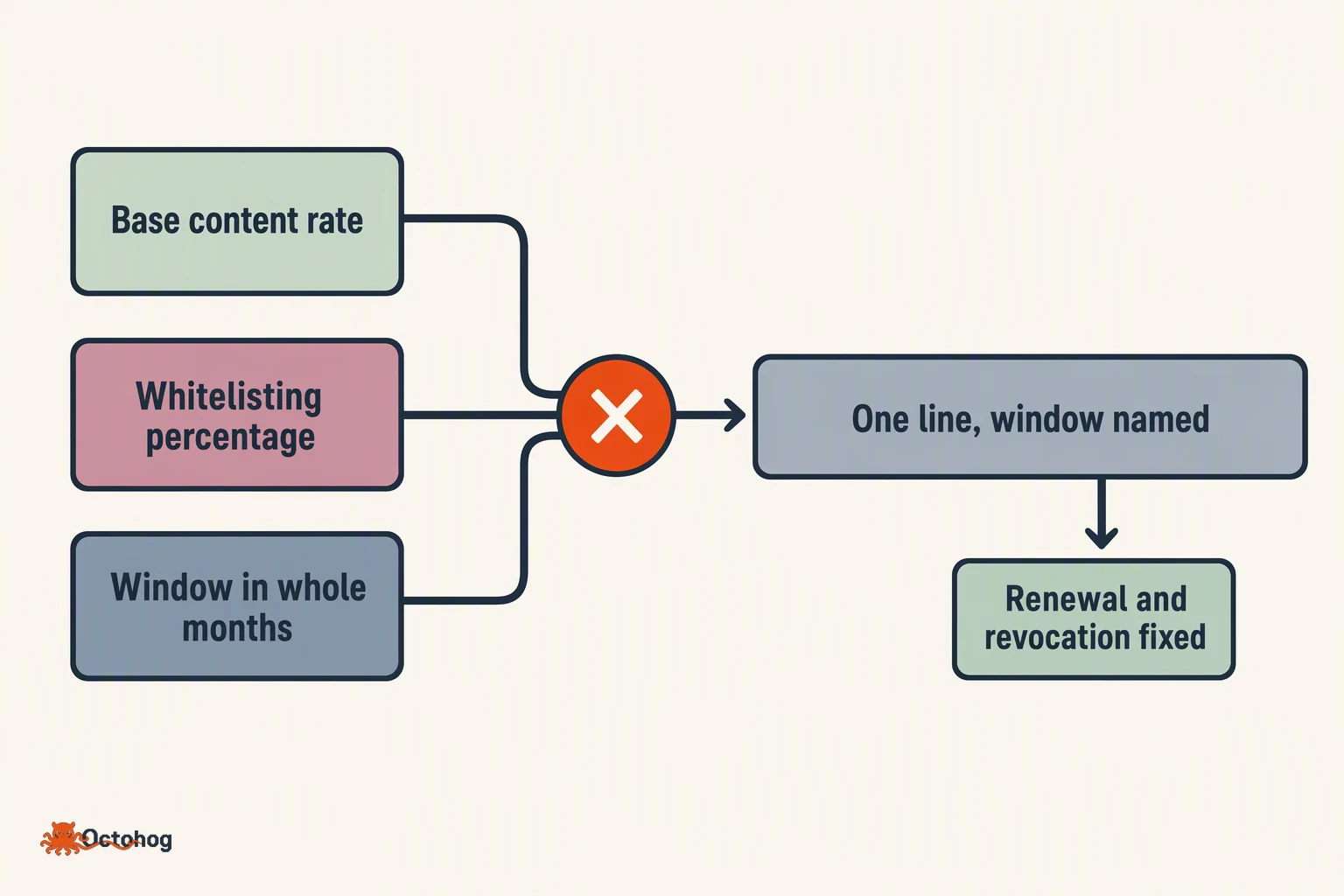
A whitelisting quote multiplies three inputs and nothing else: the base content rate, the whitelisting percentage, and the length of the window in months. The output is one number on one line, with the window named next to it. Read a quote that way and the negotiation becomes a conversation about duration instead of a conversation about whether the creator is expensive.
Work through it in this order:
- **Fix the base content rate first**, before any rights talk, so the markup has a stable number to multiply.
- Pick the percentage, then write the reason next to it: platform count, exclusivity, turnaround.
- Set the window in whole months. Open-ended is not a window.
- Multiply base rate by the percentage, then by the number of months, and read the total against the base.
- Fix renewal pricing in the original agreement, at the same monthly figure, not at the point you ask for it.
- Name the revocation terms in the same clause: notice period, and who pulls the permission.
The multiplier applies per window, not once. A half-of-base markup over a three-month window bills the base rate plus one and a half times the base rate, because each month carries its own markup. A brand that accepts a single markup for an indefinite run is pricing one month and buying twelve.
Written as "whitelisting fee, per month, per platform", the ambiguity disappears from both sides of the invoice. A flat lump sum for whitelisting removes the renewal, because there is nothing left to renew. Per-month pricing without a stated end date keeps the money flowing after the creative has fatigued.
Settle your own position on the percentage before the brief goes out, then hold it for the whole quarter so your offers stop contradicting each other across deals.
What moves the percentage up or down
Five variables justify the top of the published band, and exclusivity moves it most. Everything else on this list adjusts a quote. Exclusivity rewrites the creator's calendar, because it removes a whole category of future work for the length of the term. Expect it to be priced as lost income, not granted as a favor.
- Exclusivity scope. Single-brand exclusivity inside a category for the term is a top-of-band premium. Whole-category exclusivity with no end date is not a premium, it is a career decision, and few creators will sign it at any price.
- Media spend ceiling. A capped budget argues for the bottom of the band; no media cap argues for the top, since the creator's handle absorbs every impression the brand buys.
- Creator experience and ad history. A creator who can show which of their whitelisted ads survived past the testing phase is pricing a result, not a permission. That is the one input where past performance numbers belong in the quote.
- Content complexity. Multiple hook variants, on-camera product demos and sub-day turnaround each raise the base rate, which raises the markup automatically. Do not pay for complexity twice.
- Territory and term shape. Domestic organic-only sits low. Multi-market paid, with the right to edit, sits high.
Those five are not a market model. They are the variable list Hubfluence's June 2026 guidance names as what pushes a usage fee up (channels, duration, exclusivity, audience size), with the published direction of travel being that a single-platform organic license costs less than a multi-channel paid one [3]. The ordering above is ours.
Perpetual rights are the request to push back on hardest. They are not a sixth variable, they are the absence of one: a perpetual grant removes the renewal, which is where the compounding fee lives. Perpetual gets quoted as a flat multiple of the content fee rather than a monthly rate, in that same guidance [3]. A brand should want a shorter window than it thinks, because the ad that still works in a year is rare enough to re-license on its own terms.
Set your five positions in writing before the next brief. One quote, five named reasons.
Price the window: the duration breakpoints vendors publish
Term licenses cluster on three finite lengths, 3, 6, and 12 months, with perpetual rights quoted as a flat multiple of the content fee rather than a recurring monthly charge [3]. The monthly convention behind those breakpoints runs 20% to 50% of the base content fee for each month of use, paid ads sitting at the top of that band [3]. Multiply it out and the straight-line numbers climb fast.
| Window | Straight-line cost at 20-50% per month | Practical read |
|---|---|---|
| 1 month | 20%-50% of base fee | The unit everything else is built from |
| 3 months | 60%-150% (3 x 20%-50%) | Lowest published breakpoint |
| 6 months | 120%-300% (6 x 20%-50%) | Base fee exceeded at every rate |
| 12 months | 240%-600% (12 x 20%-50%) | Ceiling, not a quote |
| Perpetual | Flat multiple of base fee | Multiplier not published |
Source: the monthly percent-of-fee convention and 3/6/12-month term structure in Hubfluence's June 2026 usage-rights guidance, a vendor rule of thumb rather than a survey or dataset [3]. The rows past one month are straight-line arithmetic on that convention, not separately published prices.
The 240%-600% row is an arithmetic ceiling, not an observed price. No discount schedule for longer terms appears anywhere alongside that monthly band and those 3/6/12-month breakpoints [3], and the unadjusted arithmetic is what makes the gap visible: at 50% per month, a twelve-month license prices at six times the video it covers. The absence of a published long-term rate is itself the useful signal — the quoted figure for a long window is negotiated, not conventional. So ask for the 12-month price as a single figure before anyone quotes a monthly rate, because a monthly rate anchors the negotiation against the buyer.
Perpetual is the row that needs the most care. A flat multiple with no multiplier attached is all the published guidance offers [3], which means the number is set deal by deal with nothing published to check it against. Set it against your own renewal history: a brand that has never re-run a video past month nine should buy 12 months and skip perpetual.
Related reading
Price partial rights before you price the whole bundle
Split the quote by platform and territory before accepting a blended number. A usage-rights fee rises with each added distribution channel, a longer or perpetual duration, exclusivity, and a larger audience, so a single-platform organic license costs less than a multi-channel paid one [3]. Most brands buy the full bundle anyway. They do it because the creator quoted one figure and nobody asked what was inside it.
| Line item | Narrow version | Full bundle |
|---|---|---|
| Platforms | Instagram Reels only | Instagram, Facebook, TikTok, YouTube Shorts |
| Paid rights | Organic post only | Meta Partnership Ads plus TikTok Spark Ads |
| Territory | United States only | Worldwide |
| Term | 3 months | 12 months |
| Exclusivity | None | Category exclusive |
Source: the four variables that push a usage-rights fee up in Hubfluence's June 2026 guidance, a vendor framework rather than measured rates [3]. The specific platform and territory splits in the table are illustrative, not published figures.
The upload fee is the separate line some creators charge for granting the ad authorization itself, distinct from the fee for shooting the video. Keep the two apart in the purchase order. A creator billing one blended amount has no reason to drop the paid-rights portion when the campaign turns out to be Meta-only, and that is the easiest concession on the sheet to lose.
Platform-count pricing does show up in software, where it is easier to see. A $500-a-month Brand subscription on Insense includes 10 Meta Partnership Ads connections, and the $800-a-month Agency plan removes the cap [4]. At the Brand tier that is $50 per connection per month ($500 / 10). That figure comes off Insense's own undated pricing page, and it is a software seat limit on its product, not a rights fee paid to a creator — it shows the shape of per-connection pricing, not its market level.
Territory is the cheapest cut nobody makes. A store shipping to two countries needs two countries licensed. Write the territory into the brief as named markets, not as "primary markets", and price the rest as an add-on you may never buy.
Negotiate the fee down without touching the base rate
Four levers move a whitelisting fee without reopening the base content rate. Work them in this order, because each one costs the creator less than the one before it:
| Lever | What to ask for | Why it costs the creator least |
|---|---|---|
| Shorten the window | The shortest term the creator will price | Frees their calendar sooner; no rate concession |
| Cap the ad spend | A named ceiling per asset, in writing | Bounds handle exposure instead of cutting the fee |
| Buy a renewal option | A fixed rate you can trigger before lapse | Defers revenue rather than reducing it |
| Aggregate volume | One rate covering a batch of assets | Trades per-deal rate for guaranteed volume |
The renewal option is the lever most brands skip, and it is the one worth protecting hardest. The counter is: "Price the short term now, and quote a fixed renewal rate I can trigger in writing before it lapses." Fixed is the operative word. A renewal with no pre-agreed price is a repricing event disguised as an extension, negotiated from inside a campaign that is already working.
Build the trigger so silence ends the license rather than extending it. The opposite mechanic runs on Insense's own Trial subscription, which converts to the paid Brand plan automatically unless the brand cancels at least 48 hours ahead [4]. Fine for software. Wrong direction for content that may no longer be running.
Volume is the fourth lever, and the published analogue for it is again software pricing rather than creator pricing. The per-creator marketplace fee on Insense's own platform drops from 20% on Trial to 10% on Brand and 7% on Agency [4], a 13-point spread that cuts the fee by 65% ((20-7)/20) across the tiers. That is Insense's own tier structure, tied to subscription level rather than to negotiated volume with any one creator, so it proves nothing about what a creator will discount. The shape is what the argument borrows: bring eight videos to one creator, not one, and ask for a single whitelisting rate covering all eight.
Spark Ads vs Partnership Ads vs plain usage rights
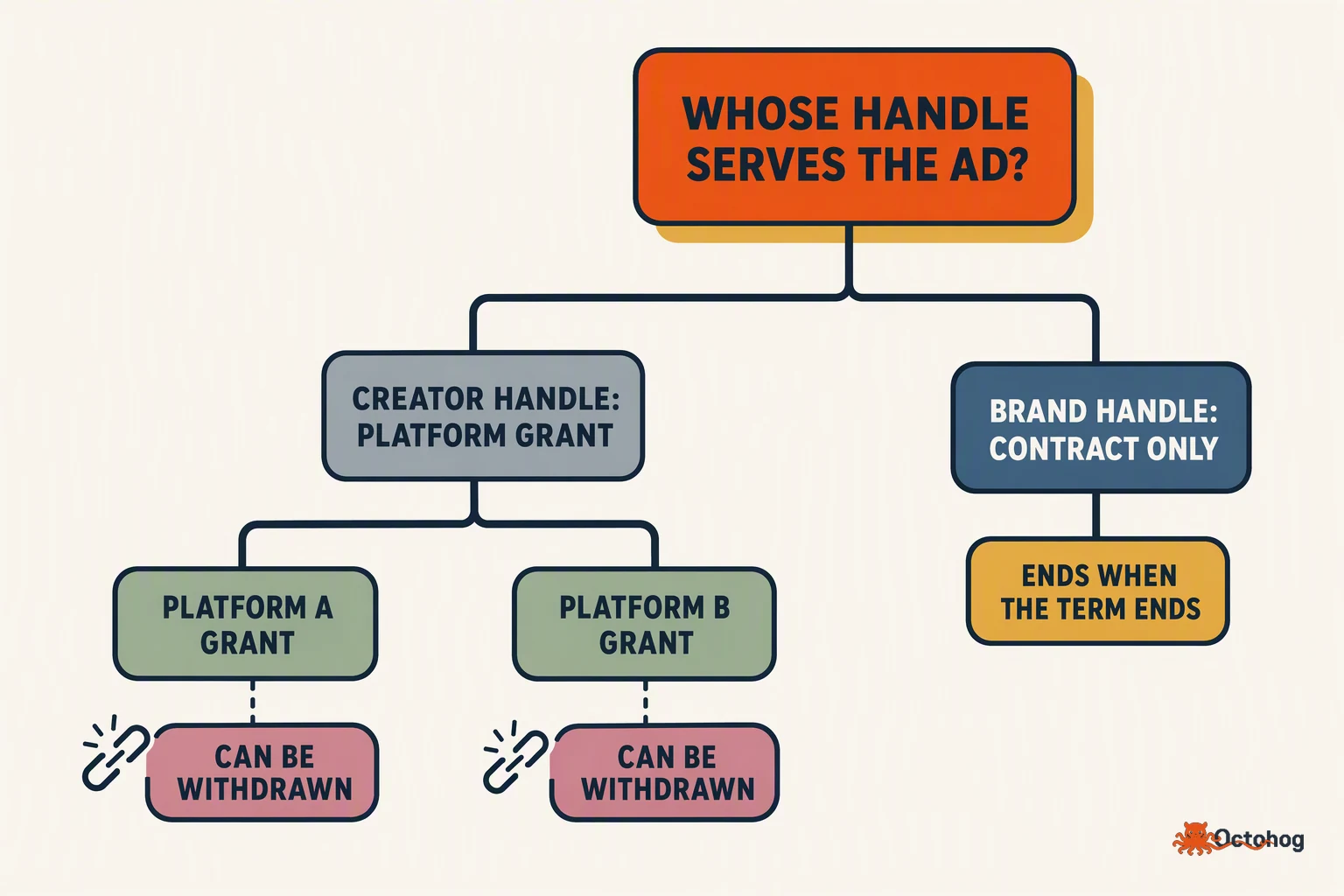
Whitelisting is a platform-side permission, not a file transfer. The creator grants the brand's ad account authorization inside the platform, the brand builds the ad against their original post, and the ad serves under their handle with their name on it. Three authorization types cover nearly every campaign, and brands routinely buy the wrong one.
| Authorization | What the brand runs | Where it is granted | How it ends |
|---|---|---|---|
| TikTok Spark Ads | Advertising built on the creator's existing TikTok post | Creator's TikTok post settings, via an authorization code | Code lapses or creator withdraws it |
| Meta Partnership Ads | Advertising served under the creator's Instagram or Facebook handle | Meta branded content tools, creator-side approval | Creator revokes, or loses branded content access [5] |
| Plain usage rights | Advertising served under the brand's handle, using the creator's footage | Contract only, no platform step | Licence term expires |
A Professional account, Creator or Business, is a precondition for Partnership Ads eligibility under Meta's rules, per Billo's March 2026 help article summarizing them — a vendor restatement of platform policy rather than Meta's own documentation [5]. Check it before negotiating the fee. A creator on a personal Instagram account cannot grant the permission being paid for, and the fix is theirs to make.
Revocation is the asymmetry in both paid types. A creator's Partnership Ads eligibility disappears if they lose access to Meta's branded content tools, through a policy violation or an account change [5]. Nothing in that sentence is under the buyer's control. So when buying paid-handle rights, write a remedy into the contract: if the authorization lapses inside the paid term, the creator delivers plain usage rights on the same footage at no extra fee, and the ad runs from the brand's own handle instead.
A campaign that cannot be matched to one of the three rows needs the third one. Plain usage rights cost less, carry no platform dependency, and no account change can revoke them.
What happens when the window expires or the creator revokes
Authorization expires on a clock the creator sets, not on the campaign calendar. Spark Ads codes on TikTok come in four fixed lengths — 7 days, 30 days, 60 days, or 365 — and the default is 30, which a brand has to renew before it lapses [6]. Diary that date. That guidance, published in a licensing vendor's help centre rather than by TikTok, does not document what happens operationally the moment a code expires mid-flight [6], so treat renewal as a hard deadline rather than a soft one, and renew the winning ad set first.
Revocation is the harder case, because the permission lives inside the creator's account and not inside the brand's. No contract clause stops a creator from withdrawing it. What a contract does is decide who pays for the consequences, which is why the agreement has to settle four things before money moves:
- Notice period. How many days' written notice a creator owes before pulling authorization, and what refund applies if they pull it early.
- Rights dispute and enforcement. Which party's lawyer handles a claim over music, a visible third party, or a trademark in frame, and what evidence of licensing the creator supplies up front.
- Indemnification. Who covers a claim arising from footage the creator shot versus from the brand's ad copy. Split it by origin, not by headcount.
- Disclosure duty. Paying a creator to whitelist content is a material connection, and the FTC's Endorsement Guides — federal guidance applying nationwide to any paid brand-creator relationship — require it to be disclosed clearly and conspicuously unless context already makes it obvious [7].
Of those four, the indemnification clause is the one we would treat as non-negotiable regardless of fee size. The fee is capped at a known number. A rights dispute over footage the brand did not shoot is not.
When the whitelisting fee is not worth paying
Yes, UGC is paid for. The creator's base fee buys the content, and the whitelisting fee is a second line item on top of it, which means it earns its place or it does not. The test is arithmetic: if the paid media going behind one creator's handle is smaller than the whitelisting fee itself, buy organic reposting rights and run the video from the brand's own ad account instead. Under that threshold the premium buys a signal there is no budget to amplify.
Three mistakes cost the most:
- Creators under-negotiating. Usage rights go un-negotiated as a separate line at a rate a billo.app guide puts at 68%, published without a disclosed sample, methodology or original study, by a marketplace vendor with an interest in the answer [8]. Read it as a vendor's claim about direction, not a measured rate.
- Brands buying perpetual on short-lived creative. Rights bought in perpetuity on an asset that fatigues inside a quarter mean paying for a licence that outlives its CTR.
- **Brands whitelisting unvetted handles.** Paid identity goes to someone else's posting history, and the posting history is not reviewed after the contract is signed.
Set a media spend cap per creator before negotiating. The cap sets the fee, not the other way round.
Frequently asked questions
Do I have to pay for UGC?
Yes. A creator's base fee pays for the content itself, and organic reposting rights are normally bundled into that base fee at no extra charge, according to a billo.app usage-rights guide [8]. Running the same video as a paid ad sits outside that bundle. Paid amplification and whitelisting need a separate agreement and separate money, agreed before the ad goes live.
What should I expect to pay for using UGC content?
Expect a quote in three inputs rather than one number: the creator's base content rate, a whitelisting percentage applied to it, and the licence duration. Ask for each itemized on the invoice so you can see what shortening the window saves. Organic-only reposting stays inside the base fee. Paid usage is priced, dated, and renewable.
How much do influencers charge for whitelisting?
Additional whitelisting and paid-usage fees sit at 50% to 100% of the creator's base content rate, with usage already included in the base deal near a 0% markup, per Lumanu's September 2026 guidance [2]. Priced by the month instead, Hubfluence's June 2026 guidance puts a usage-rights licence at 20% to 50% of the content fee per month of use, with paid-ad usage at the top of that band [3]. Both are vendor-published conventions rather than surveyed market rates. In practice the percentage moves with licence duration, exclusivity, and whether the brand wants the creator's handle on competing category advertising. Ask for the quote in two parts, because a single blended number hides which input is being paid for.
How does whitelisting work in UGC?
Whitelisting is a platform-side permission. The creator authorizes the brand's ad account inside the platform, the brand builds the ad against their post, and it serves under their handle with their name on it [1]. Authorization carries a fixed expiry window chosen at setup, and the creator keeps the ability to withdraw it. The contract, not the platform, governs what happens then.
References
- Influencer Whitelisting: What It Is and How to Do It Right — insense.pro
- How Do Influencers Charge for Whitelisting and Usage Rights? — lumanu.com
- Usage rights: what they mean & cost — hubfluence.io
- Choose Your Ideal Plan for Influencer & UGC Campaigns, Insense — insense.pro
- For Creators: Creator Eligibility Requirements for Partnership Ads (Meta) — billo.app
- Creator's Guide to Providing TikTok Spark Codes — archive.com
- Disclosures 101 for Social Media Influencers — ftc.gov
- Mastering UGC usage rights: what brands need to know about licensing creator content — billo.app