UGC Campaign Pricing — What Brands Actually Pay in 2026

· Updated · 23 min read

Last updated: 2026-08-18
A UGC campaign costs $50 to $2,000 per video in 2026, and the spread is set by creator tier and what the brand does with the footage afterward. Content-only fees band at $50-$150 for nano creators, $150-$500 for micro, and $500-$2,000 for mid-tier [1]. The most common single figure is $100 to $250 before usage rights are added [1]. Then rights add 30-50% on top [7].
That last line is where most budgets break. A brand quotes the video, signs for perpetual rights, and never prices the term it just bought.
Below: the four line items a rate card separates, 2026 bands by tier, why Meta's Partnership Ads performance gap moved pricing inside 14 months, what each sourcing channel adds on top of the creator fee, a platform take-rate comparison, and the license clause that costs more than the shoot.
What is a UGC campaign, and what does a rate card for one look like?
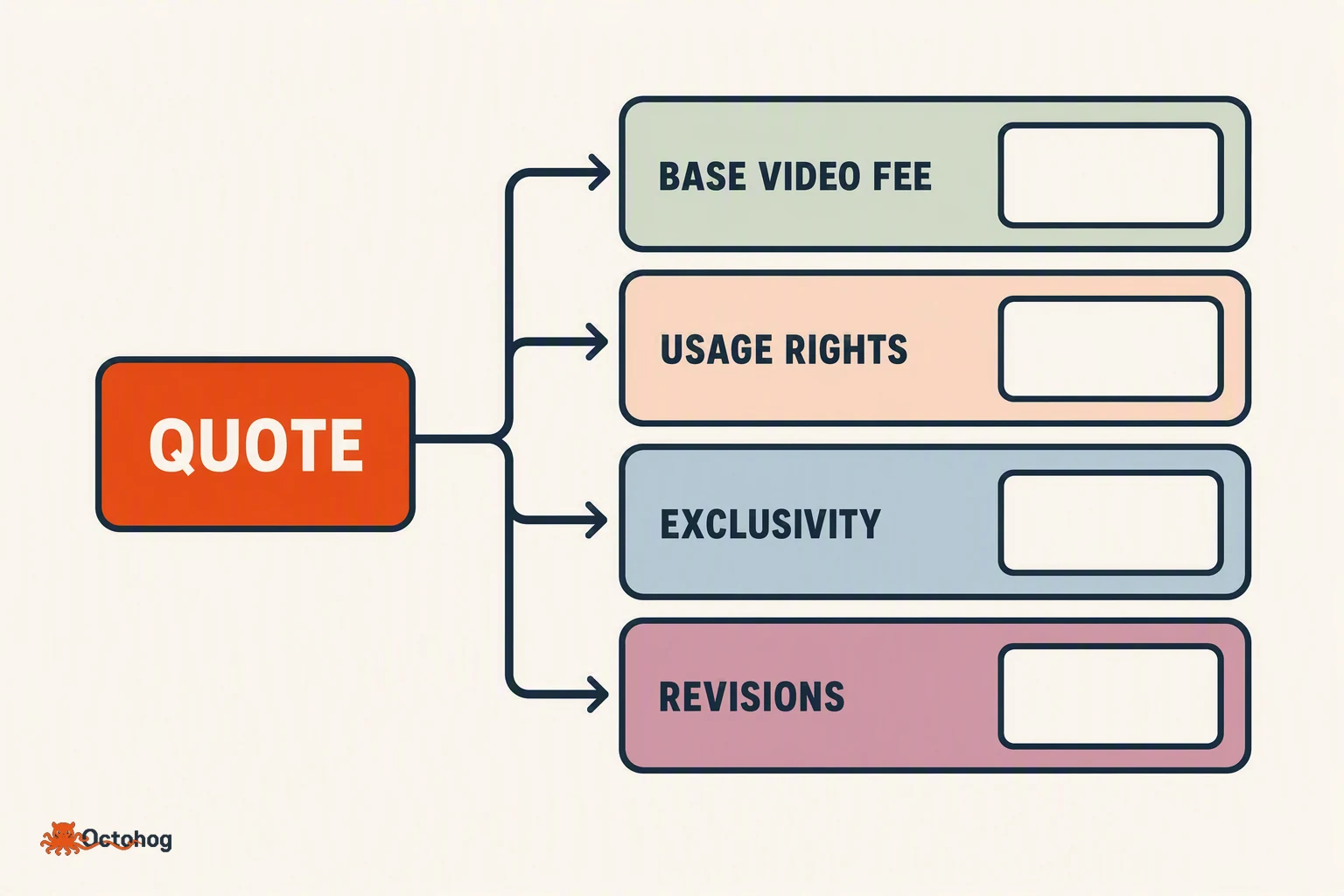
A UGC campaign is a paid content deal where a brand hires creators to shoot product videos the brand then owns and runs as ads, with no obligation that the creator post anything to their own audience. The deliverable is footage, not reach. A rate card for one prices four line items separately: base video fee, usage rights, exclusivity, and revisions.
Those four are the whole quote. Everything else — shot lists, hook counts, turnaround — moves the base fee up or down inside its own band. A UGC collaboration goes sideways when a brand negotiates one number, "$200 a video," and then discovers that number bought organic-only rights for 30 days and one round of edits.
Here is what each line item actually buys:
- Base video fee. One finished vertical video, shot by the creator, delivered as a file. Entry-level creators price this at $50 to $100; established ones start at $500 before any licensing is added [2].
- Usage rights. The license term and the channels. Standard paid usage runs 30% to 100% of the base creation fee, and a full buyout adds 100% to 150% on top of it [1].
- Exclusivity. A promise not to shoot for a named competitor for a fixed window. Priced separately, always.
- Revisions. How many rounds of changes are included before the creator bills again. One is standard. Two is generous.
Write the rate card so each of those has its own row and its own number. A single blended figure hides which one you are actually negotiating, and it is nearly always the rights.
A flat "per video" price with no license term attached is not a discount, and it deserves pushback from either side of the deal. It is an unwritten clause, and the argument arrives later, usually the week the brand wants to put the video behind paid spend. The reason it lands that week is structural rather than anecdotal: the vendor pricing that governs this market treats the license as a separate multiplier, not a rounding error. Insense's published rate guidance prices standard paid usage at 30% to 100% of the base creation fee and a full buyout at 100% to 150% more [1]; Social Native's 2026 pricing analysis puts the same premium at 30-50% of base, enough to turn a $200 video into a $260-$300 asset [7]. Two independent vendor sources, one direction. A quote that omits the term has silently priced that multiplier at zero, which is why it reopens the moment the footage moves to paid. Ask for the term in writing before the shoot.
Creators pricing themselves have the mirror-image job. Set a base fee you would accept for organic-only, 30-day use, then treat rights and exclusivity as add-ons with published multipliers. A buyout at 100% to 150% above base [1] is not a favour you do a good client. It is the market rate for giving up the asset permanently.
A note on where the numbers in this playbook come from, because they are not all the same grade of evidence. The strongest tier is platform documentation and published pricing pages — TikTok's own Ads Manager help articles on Spark Ads [3][8] and Insense's live pricing page [6] — where the operator publishes the rule and is bound by it. Below that sit vendor rate guides that aggregate deals across their own marketplaces: Insense [1], Billo [2], and Social Native [7]. These are the best public read on what changes hands, and they are also written by companies with a commercial interest in the rates looking healthy, so they are quoted here as bands rather than precise points. Lumanu's whitelisting survey [5] is self-reported creator data, useful for the shape of the market — how many charge separately — rather than the exact level. eMarketer [4] is third-party industry research, independent of any marketplace. Where two tiers agree, the claim is stated plainly. Where only one carries a figure, it is attributed on the sentence.
Octohog
The spreadsheet was never the campaign.
Briefs, shortlists, outreach and replies live in one workspace, with creator evidence attached to every decision you make.
Open the workspace7-day free trial
The 2026 rate bands: what brands pay and what creators charge per video
Brands pay $50 to $2,000 per UGC video in 2026, and where you land inside that range is set by creator tier and what the brand does with the footage. Content-only fees band at $50-$150 for nano creators with 1,000 to 10,000 followers, $150-$500 for micro creators at 10,000-50,000, and $500-$2,000 for mid-tier creators at 50,000-200,000 [1]. The most common single figure paid for a short-form video is $100 to $250, before usage rights [1].
Creator-posted rates sit higher, because the brand is buying distribution as well as footage.
| Deliverable | Typical rate | What the brand gets |
|---|---|---|
| Nano creator, content only (1k-10k) | $50-$150 | Raw + edited video file |
| Micro creator, content only (10k-50k) | $150-$500 | Video file, usually 1 revision |
| Mid-tier creator, content only (50k-200k) | $500-$2,000 | Video file, multiple hooks |
| Baseline short-form video, any tier | $100-$250 | One vertical video, organic rights |
| Creator-posted, Instagram | ~$364 | Video plus a post on their handle |
| Creator-posted, TikTok | ~$350 | Video plus a post on their handle |
| Creator-posted, YouTube | ~$675 | Video plus a post on their channel |
Source: Insense's 2026 pricing table [1] and Billo's 2026 rate guide [2]. Both are marketplace operators reporting on their own deal flow, so read the rows as bands with real spread around them rather than fixed prices.
The YouTube premium is the number worth staring at. At about $675 against $350 on TikTok [2], the same creator-posted deal costs roughly 93% more on YouTube (($675-$350)/$350 = 93%). Longer edit, longer watch time, smaller supply of creators who shoot horizontal.
Creators do make money at these rates, and the honest version is that the money is in volume and rights, not in any single video. A creator holding four brands on retainer at eight videos a month, priced at the $150-$500 micro band [1], is running a business. One shooting one-off $100 videos is running a hobby with invoices.
Brands looking for UGC creators should budget by the month, not the asset. Ten videos from micro creators at the middle of the band is roughly $3,250 (10 × $325), plus rights on whichever three you actually run as ads. Price the winners twice. Price the rest once.
Why UGC pricing moved in the last 14 months
Paid ad formats moved first, and pricing followed them. Meta's expanded Partnership Ads deliver 19% lower cost-per-acquisition and 13% higher click-through rates than standard ad formats [4], which turned creator footage from a cheap organic filler into a media-buying input with measurable performance attached. When a format performs 19% better on CPA [4], brands stop asking whether they can use the video and start asking how long they can run it. That question is a rights question, and rights are where the money went.
Worth noting what that 19% is and is not. It comes from eMarketer's reporting on Meta's own format expansion [4] — third-party coverage of a platform's performance claim, not an independent controlled test — and it compares Partnership Ads against standard formats in aggregate, not creator footage against brand footage holding everything else constant. The direction is well evidenced and the mechanism is plain: a buyer who sees a format beat their baseline on CPA will pay to keep running it. The precise figure is the platform's, and a brand should expect its own gap to differ.
TikTok pushed the same direction from the format side. Each Ads Manager account can run up to 10,000 Spark Ads, sourced by linking creator accounts, collecting authorization codes, or routing content through TikTok Business Center [3]. That one is first-party platform documentation, so the mechanics are exact rather than surveyed. The ceiling is high enough that no brand hits it. The friction is the authorization code — every Spark Ad needs a creator's explicit permission, on a term, which forces the license into the negotiation whether or not the brief mentioned it.
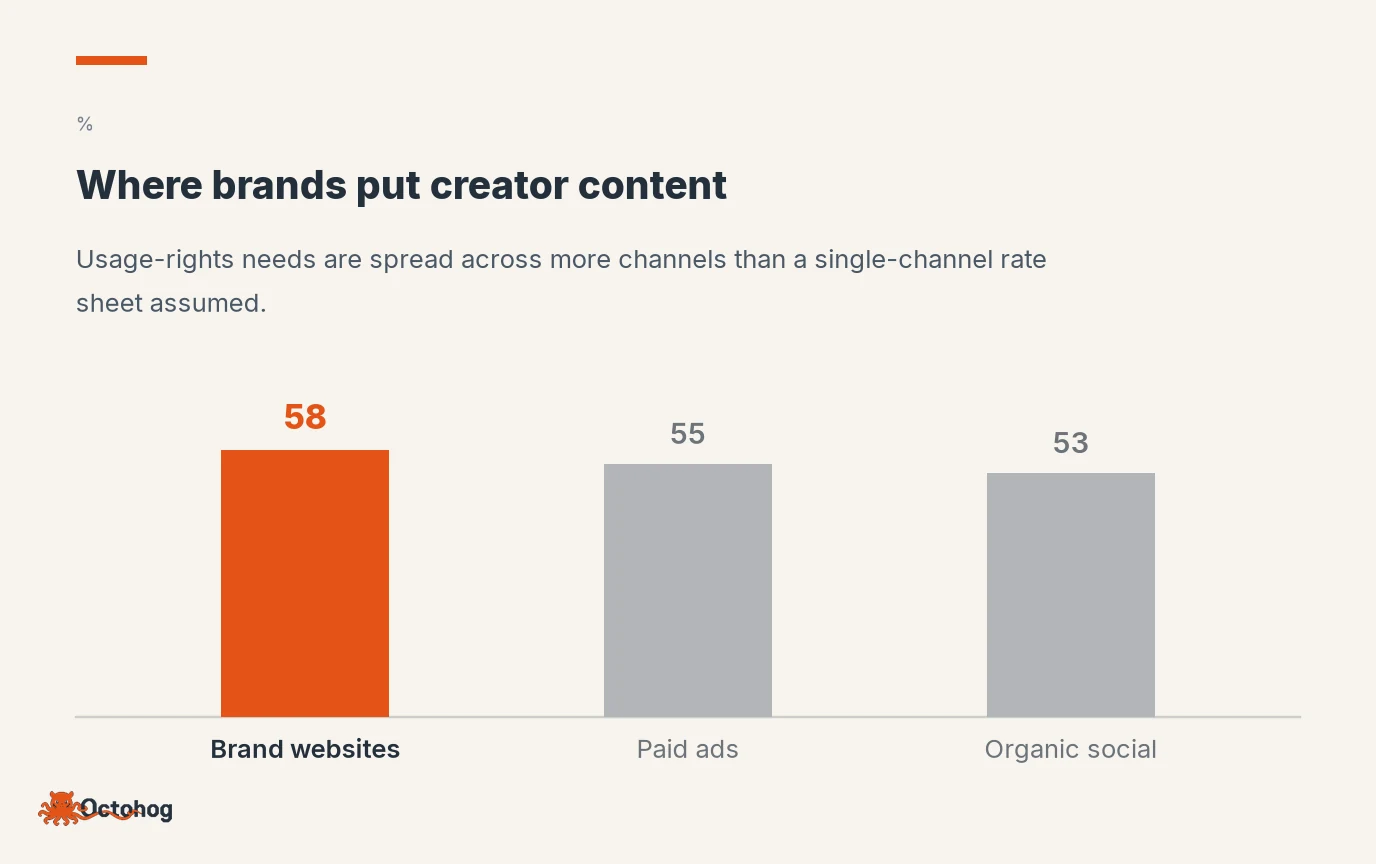
Then the channel count grew. As of the December 2025 benchmark, 58% of brands put creator content on their websites, 55% run it in paid ads, and 53% use it on organic social [4]. A 2024 rate sheet priced one channel. A 2026 quote prices three, and the creator is right to charge for each.
UGC is still very much a thing in 2026 — more so than in 2024, and for an unromantic reason. The format won on paid performance, not on authenticity. A UGC influencer who once charged for a post now charges for a license, and the brands buying are media buyers with CPA targets, not brand marketers with awareness budgets.
Creator supply went the other way. More people make UGC now, which should have pushed base fees down, and at the entry tier it did — Billo's guide still puts entry-level creators at $50 to $100 a video [2]. Rights inflation ate the savings: usage rights now add 30-50% to base [7], and a full buyout runs 100% to 150% above it [1]. The base video got cheaper; the permission to run it got more expensive, and the permission is the part you cannot skip once the ad works. Both halves of that trade are vendor-reported bands, so treat the shape as solid and the exact percentages as directional.
Reprice any rate sheet written before mid-2025. Check the license term first, then the base fee.
Set the number before you send the brief
State the budget in the brief. Not a range, not "competitive rates" — the number you will pay for one video, the number of videos, and how long you get to use them. A brief that names the figure gets quotes you can compare in an afternoon. A brief that hides it gets a negotiation, and the negotiation always ends higher than the number you were protecting.
Four fields cause nearly every repricing argument. Insense's pricing guide names exclusivity terms of 30 to 90 days, usage-rights duration, deliverable complexity, and turnaround time as the things a creator cannot quote firmly without [1]. Pin all four before you send anything.
- Deliverable count and format. "3 vertical videos, 15-30 seconds, 9:16, delivered as MP4 plus raw files." Not "some content."
- License term and channels. "Paid social and website, 6 months, worldwide." The channel list is the price; the term is the multiplier.
- Exclusivity window. "No competing skincare brands for 60 days." Inside the 30-to-90-day band creators expect [1], and priced as its own line.
- Revision rounds. "One round of edits included, second round billed at 25% of the video fee."
- Turnaround. "Delivery 10 days from product arrival." Rush work costs more, and saying so up front stops the argument.
- Hook count. "Three opening hooks per video, same body." This is the field brands forget, and it is real extra shooting.
That list is the whole brief on the commercial side. The creative half — product, angle, tone, what not to say — belongs in a separate document, because the creator's accountant reads one and the creator reads the other.
A good UGC collaboration puts these in the first message, not the contract. By the time a contract is drafted, both sides have anchored on a number that assumed something different, and someone gives ground they resent.
Rewrite your current brief template tonight. Add the six fields above as required lines, send it to the next three creators you approach, and see how many quotes come back within 10% of each other. If they still scatter, one of the six fields is still vague. It is usually the license term.
Related reading
Price the license separately from the video
A UGC campaign carries two prices: the cost of making the video, and the cost of using it. Quote them on separate lines or you will pay the second one twice. Just over half of influencers charge a distinct fee to whitelist, boost, or amplify content beyond the base creation fee — 51% of them [5]. That is the majority position, not an outlier tactic. It is also self-reported creator data collected by a payments company that serves creators [5], so read it as evidence that separate rights billing is now standard practice rather than as a precise census.
The license is where a $200 video becomes a $600 one, so price the term before you price the shoot. A workable frame multiplies the base creation fee by the length of the term and the size of the audience the brand puts behind it.
| License term | What it grants | Multiplier on base fee |
|---|---|---|
| Organic only, 30 days | Brand's own feed and stories | 1.0x |
| 3 months, organic + paid | Ad account usage, brand handle | 1.25x |
| 6 months, organic + paid | Ad account usage, brand handle | 1.5x |
| 12 months, all channels | Ads, email, site, retail screens | 2.0x |
| Whitelisting add-on | Ads run from the creator's handle | 1.5x on top of the term |
That table is a negotiating frame built to sit inside the published bands, not a surveyed rate card — no source prices licenses term by term at this granularity. Its anchors are the two ends that are sourced: organic-only at 1.0x is the base fee by definition, and the paid steps stay inside the 30% to 100% range published for standard paid usage [1], with the 2.0x all-channel row landing at the buyout floor of 100% above base [1]. Use it to structure the conversation, then move the middle rows to whatever the creator's own quotes support.
Amplification has a second pricing model that scales with media budget instead: one approach has "the influencer might charge 4% of ad spend", which puts an added $2,000 fee on a $50,000 paid promotion budget [5]. Pick whichever model is smaller for your spend level and say which one you are using in the brief. Below roughly $10,000 in media, the flat multiplier wins. Above it, the percentage does — the crossover is just arithmetic between the two models above, not a published benchmark, so run it on your own base fee.
Is UGC content legal?
UGC content is legal to use when the creator has granted written permission covering the exact channels, term, and edits you intend. A customer tagging your brand grants nothing. Reposting a tagged video into a paid ad is copyright infringement plus, in many markets, a personality-rights problem, because the person's face is now in an advertisement. This is a general description of how licensing works, not legal advice, and personality and advertising rules vary enough by market that a campaign running in several countries should get the contract reviewed locally.
Content ownership and a license are different things, and most UGC partnership contracts transfer the second, not the first. The creator keeps the copyright. You rent it. Ask for a buyout only when a video is already a proven winner, because a buyout on an untested asset is a bet you have no data for — and at 100% to 150% above the base fee [1], it is the single most expensive line on the card. Write the renewal price into the first contract, at a stated figure, so the 12-month expiry is a renewal and not a hostage negotiation.
Where brands find UGC creators — and what each channel adds to the price
Four channels supply UGC creators, and each one adds cost in a different place: marketplaces charge a subscription plus a fee per payout, agencies charge a management percentage, direct outreach charges your calendar, and your customer list charges almost nothing but converts slowly. Only the first of those four publishes its numbers, which is worth stating plainly before the comparison: Insense's plans and fees are on a public pricing page [6], while agency retainers, outreach reply rates, and customer-sourced costs are negotiated privately and described here in qualitative terms rather than with figures that have no public source.
Marketplaces price access, then price transactions. Insense's Brand-tier subscription for running UGC campaigns starts at $500 per month when billed quarterly, which is $1,500 committed up front [6]. It also sets a $100-per-video floor for collaborations booked through the marketplace [6]. Budget the subscription as fixed overhead and divide it across the videos you will actually commission: at 10 videos a quarter, that platform access is $150 per video ($1,500 / 10), which can exceed the creator fee itself.
Agencies invert the math. There is no software subscription, but the management layer is priced as a share of what you spend, and minimum engagements are typically quoted per month rather than per asset. That fee buys casting, briefing, revisions, and one person who chases late deliveries. The break-even against an in-house coordinator arrives somewhere in the low tens of videos a month; below that, you are paying a retainer to manage six emails. No public rate card covers agency minimums, so treat that threshold as a planning heuristic to test against real quotes.
Direct DMs are the cheapest per asset and the most expensive per hour. No platform cut, no agency margin, and a reply rate that will look grim next to a marketplace where creators applied to work with brands. Expect to contact many creators for every one who ships. The saving is real, and it is a time-for-money trade rather than a discount.
Your own customers are the underused channel. A ugc collaboration with someone who already bought the product costs a free replacement unit plus a modest video fee, and their footage carries specifics a hired creator has to be briefed into: the unboxing, the two-month result, the reason they switched. It also lands inside a market where brands already put creator content on their websites, in paid ads, and on organic social [4], so the same customer video pays for itself across more placements than a 2024 brief assumed. Pull the list of customers who left a review over 4 stars and tagged the brand, then email the top 50.
Fee stacking is what people miss. A $150 creator fee on a marketplace with a subscription and a percentage cut is not a $150 asset. Add the platform fee, amortize the subscription, add the license multiplier, and compare that landed number against the same brief run through a ugc influencer you found yourself. Run it once per channel before you commit a quarter's budget.
Best UGC platforms for creators, compared on how they pay
Feature lists do not tell you what a platform pays. Take rate, per-video floor, and payment terms do, and those three numbers decide whether ugc work on a given app is worth the shoot. Insense publishes its fee ladder, and it moves with the brand's plan, not the creator's tenure.
| Insense plan | Marketplace fee on creator payouts | What it signals for creators |
|---|---|---|
| Trial | 20% [6] | Brand is testing; smallest budgets |
| Brand | 10% [6] | Committed budget, repeat briefs |
| Agency | 7% [6] | Multi-client volume, steady flow |
Source: Insense's published pricing [6]. The table is here because Insense is the one marketplace in this comparison that prints its take rate; the right-hand column is inference about what a brand's plan tier implies, not published guidance.
Read that ladder from the creator's side. The fee sits on the brand's bill in the published structure, but a brand on a 20% plan is quietly working with a smaller net budget than the same brand on the Agency tier [6], and the creator fee is where the difference gets absorbed. That last step is an inference about budget behaviour rather than a documented policy — Insense publishes who is billed, not who absorbs it. Still, prioritizing brands who have been on a platform long enough to have moved off the entry plan is a cheap bet, and their briefs tend to come with fewer rounds and faster approvals.
The rest of the market hides the take rate inside the price. Billo, Trend, and Fiverr all quote the brand a bundled figure and pay the creator a share of it that is never printed on a pricing page — which is precisely why no percentage appears for them here. Fixed-price ugc apps are the same shape: the platform sets the retail price, the creator accepts it or does not, and there is no negotiation lane for usage rights. That is fine for a first ten videos and bad as a business.
Payment terms are the number nobody compares and everybody feels. Marketplace escrow generally releases on brand approval, which means an unresponsive brand can hold a payout for weeks. Ask two questions before accepting a brief: how long after delivery does approval auto-release, and what happens if the brand requests a third revision. A platform with an auto-release window is worth several points of take rate.
TikTok Creator Marketplace pays nothing per video on its own — it is a discovery layer, and the deal happens off-platform. Treat it as a lead source, not a payer.
Pick two platforms, not five. Run four videos through each over one month, log the landed rate after fees and the days from delivery to cash, and drop the one that loses on either.
Build the campaign budget backward from cost per usable asset
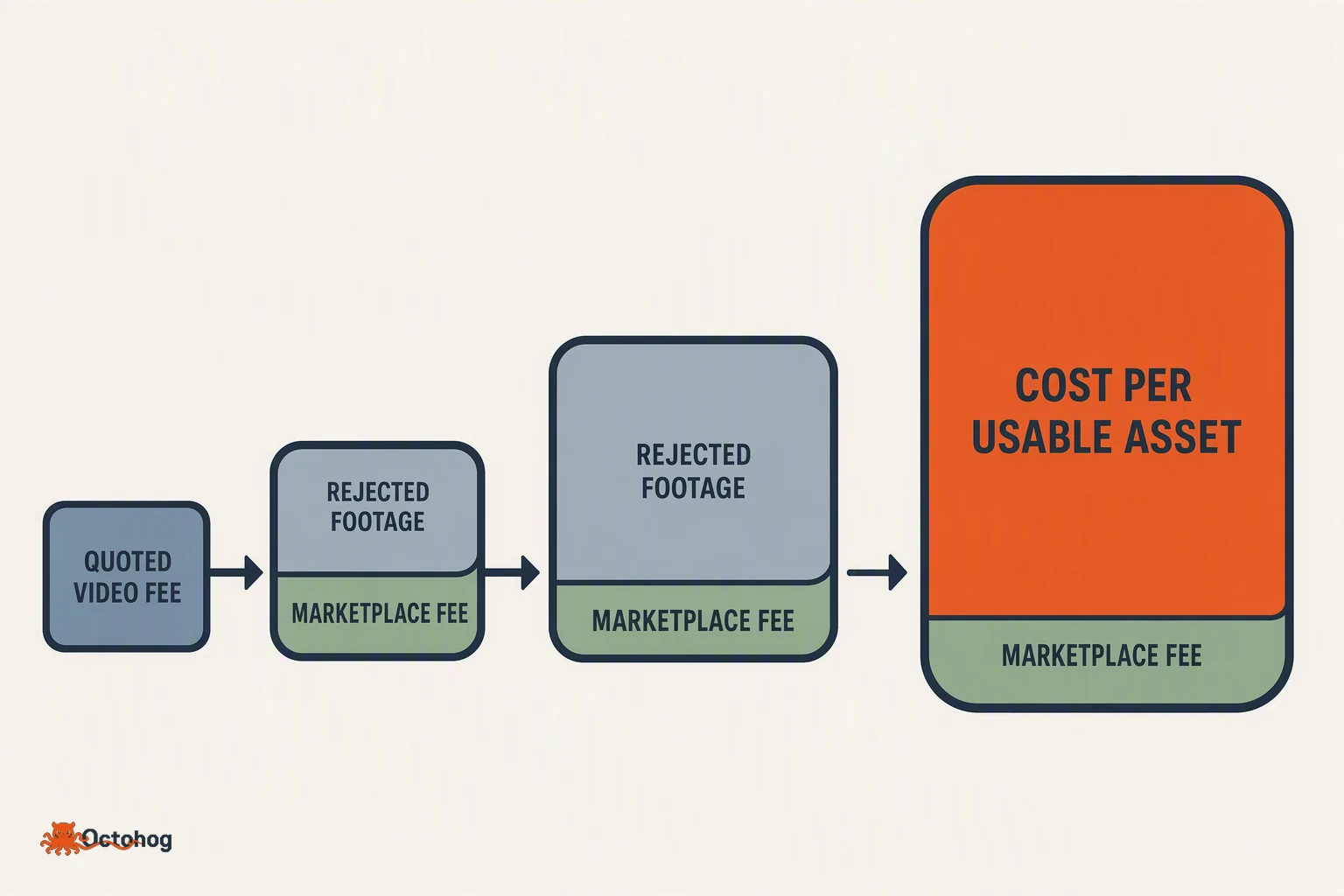
Cost per usable asset is the only budget line that survives a campaign. Not cost per video. The average price for a single UGC video in 2026 sits around $212, and short-form 15-60 second cuts run $150-$300 [7]. That price is an input to a budget, not the budget.
Three costs sit between the quote and a shipped ad: rejected footage, reshoots, and editing hours nobody puts in the quote. Set your own rejection rate before you brief anyone, and plan on roughly a quarter of deliverables never running until you have enough creators to know your real number. That one-in-four is a planning placeholder, not a sourced benchmark — no public dataset prices UGC rejection rates, so the point of the worked example below is the method, and you should substitute your own ratio the moment you have twenty deliverables to count. At the $212 average [7] with one in four rejected, cost per usable asset is $283 ($212 / 0.75 = $283). The creator's rate did not move.
Marketplace fees stack on top, and they are quoted against the creator's fee rather than your total. Insense charges 20% on its Trial plan and 7% on its Agency plan [6]. On that $283 usable asset, the Trial plan lands at $340 ($283 x 1.20) and the Agency plan at $303 ($283 x 1.07). Same footage. Same creators. The gap between those two figures — roughly $37 per asset on this worked example, arithmetic from the published 20% and 7% rates [6] — comes entirely from which subscription tier you happened to sign.
Now build the ugc campaign backward. Start from the number of assets that must actually ship this quarter, multiply by the loaded figure rather than the quoted one, and treat everything below that total as underfunded rather than lean. A ugc strategy that budgets thirty videos at the $212 average [7] has budgeted for maybe twenty-two ads, on the same one-in-four rejection placeholder used above.
Two line items are worth adding on purpose:
- Paid reshoot allowance. One reshoot per creator, priced at the original rate, agreed in the brief.
- Raw footage delivery. Ask for the unedited files alongside the cut so your editor can rebuild a hook without rebooking a shoot.
- Edit hours. Either your team's time or a freelance rate per asset, counted before you approve the creator list.
- Platform fee tier. Check it against volume before signing, not after.
Track cost per usable asset in the same sheet as cost per acquisition. If the first drops and the second does not, the problem is the brief.
Octohog
The spreadsheet was never the campaign.
Briefs, shortlists, outreach and replies live in one workspace, with creator evidence attached to every decision you make.
Open the workspace7-day free trial
The pricing mistakes that cost both sides money
Refuse perpetual rights at organic rates. That single term is the most expensive thing a brand asks for and the most common thing a creator gives away without noticing, because it costs nothing on the day and everything eighteen months later. Usage rights add 30-50% to a creator's base fee, which turns a $200 video into a $260-$300 asset once the brand can run it as a paid ad [7] — and a full buyout, which is what perpetual rights are, runs 100% to 150% above base [1]. Perpetual rights at $200 mean neither premium was ever paid.
Time-box the license instead. TikTok's Spark Ads authorization duration is customizable, so a whitelisting deal can expire with the flight rather than run open-ended, and each Ads Manager account supports up to 10,000 active authorized Spark Ads [8]. That is documented platform behaviour, not a workaround — the lever is in the product. Set the duration to the campaign window and renew it if the asset is still working. Renewals are cheap. Retroactive negotiations are not.
Three more terms belong in the refuse column on both sides of a ugc partnership:
- Unlimited revisions. Cap at two rounds and define a revision as a change to an existing cut, not a new concept. A new hook is a new deliverable.
- Unpaid concept rounds. Scripts and hook ideas are the work. A brand asking three creators to pitch before anyone is booked is buying strategy for free.
- Open-ended category exclusivity. Exclusivity is a fee and a date, or it is not in the contract. Creators expect a 30-to-90-day window [1]; locking one out of an entire category for a year at single-video rates is the worst trade a creator can sign.
The whitelisting threshold is simpler than most guidance makes it. If the paid budget you plan to put behind an asset is smaller than the licensing premium the whitelisting itself costs, skip it and buy organic rights only. You are paying for permission you cannot spend against. The arithmetic runs off the two published amplification models — a multiplier on the base fee, or roughly 4% of ad spend [5] — so work it on your own numbers rather than on a rule of thumb; brands on small monthly ad budgets rarely clear the line, and the money is better spent on a fourth creator than on ad rights for the first three.
Put the license term, the revision cap, and the exclusivity end date in the brief, above the rate. Whoever names them first sets them.
Frequently asked questions
Do UGC creators make money?
UGC creators make money per deliverable rather than per follower, which is why ugc work scales for people with no audience at all. A $5,000 budget that buys one micro-influencer post instead buys roughly 15-25 separate UGC assets through creator-marketplace rates [7]. Income comes from volume, repeat retainers, and charging separately for usage rights rather than folding them in free — and just over half of influencers already bill those rights as a separate line [5].
Is UGC still a thing in 2026?
UGC is still a working channel in 2026, and what changed is the paperwork, not the demand. Brands that treated creator video as an experiment three years ago now run it as a standing line item with license terms, revision caps, and named rate bands, and creator content now runs across websites, paid ads, and organic social at most brands rather than in one channel [4]. The ugc model matured into procurement. Creators who price rights separately are earning more per shoot than creators who bundle everything into one number.
Is UGC content legal?
UGC content is legal when the rights are licensed in writing before the content runs. A customer's Instagram post is theirs until they grant you permission, a repost is not a license, and paid ads need explicit ad rights. Two things break campaigns: unlicensed background music and missing disclosure on paid partnerships. Get the grant in the contract, name the platforms, and name the end date. This is a description of standard practice rather than legal advice; rules differ by market.
What brands pay for UGC?
Brands pay two separate bills for UGC: the creator's fee per asset, and the software or marketplace that finds and pays those creators. Insense's Brand plan runs $500 per month, or $1,500 billed quarterly, covering unlimited creator hires on one connected brand, entirely separate from creator pay [6]. Compare ugc apps on take rate and per-asset fees, not on feature lists — and note that most of the market does not publish a take rate at all, which is itself a data point when you are choosing where to work.
References
- How Much Do Content Creators Cost? (Based on Following Size) — insense.pro
- UGC Rates in 2025: What Brands Actually Pay (and Why It Varies) — billo.app
- How to create Spark Ads for Manual and Search Campaigns in TikTok Ads Manager — tiktok.com
- Meta expands partnership ads to turn creator content into performance — emarketer.com
- How Influencers Charge Whitelisting & Usage Rights | Lumanu — lumanu.com
- Choose Your Ideal Plan for Influencer & UGC Campaigns, Insense — insense.pro
- Influencer Marketing Pricing in 2026: What Brands Are Actually Paying Per Asset — Social Native AI — socialnative.ai
- About Spark Ads FAQs | TikTok Ads Manager — tiktok.com