Instagram Influencer Marketing Rates & Vetting Checklist

· 27 min read

Last updated: 2026-09-25
Instagram influencer marketing is priced per deliverable, not per follower. The clauses sitting under the fee move the number more than the tier label does. Micro-influencer posts ran $250 to $5,000 each in 2026, a 20x spread inside one follower tier ($5,000 ÷ $250 = 20), according to Shopify's 2026 Instagram rate table [1]. That spread is the whole problem. Below: the 2026 rate bands by tier and by format, the arithmetic for checking a quote against your own media costs, the engagement and fraud ratios that decide whether a rate was ever real, and the usage, exclusivity, and disclosure terms that reprice a deal after signature.
The figures here come from three kinds of source, and the difference matters when you quote them back at a creator. Platform and market benchmarks — the per-post rate bands and the pricing formulas — come from Shopify's published 2026 Instagram pricing breakdown [1], with market-size forecasting from Statista [2]. Performance figures come from Captiv8's 2025 affiliate marketing report as covered by eMarketer [7], and commission benchmarks from Tapfiliate's analysis of more than 2,600 affiliate programs [5]. Contract and exclusivity guidance comes from practitioner legal commentary on influencer agreements [8]. Everything else — the negotiation order, the ratios, the failure patterns — is trade practice, stated plainly as that and carrying no citation, because no published study measures it.
- What is Instagram influencer marketing, priced as a media buy?
- Quotes moved in 2026, and the spread inside each tier moved more
- Benchmark the quote against the tier before you answer it
- Price the format, not the post: Reels, Stories, and feed carry different numbers
- Read the audience before you read the rate card
- Catch the fraud signals that survive a pretty media kit
- Negotiate usage rights, exclusivity, and whitelisting as separate line items
- Write the brief so the rate holds through revisions
- Disclose under the FTC Endorsement Guides or the rate becomes the cheapest part of the campaign
- Compare flat fee, CPM, affiliate, and ambassador deals on the same spreadsheet
- Measure ROI past engagement rate: tracked revenue, EMV, and what each one hides
- Where these deals go wrong: five failures worth more than the rate you saved
- Frequently asked questions
What is Instagram influencer marketing, priced as a media buy?
Instagram influencer marketing is a paid media transaction: a brand buys named deliverables from a creator's account at an agreed rate, for an agreed license term. The unit is the post, the Reel, or the Story frame.
Three things set the price, and only one of them is the audience. Deliverable count, license term, and exclusivity window do the rest of the work. Shopify's 2026 pricing breakdown describes compensation on Instagram splitting into flat per-post fees and performance-based deals, with payment, deliverables, usage rights, and exclusivity set as explicit negotiated terms — and the performance side taking ground through 2026 [1].
Creator partnerships priced as a brand-awareness activity become unmeasurable by design, which is usually the point for whoever wrote the invoice. Priced as media, the same deal compares against a Meta Ads line item: cost per thousand views, cost per engagement, cost per acquisition. Sponsored post pricing is only the entry ticket to that comparison.
Write the rate, the deliverable list, and the license term on the same line of the brief before anyone talks about creative. A quote missing any of the three is not a quote. It is a placeholder that gets renegotiated after the shoot, when you have lost your leverage and the creator has lost their patience.
Quotes moved in 2026, and the spread inside each tier moved more
Micro-influencer posts on Instagram ran $250 to $5,000 in 2026, a 20x spread inside a single follower tier ($5,000 divided by $250 = 20), per Shopify's rate table [1]. Nothing else in this market moves a price by 20x. Not the niche, not the turnaround, not the season. The tier label tells you very little once you have seen how wide its band is.
The same table puts mid-tier Instagram posts at $1,600 to $10,000 per post and macro posts at $5,000 to $25,000 per post [1]. The top of the mid band sits $5,000 above the floor of the macro band ($10,000 minus $5,000 = $5,000). So a mid-tier creator with strong numbers and a macro creator with weak ones can send you the identical fee, and both sit inside published benchmarks.
How much to pay for influencer marketing is a question about your own media math, not about which tier the creator sits in. Set a ceiling from what the placement is worth at your current acquisition cost, then hold the quote against it. Anything above that ceiling needs a reason written into the contract: exclusivity, extra cuts, paid usage, a rush turnaround. If the creator cannot name the reason, the number is an opening position.
US influencer marketing spend is forecast by Statista at roughly $12.17 billion in 2026 [2]. Money at that scale produces pricing set by what the last buyer paid rather than by what the audience is worth. That is the mechanism behind a quote that feels arbitrary, and it is why two creators with near-identical accounts can be $4,000 apart.
Engagement rate is the one benchmark that travels across every tier, and it is the number creators volunteer least often when they send a rate. Ask for it as a dated screenshot from Instagram Insights covering the last month. Cost-effective advertising on Instagram comes from a small audience that acts, not a large one that scrolls, so the bottom of the micro band frequently beats the top of it.
Treat published tier bands as a sanity check, never as a price. Given a band that spans 20x inside one tier [1], a quote sitting inside it can still be triple what the account deserves, and a quote above it can be fair when the license runs long. Ask for the view counts on the creator's last three posts before arguing about the fee. The spread lives in those three numbers.
Benchmark the quote against the tier before you answer it
Shopify's 2026 rate table puts nano-influencer posts at $25 to $150 each and mega-influencer posts at $10,000 or more per post [1]. That is the full width of the market you are buying in. Place the incoming quote inside that width first, then convert it into a media number you can set beside your paid social costs.
The table compares 2026 Instagram per-post rate bands at the three tiers with published figures.
| Tier | Instagram post rate (2026) | What the fee buys |
|---|---|---|
| Nano | $25 to $150 per post | Audience trust, small reach, low production |
| Macro | $5,000 to $25,000 per post | Reach plus footage a brand can reuse in ads |
| Mega | $10,000 or more per post | Celebrity association and negotiated exclusivity |
Source: Shopify's June 2026 Instagram rate table [1].
The middle tiers sit between the nano ceiling and the macro floor, and their bands overlap one another instead of stacking neatly. Tier classification is a sorting device for your outreach list. It is not a pricing method, and treating it as one is how buyers end up paying macro money for macro follower counts and nano performance.
How many followers do you need to be a paid influencer?
No follower count makes someone a paid influencer. Brands pay nano creators at the bottom band in the table above, and they decide on engagement rate, audience fit with existing buyers, and whether the creator can deliver a usable hook without three rounds of notes. A tight small audience gets paid. A large inert one gets ignored.
Does Instagram pay per 1,000 views?
Instagram does not pay creators a fixed rate per 1,000 views on organic posts. Brands do, through CPM, and Shopify publishes both pricing formulas in use: the CPM route, where the rate equals the number of views divided by 1,000 multiplied by the CPM rate, and the engagement route, where the rate equals follower count multiplied by engagement rate multiplied by a rate per engagement, plus additional factors [1].
Use the CPM version when the post is a reach buy and the engagement version when you are buying comments, saves, and shares. Run either on the creator's own recent view counts rather than on follower count, and the output is directly comparable to your Meta Ads CPM. Creator earnings estimates published by tools use one of these two formulas underneath — worth knowing before you quote one back at a creator as though it were a market price.
Do the conversion before you reply:
- Take the quoted flat fee.
- Divide it by the creator's median view count from their last three posts.
- Multiply by 1,000. That is their effective CPM.
- Compare that single number to what you already pay Meta for the same audience.
If the creator's CPM loses badly and the footage is not licensed for paid use, the deal is decoration.
Price the format, not the post: Reels, Stories, and feed carry different numbers
Price each Instagram format separately, because each one sells a different thing. A Reel is bought for distribution past the creator's own follower list, since the recommendation system decides most of who sees it. A feed post is bought for permanence: it stays on the grid, it anchors a profile visit, and it can run as Meta Ads creative for as long as the license allows. A Story is bought for the click and nothing else.
The table compares what each Instagram format delivers for the fee attached to it.
| Format | Deliverable | Audience it reaches | Shelf life |
|---|---|---|---|
| Instagram Reels | Vertical video, brand hook in the opening seconds | Followers plus recommended viewers | Weeks, sometimes longer |
| Feed post | Static image or carousel, permanent on the grid | Mostly followers, plus profile visitors | Permanent until deleted |
| Story frames | Swipe-up link, poll, or question sticker | Followers who already open the account daily | One day |
| Live | Scheduled co-hosted session | Followers online at that hour, plus replay viewers | Replay only |
A Reel quoted at the same price as a single feed post is either a bargain or a warning. Bargain if the creator's Reels consistently out-reach their feed and they simply have not repriced. Warning if they cannot tell you their median Reel reach, because a creator who does not track format-level reach is not tracking what they are selling you. Ask which of their last five Reels went furthest and why they think so. The answer sorts professionals from hobbyists faster than any rate card.
Story frames are the format buyers overpay for most. They vanish in a day, they carry no reuse value unless you negotiate the raw file, and their click-through depends entirely on how much the creator's audience trusts them. Buy Stories as a link-delivery add-on attached to a Reel or a feed post, never as the main deliverable, and never at a price that approaches permanent placement.
What is the 3-2-1 rule on Instagram?
The 3-2-1 rule is a creator habit that circulates in the community, not an Instagram policy or a ranking setting. It is used two ways: as a daily engagement routine — leave three comments on other accounts in your niche, reply to two comments or DMs on your own content, publish one post or story — and as a weekly posting mix of three value posts, two engagement posts, and one promotional post. Instagram publishes neither version and gives neither any weight.
It matters to a brand buyer for one reason. A creator who works to that mix treats your sponsored post as their single promotional slot, which is why a Reel dropped into a crowded promo week underperforms the same Reel in a quiet one. Put the format in the brief line, with its own fee, and ask what else the creator has booked that week. Then price the Reel against their Reel reach, not against a follower count.
Read the audience before you read the rate card
A healthy Instagram engagement rate runs 3% to 6%, and anything above 7% is strong [3]. Read that band against the creator's tier before you call it a pass. Nano accounts between 1K and 10K followers often clear 5% without help [3], so a 4% nano is a middling account, while a 4% account with half a million followers is an outlier worth a call. The rate card comes after this. Not before.
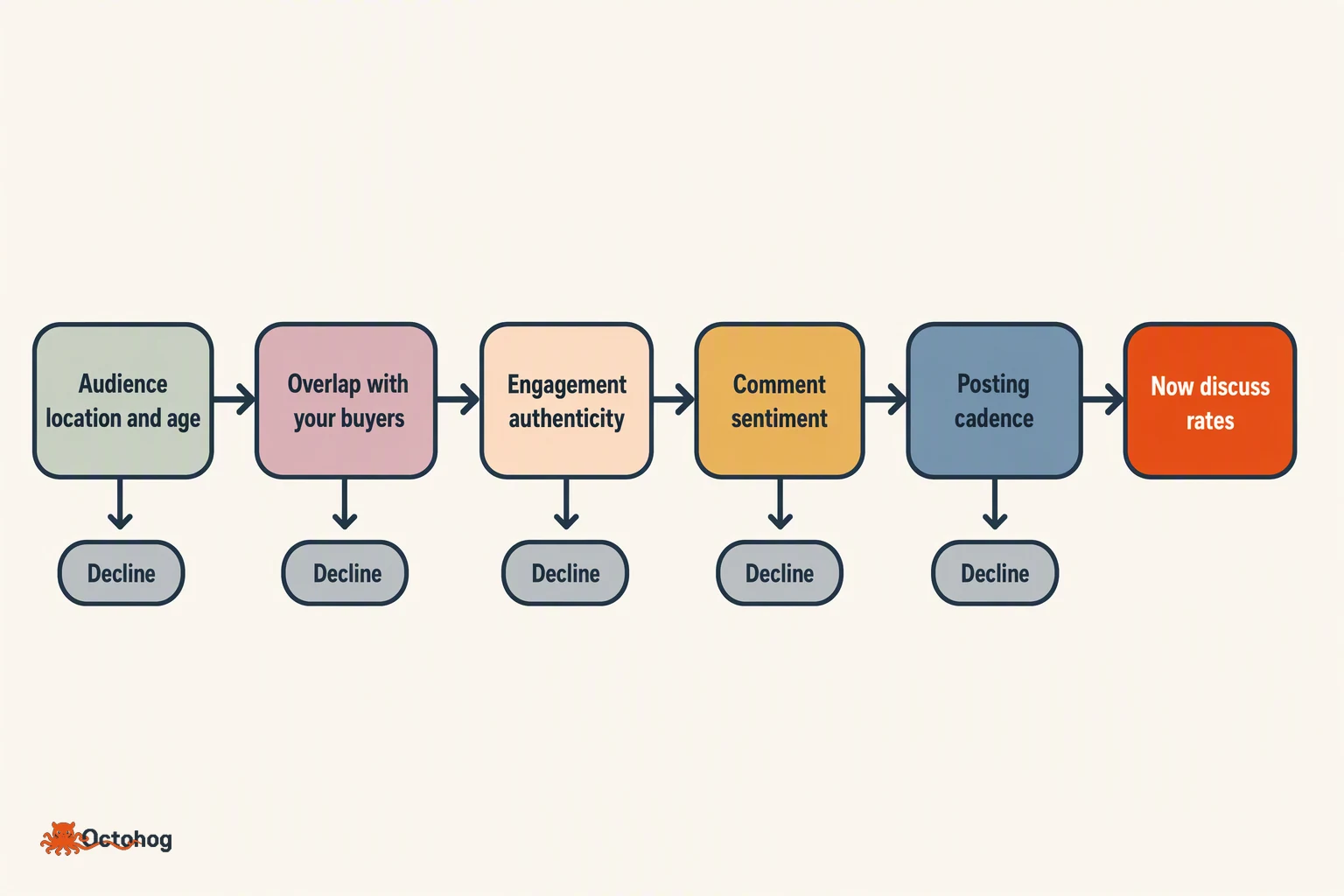
Run the vetting in this order, because each step can end the conversation before you spend time on the next one:
- Audience location and age. Ask for the Instagram Insights screenshot of top countries and age bands, not a summary of it.
- Audience overlap with your existing buyers. Compare the top two countries and the dominant age band against your own order data.
- Engagement authenticity. Check whether the engagement rate holds across the last nine posts or sits on two spikes.
- Comment sentiment. Read the comments on a paid post, not an organic one. Paid posts are where indifference shows.
- Posting cadence. Three posts in the last 30 days means functionally inactive, whatever the follower count says [3].
- Format history. Confirm they have shipped the format you are buying, in the aspect ratio you need.
Audience demographics outrank engagement rate in that order for a structural reason. A creator clearing the 7% strong-engagement bar [3] whose audience sits in a country you do not ship to should be cut before a creator sitting at the 3% floor of the healthy band [3] whose audience matches your buyers exactly. Engagement measures whether people react. Demographics measure whether reacting could ever become an order. A signal hierarchy that puts the percentage on top is a hierarchy built by whoever is selling the percentage.
Discovery tools earn their subscription on the audience-data layer and almost nowhere else. Audience-analytics platforms are worth paying for because they read follower-level country, age, and language data you otherwise have to request account by account, screenshot by screenshot. The search-and-shortlist features are a convenience. The audience breakdown is the product.
Social listening is the discovery method most Instagram buyers skip, and it produces better shortlists than any filter query. Search your own brand name, your category, and your two closest competitors in Instagram search and in tagged photos. Creators already posting about the category unprompted have demonstrated the one thing a media kit cannot: that they will talk about this without an invoice attached. Start the outreach list there, then run the six checks above on every name before you ask for rates.
One tier benchmark applies to one creator only when the audience, the cadence, and the comment quality all survive. When one of the three fails, the benchmark is not a low quote or a high quote. It is the wrong number for this account, and no negotiation fixes that.
Catch the fraud signals that survive a pretty media kit
Fake followers are a ratio problem, and you can compute every ratio that matters from a public profile without buying a tool. Open the creator's grid, take the last nine posts, and ignore the pinned ones. Pinned posts are chosen precisely because they are unrepresentative.
Check these five ratios in order, and treat any two failures together as a decline:
- Likes against followers. A profile where like counts sit at a tiny fraction of the follower number, post after post, bought the followers. Compare the implied rate against the 3% to 6% healthy band [3] before deciding.
- Comments against likes. Real audiences comment at a small but steady share of likes. Pods push comments abnormally high; bought followers push them to near zero.
- Comment length and specificity. Count comments that name something in the post. Strings of emoji, "amazing", and "so good" arriving in a cluster within minutes are pod traffic.
- Story views against followers. Ask for the Instagram Insights story view count. Stories are the hardest metric to inflate, so a healthy grid above a dead story is the clearest tell there is.
- Follower growth shape. Straight-line growth across months is purchased. Real accounts grow in steps, because real accounts have posts that worked.
Engagement pods are the harder catch, and the giveaway is symmetry. Pull the handles commenting on the creator's last three posts, open two of those accounts, and look at who comments on theirs. When the same six or seven handles appear on both sides, you are looking at a "comment for comment" arrangement. Those comments will never convert, because the people leaving them are working, not shopping.
Reject the media kit as evidence. A media kit is a sales document, and the reach figures in one are self-reported screenshots that can be cropped, aged, or lifted from a single outlier post. Ask instead for a screen recording of Instagram Insights that scrolls through the last month, showing the account switching between posts. Recordings are far harder to fake than stills, and a creator who refuses a recording has told you the answer.
Sponsored-post history is the check most buyers never run. Find the creator's last two Paid Partnership posts, compare their engagement against their organic average, and check the cadence around them — an account posting three times in 30 days is functionally inactive whatever its follower count [3]. A grid that collapses the moment a brand tag appears has an audience that follows for the person and mutes the commerce. That is not fraud. It is worse, because it is real people who will not buy, and no ratio catches it.
Run the ratios before the vetting call, not after. Five minutes on a phone disqualifies most of a shortlist, and the creators who survive it are the only ones whose rates are worth discussing.
Related reading
Negotiate usage rights, exclusivity, and whitelisting as separate line items
Price the license before you price the video. A bundled quote hides which clause is actually expensive, and the clause that costs the most is almost never the one the creator thinks they are charging for. Ask for three numbers instead of one: the content fee, the usage term, and the amplification rights. Three lines, one contract.
The table below separates what each clause buys, so you can price a paid-usage request instead of arguing about a total.
| Clause | What the brand gets | Where the content runs | What the creator gives up | Price it as |
|---|---|---|---|---|
| Content fee | The asset, delivered | The creator's own grid | Time and production | Flat fee per deliverable |
| Organic usage rights | Repost on brand-owned channels | Brand feed, brand Stories, site | Nothing exclusive | Small uplift on the content fee |
| Paid usage rights | The asset as Meta Ads creative | Instagram Reels and feed placements | Control over how often it appears | Multiple of the content fee, scaled by term |
| Whitelisting | Ads served from the creator's handle | Partnership Ads under their name | Their identity and comment section | Priced above paid usage, always |
| Category exclusivity | No competitor work for a set term | Everywhere | Future income from your category | Monthly retainer, never a one-off |
What a 12-month paid term actually costs
A 12-month paid-usage request is a different purchase from a 30-day one, and the price difference is not a rounding adjustment. Hold onto the ordering, since no published table prices usage terms the way Shopify's table prices posts: organic rights add an uplift on the content fee, paid rights price above organic and scale with the length of the term, and a full year of paid usage is the most expensive version of the request. Ask the creator to quote all three and the shape of their own pricing becomes visible.
Buy the term you will use. Most DTC brands renew the same three hero assets and let the rest expire, so a blanket year on every video funds footage nobody will ever put spend behind.
Whitelisting is the clause to negotiate hardest
Whitelisting hands your ad account permission to run creative from the creator's own handle. Their name carries your claims, and their comment section absorbs your customer service. That is why it prices above plain paid usage, and why it should never be folded into a content fee. Agree in writing on who moderates comments, which claims are approved, and the date access is revoked. Then give the creator a revocation right if the ad copy changes.
Exclusivity is usually the one to cut
Category exclusivity is the clause brands buy out of reflex and use least. You are paying a creator not to work, which is the most expensive thing you can ask for and the hardest to verify. Legal commentary on influencer agreements makes the same point from the other side: exclusivity length and the exact definition of a competitor have to be negotiated, and uncompensated restrictions are frequently unenforceable [8]. Cut it on the first contract, add a short non-compete window around your launch dates if you need protection, and spend the difference on a second creator instead. Two voices beat one silenced competitor.
Take your last bundled creator quote, split it into these five lines, and send it back for a line-by-line restatement. The clause that moves most is the one you were overpaying for.
Write the brief so the rate holds through revisions
A quote drifts when the brief leaves the deliverable count, the revision count, and the approval path to be decided after the creator has already shot. Contract templates that hold up name the type of content, the number of posts, the platforms, and the deadlines, with an approval process agreed before production begins [4]. Settle those on the outreach call, not in the revision thread.
A brief structure template that survives contact with a real shoot carries eight lines:
- Deliverables, counted. "Three in-feed Reels, one carousel, four Story frames" — not "a content package".
- Revision rounds, capped. Two rounds, each returned inside a named window, with a per-round rate for a third.
- Hooks, supplied. Give the creator three opening lines to test. The hook is the claim, and the claim is yours.
- Caption optimization, owned. State who writes the caption, who approves it, and which product claims are off-limits.
- Disclosure, specified. Name the exact tag and its placement, and make it a condition of final payment.
- Raw footage, requested up front. Asking after delivery is a new negotiation at the creator's price.
- Campaign planning timeline, dated. Brief sent, first cut due, revisions returned, live date — the deadline set named in template guidance [4].
- Kill clause. What happens to the fee if the content never runs.
Creative freedom versus control is settled the same way every time in a working creative content strategy: the brand controls the claim, the offer, and the disclosure; the creator controls the script, the shot list, and the edit. Brands that invert that pay for polished footage nobody watches. Creators who take a brief with no hook list are shooting for a revision round they were not paid for.
Partnership outreach tactics matter less than what the outreach message contains. Send the deliverable list and the fee in the first message. The creators who ghost that message were never going to hold the rate anyway, and you have lost two days instead of two weeks.
Disclose under the FTC Endorsement Guides or the rate becomes the cheapest part of the campaign
Both parties carry liability for an undisclosed sponsorship. The Federal Trade Commission can pursue the brand, the agency that placed the deal, and the creator who posted it. The Endorsement Guides treat a material connection as anything a reasonable follower would want to know: cash, free product, affiliate commission, a discount code, even an ongoing relationship with no money in it this month. A gifted product is a material connection. Brand authenticity arguments do not change that.
Disclosure has to be understood at a glance, and placement is where most campaigns fail rather than wording. What the FTC accepts is plain and unhedged: "#ad", "Sponsored", or "Paid partnership with", placed where a reader sees it before they engage with the content.
What it rejects is the set of things brands keep asking creators to do instead:
- Disclosure buried in a hashtag block below the fold.
- Vague tags like "#collab", "#sp", or "#thanks".
- Disclosure only in a bio, only on a linked page, or only in a comment that collapses.
- Text laid over a busy Story frame for a beat, unreadable and gone.
Instagram's own Paid Partnership label is a floor, not a defence. Treat it as a supplement to a spoken or on-screen disclosure in video: the label sits in chrome the platform can restyle at any time, and viewers watching a reshared clip never see it at all. Video needs the disclosure said out loud or burned into the frame, early, in both the caption and the content itself.
Legal compliance belongs in the contract rather than in a reminder email, alongside the approval process the templates already call for [4]. The clause that works names the exact disclosure string, names its placement, requires it to stay live for the full term of the post, and makes final payment conditional on both. Add the right to require a takedown and repost at the creator's cost if the disclosure is missing or edited out later.
The part buyers miss is that disclosure exposure scales with the deliverable count, not with the campaign. Every post is its own endorsement. A roster of creators each shipping several posts multiplies the surface a regulator or a platform can act on, and the contract clause above is the only thing that scales with it. The cost of getting this wrong is not carved out of the rate you negotiated. It sits alongside it, which is why the rate stops being the expensive part of the campaign.
Compare flat fee, CPM, affiliate, and ambassador deals on the same spreadsheet
Flat-fee rates on Instagram run $25 to $150 per post for nano-influencers and climb to $10,000 to more than $50,000 per post at the mega tier [1]. Pick the compensation model against your gross margin and your attribution setup before you argue about that number. The model decides who carries the risk when a post underperforms, and that is the only question influencer pricing models actually answer.
Four models, compared on what a finance review asks about each:
| Model | Cost predictability | Tracking method | Break-even trigger | Best for |
|---|---|---|---|---|
| Flat fee | Fixed at signature | Post-level reach and saves | Cost is sunk whether or not the post performs | Content you will also run as paid |
| CPM | Variable, uncapped unless you cap it | Platform-reported views | Every view above your target CPM | Reach campaigns with a view-count goal |
| Affiliate | Fully variable, paid from revenue | Affiliate link tracking and unique codes | First sale that clears the commission | Margins that survive a 30% cut |
| Ambassador retainer | Fixed monthly, falls per asset over time | Blended: codes plus post-level reach | Month three of the same creator | Repeat buyers and category education |
Commission benchmark in the affiliate row: Tapfiliate's analysis of more than 2,600 affiliate programs [5].
CPM deals price attention instead of output. Beauty content on TikTok commands $10 to $20 CPM, so 100,000 views at a $15 CPM pays out $1,500 [1]. Run the same arithmetic backwards before you agree to one: a $1,500 flat fee only beats that deal if the post clears 100,000 views ($1,500 ÷ $15 × 1,000). Cap the payout. An uncapped CPM deal on a post that goes wide is a budget line you did not approve.
Affiliate arrangements move the risk onto the creator, and creators price that risk accordingly. SaaS affiliate programs sit around 30% recurring commission across that same analysis of more than 2,600 programs [5]. Hold that number in mind when a physical-product brand offers a creator ten percent of a one-time order. One pays forever. The other pays once, and the creator does the maths faster than you think.
Brand ambassador programs are the only model where the cost per asset falls. A long-term partnership strategy replaces four rounds of briefing a stranger with one creator who already knows the product objections. Bundle campaign goals into that retainer rather than buying them separately: product placement in organic posts, a giveaway strategy for list growth, whitelisted paid usage.
Gifting is not a compensation model. It is a discount on one, and it works only where the product retails above the creator's per-post rate.
Put your last four campaigns into one spreadsheet with a cost-per-asset column and a cost-per-attributed-order column. The model that wins is usually not the one you defaulted to.
Measure ROI past engagement rate: tracked revenue, EMV, and what each one hides
The 50,000-100,000-follower Instagram tier converted at 1.3% in Captiv8's 2025 affiliate data, up 46% year over year and the highest tracked rate of any tier measured [7]. That number exists because those posts were tracked to a checkout. Engagement rate cannot produce it, and no volume of saves will.
Build the measurement before the campaign. Give every partner their own UTM-tagged link — along the lines of utm_source=creator_jessica&utm_medium=affiliate&utm_campaign=summer_drop — so each post resolves to individual conversions instead of an aggregate engagement count, and the creator becomes a row in your analytics instead of a line in a recap deck [6]. Pair that link with a per-creator discount code inside your shopping integration, because in-app browsers and link handling on mobile drop a share of clicks before they reach your store. The gap between code redemptions and link conversions is your attribution loss, and you want it measured rather than argued about in a review meeting.
Read tier performance off the same tracked numbers. The 500,000+ macro tier converted at 0.7% in that 2025 Captiv8 report, roughly half the micro tier's 1.3%, even after improving from 0.45% [7]. A macro post therefore needs close to double the clicks of a micro post to land the same order count. Price it that way or skip the tier.
Earned media value is where a return figure gets inflated. EMV takes impressions, comments and saves, prices them at an ad rate you never bid on, and reports the product as though it were money. Nothing in that calculation contains a buyer. EMV works as a reach index and nothing more: fine for comparing two creators' distribution, misleading the moment it sits in the same column as revenue.
Keep awareness metrics on their own line. Reach, saves and follower growth are worth monitoring monthly, since they predict which creators stay cheap to rebook, but they do not belong in a ratio with the fee in the denominator. Split your marketing goals and KPIs accordingly: tracked revenue per dollar of fee for the performance half, saves and profile visits for the awareness half. Then refine on the performance half only. Pull last quarter's creator rows, sort by tracked revenue divided by fee paid, and cut the bottom third before you renew anybody.
Where these deals go wrong: five failures worth more than the rate you saved
Overpaying the macro tier for reach it cannot convert. The 500,000+ follower tier converted at 0.7% in Captiv8's 2025 affiliate data [7], while nano-influencers under 50,000 followers grew revenue per click 74% year over year on a $193 average order value in the same report [7]. Macro reach is a media buy wearing a creator's face. Budget it from the awareness line, cap the fee at what tracked orders justify, and stop calling the difference performance.
Signing without an exclusivity definition. A clause that forbids "competitors" without naming them or setting a term buys nothing. Negotiate the length of exclusivity and the exact definition of who counts as a competitor, because uncompensated restrictions are frequently unenforceable [8]. Sixty days against three named brands is a clause you can hold. A twelve-month blanket ban with no fee attached is the clause that gets deleted the week you need it.
No crisis clause. Negotiate the triggering conditions and the remedies before the campaign starts, since your product and your logo can stay live on a creator's grid long after the conduct that makes you want them gone [8]. Write down who declares a trigger, how many hours the creator has to remove the post, and whether the fee is refunded or credited against the next flight. Do it at contract stage. Nobody negotiates this well at 11pm.
One-off campaigns with no renewal test. A single post produces one data point and no baseline, which means every renewal decision after it is a guess dressed as judgment. Book three-post flights with the renewal bar stated in the brief: above your tracked cost-per-order target the creator gets rebooked, below it they do not. Creators price flights lower than one-offs anyway, so the test costs less per asset than the guess did.
Assuming the audience travels. Instagram and TikTok reward different edits and different hook lengths, so strong Reels numbers predict very little about the same creator's TikTok performance, and the reverse holds too. The same mistake shows up across markets: a creator's follower count says nothing about where those followers can actually buy from you. Check the audience-country split before funding an international launch. Brief local creators for local markets instead of translating a caption and hoping the joke survives.
Frequently asked questions
What is the 3-2-1 rule on Instagram?
The 3-2-1 rule is a creator convention rather than an Instagram policy, and it circulates in two forms. As a daily engagement routine it means three comments left on other accounts in your niche, two replies to comments or DMs on your own content, and one post or story published. As a weekly posting mix it means three value posts, two engagement posts, and one promotional post. Instagram publishes neither version and gives neither any ranking weight, so judge the habit on saves and profile visits — and, if you are buying, on whether your sponsored post is landing in that single promotional slot.
How much to pay for influencer marketing?
Pay what your tracked order economics support rather than what the follower count implies. Nano-influencer affiliate campaigns averaged a $193 order value in 2025, with revenue per click up 74% year over year, per Captiv8's affiliate marketing report [7]. At that order value, a fee is defensible when tracked orders recover it inside one flight. Ask for link-click counts from the creator's last three campaigns before you name a number.
Does Instagram pay per 1000 views?
Instagram does not pay creators a standard per-1,000-view rate. Payout programs have run invite-only and opened and closed by market, so no creator can build a rate card on view counts alone. Creator income on Instagram comes from brand fees, affiliate commissions and product sales. Price the deliverable and the usage rights, then use views as a sanity check on reach.
How many followers do you need to be a paid influencer?
No follower threshold makes someone a paid influencer, because brands pay for conversions and not for size. Nano-influencers under 50,000 followers led every tier on revenue-per-click growth in 2025, up 74% year over year [7]. Accounts at a few thousand followers get paid when the audience buys. Bring link-click screenshots and one past order count to the pitch.
References
- Influencer Pricing: The Cost of Influencers in 2026 — shopify.com
- U.S. influencer marketing spend 2021-2027 | Statista — statista.com
- How to find influencers who actually drive sales — hubfluence.io
- Free Influencer Contract Templates to Protect Your Brand Deals — clickup.com
- Affiliate Marketing Commission Rates in 2026: Benchmarks, Models, and the Formula That Actually Works — tapfiliate.com
- UTM Parameters: How to Use Them (2026) — shopify.com
- Captiv8 affiliate marketing report shows the sector maturing — emarketer.com
- Influence At Your Own Risk: Navigating Influencer Contracts — afslaw.com