Influencer Whitelisting Rates: What Brands Actually Pay

· 15 min read

Last updated: 2026-08-17
Whitelisting fees run roughly 30% per month on top of the base content price [2], and that base runs $500-$5,000 per post for a micro-influencer and $10,000-$25,000 per post for a macro [2]. Nobody publishes that arithmetic, because 51% of influencers charge a separate whitelisting fee while 80% have been asked to amplify content, and the gap between those two numbers is where every vague quote lives [3].
Whitelisting is not usage rights. It is handle-level ad permission: the brand publishes new ads under the creator's handle, aimed at people who never followed them, and pays for the window rather than the footage. Basic 30-day rights add 15-25% to a base rate; extended terms scale to 50-100% or more [4]. Follower count sets the base. Spend, term, and exclusivity set the multiple.
Below: the definition that separates permission from licensing, rate bands by follower tier, the three variables that move a quote more than audience size, the four payment models, Instagram partnership ads and TikTok Spark Ads setup, a line-by-line negotiation script for "this is usually free," and six contract clauses that quietly double the deal.
What is whitelisting on social media?
Whitelisting on social media is a permission grant: the creator gives a brand advertising access to their own handle, so the paid ads that result carry the creator's name in the byline instead of the brand's. The identity on the ad stays the creator's. What changes hands is ad account access, not content.
Three levels of that access exist, and they are priced differently. Partner-level permission lets the brand build ads from scratch on the creator's handle, targeting audiences the creator never sees. Post-level permission covers one existing piece of whitelisting influencer content. A single-use ad code covers one campaign and expires.
Compensation tracks three variables rather than one bundled fee: the level of ad account access granted, how long the ads run, and the usage rights included [1]. That third one is a separate purchase, which is where most quotes go wrong.
Buy the narrowest permission that does the job. If the brand only wants to put spend behind a post the creator already published, partner-level access is more permission than the campaign needs and more money than the brand should pay.
Octohog
The spreadsheet was never the campaign.
Briefs, shortlists, outreach and replies live in one workspace, with creator evidence attached to every decision you make.
Open the workspace7-day free trial
Whitelisting is not usage rights, and paying for one does not buy the other
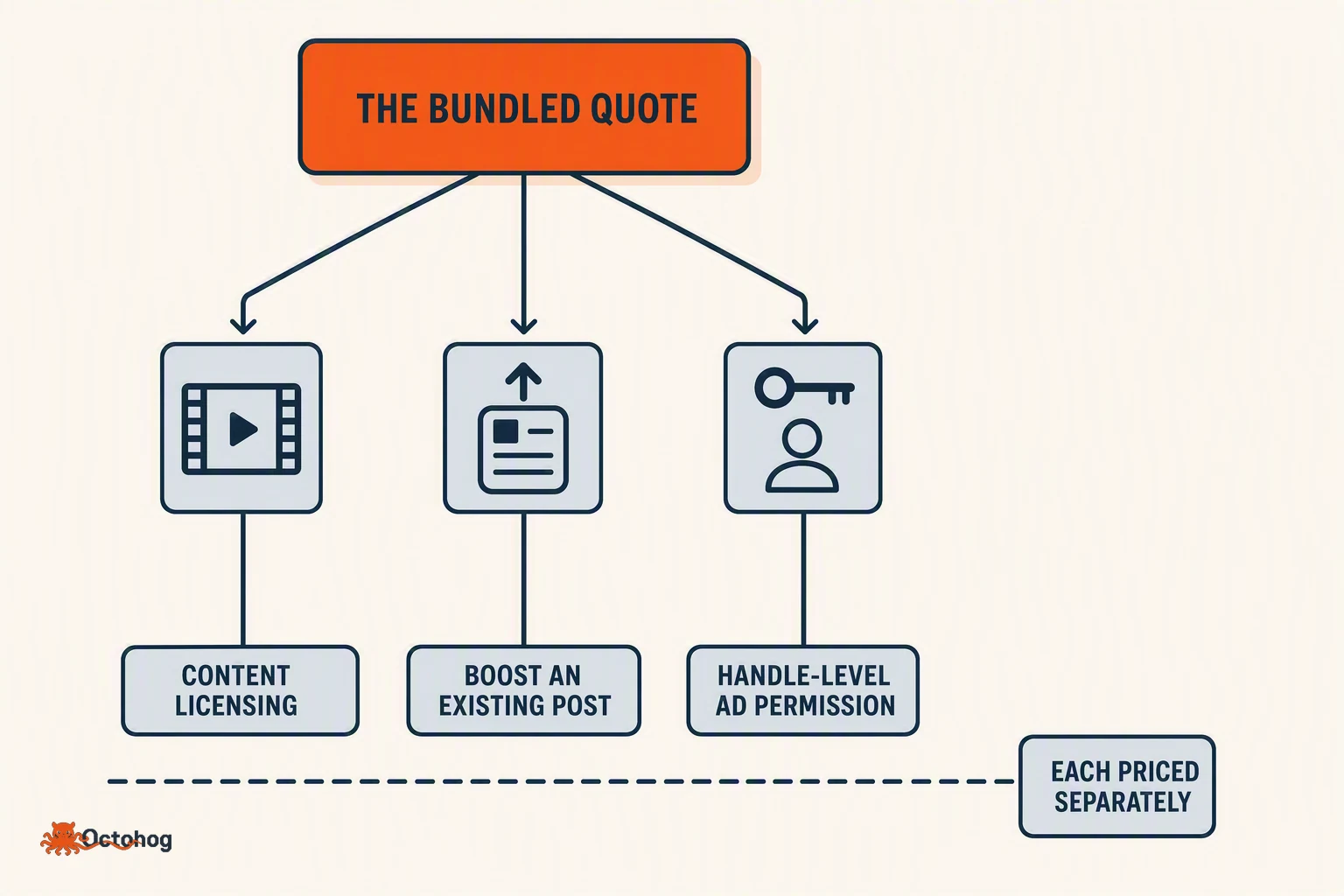
Three things get bundled into one number, and each is a separate purchase. Content licensing buys the footage for the brand's own channels. Boosted branded content puts spend behind a post the creator already published. Handle-level ad permission lets the brand build new dark posts and partnership ads under the creator's byline, aimed at people who never followed them.
Usage rights alone add 30-50% on top of the base content cost, and that sits separate from the monthly whitelisting fee [2]. Pay for one, get one. Not three.
Why the rate is vague: every page that ranks for this has a reason to keep it that way
The pages ranking for this term are published by companies with a stake in the answer staying soft. Vendor glossary pages sell software, not rate transparency; an agency quoting a client margin has no reason to publish the creator's cut; and rate cards move through NDAs on both sides. The result is a search results page full of definitions and one honest Reddit thread.
Here is the datapoint that survived. A Lumanu survey found 51% of influencers charge a separate fee to let brands whitelist, boost, or amplify content beyond their standard creation fee [3]. The same survey put the demand side at 80% — that share of influencers had been asked to amplify content as part of a collaboration [3]. Read those two together and the market's problem is visible: four in five creators get asked, about half have a price for it. The other half are quoting from nothing.
One documented pricing model charges roughly 4% of ad spend for whitelisting rights, which puts $2,000 on a $50,000 campaign [3]. That model has a problem the flat-fee models do not. The creator's fee scales with the brand's budget while their work stays identical, so a brand that finds a winning ad and keeps pushing spend upward pays more and more for the same permission.
I would price the term, not the spend. Percentage-of-spend deals reward the creator for the brand's media buying and punish the brand for succeeding, which is the wrong incentive on both sides of the table. Flat monthly access with a defined end date is the model both parties can forecast.
Ask for the collaboration fee and the amplification fee as two separate numbers before any contract language exists. A creator who cannot separate them has never priced whitelisting, and a brand that will not separate them is hoping you won't.
How much to charge for whitelisting: the rate bands, by follower tier and term
Whitelisting fees run roughly 30% per month on top of the base content price [2]. That is the anchor number, and it means the follower tier sets the base while the term sets the multiple. A micro-influencer at 10K-100K followers charges $500-$5,000 per post; a macro-influencer at 500K-1M charges $10,000-$25,000 per post [2]. Same template, different tier. The whitelisting fee compounds on whichever base applies.
Run the arithmetic on the low end of each tier for a three-month term:
| Tier | Base per post | Whitelisting, 1 month (30%) | Whitelisting, 3 months | Total, 3-month term |
|---|---|---|---|---|
| Micro, 10K-100K | $500 | $150 | $450 | $950 |
| Micro, 10K-100K (high end) | $5,000 | $1,500 | $4,500 | $9,500 |
| Macro, 500K-1M | $10,000 | $3,000 | $9,000 | $19,000 |
| Macro, 500K-1M (high end) | $25,000 | $7,500 | $22,500 | $47,500 |
Source: the 2026 influencer pricing breakdown [2]; monthly figures derived at 30% of base.
The three-month column is where brands stop reading. A $500 micro post nearly doubles to $950 once the handle stays open for a quarter ($500 + 3 x $150 = $950), and the macro low end goes from $10,000 to $19,000 on the same arithmetic. The permission costs as much as the content did.
Converting a monthly fee to a percentage of ad spend
Percentage-of-spend quotes and monthly quotes are the same deal expressed two ways, and either side can convert. Divide the monthly fee by planned monthly ad spend. The same flat fee reads as a low single-digit percentage against a large media budget and several times that against a small test budget. The creator's number did not move. The brand's budget did.
That conversion is the negotiation. A creator quoting 30% monthly on a $500 post is cheap for a brand spending heavily behind it and expensive for one running a small test, so the brand with real budget should offer the flat monthly rate first and the brand with a small test budget should ask for percentage.
What the term length should actually be
Set the term to the creative's useful life, not the campaign calendar. Most UGC ads fatigue inside 60 days, which means a 12-month whitelisting term is nine months of paying for permission on an ad nobody is running.
Buy 60 days with a defined renewal price written in at signing. Renewals cost less to negotiate than extensions do, and the creator gets a second payment instead of one discounted year.
Related reading
Price the three variables that move the quote more than follower count
Three inputs move a whitelisting quote more than audience size does: planned ad spend, term length, and exclusivity. Ad spend sets the scale of the risk the creator is taking on, term sets the multiple, and exclusivity prices what they turn down to work with you. Follower count only sets the base that those three multiply. Name all three before anyone names a price.
- Planned ad spend: brands typically open at $500 to $1,000 per creator to validate performance before scaling [4].
- Term length: basic 30-day usage rights add 15% to 25% on top of the base rate [4].
- Extended terms: longer durations push that same premium to 50% to 100% or more [4].
- Category exclusivity: what the creator charges for every competitor brief they decline while your term runs.
- Competitor brand conflicts: name the two or three rivals you want blocked, not the whole category.
- Renewal price: agree the cost of extending a winning asset before the first term starts.
Tell the creator your ad spend figure. A creator quoting blind assumes you will run six figures through their handle and prices for that; a creator who knows the test budget is $500 prices for a test. Vagueness costs the brand money, not the creator.
Usage rights negotiation goes wrong in one predictable way. The brand asks for perpetual, worldwide, all-channel rights on a validation flight, pays the extended-duration premium of 50% or more [4], and then retires the creative in week three. Buy the short term first and renew what performs. Renewal on a proven asset is the cheapest media you will buy all quarter.
Exclusivity is the variable I would cut first. Most brands ask for it by reflex, run one campaign nowhere near a competitor, and never invoke the clause they paid for. Blocking two named rivals costs a fraction of blocking a category and protects the thing you were actually worried about.
Put campaign budgeting for the license next to media in the sheet, not inside the content fee. Write your spend, your term, and your blocked-brand list into the brief before you contact a single creator. Those three lines are the quote.
Compare the four ways whitelisting deals get paid
Four pricing models cover almost every whitelisting deal signed today, and they differ on who carries the upside when the creative works.
| Model | What the brand pays | Favours | Breaks down when |
|---|---|---|---|
| Flat term fee | One fee per creator, per term | Brand | Spend scales far past the fee |
| Percentage of ad spend | ~4% of media budget [3] | Creator | Media budget is small |
| Monthly retainer | Fixed monthly fee, rolling access | Brand | Creative fatigues and nobody reshoots |
| Per-asset license | $300-$1,000 per Reel at 10K-50K followers [4] | Creator | You need many assets fast |
Percentage deals are where the two sides quietly diverge. A creator charging 4% of ad spend earns an extra $2,000 once a brand runs $50,000 through their handle [3]. That is fair when the creator's face is carrying the account. It is expensive when your media team's targeting is doing the work and the creative is one of nine in rotation.
Per-asset licensing scales with the creator, not the campaign. Micro-creators at 10K-50K followers run $300 to $1,000 per Reel, while macro-creators command $5,000 or more [4]. Same asset, same ad account, different invoice.
Pick on your own numbers, not on fairness. If your cost per action is stable and your customer acquisition cost is already known, a flat term fee is the model that keeps brand ROI predictable, because your cost stops moving while your spend does not. If you are still testing hooks and cannot forecast spend, percentage deals cost less in absolute terms and buy you a creator who wants the budget raised.
A managed service adds a fee on top of whichever model you choose. Ask whether that percentage sits on media or on the creator fee. The answer changes your total by more than the model choice does.
Open your last flight, divide total creator cost by spend, and see which model you were already on.
Set up whitelisting on Instagram and TikTok before you agree a fee
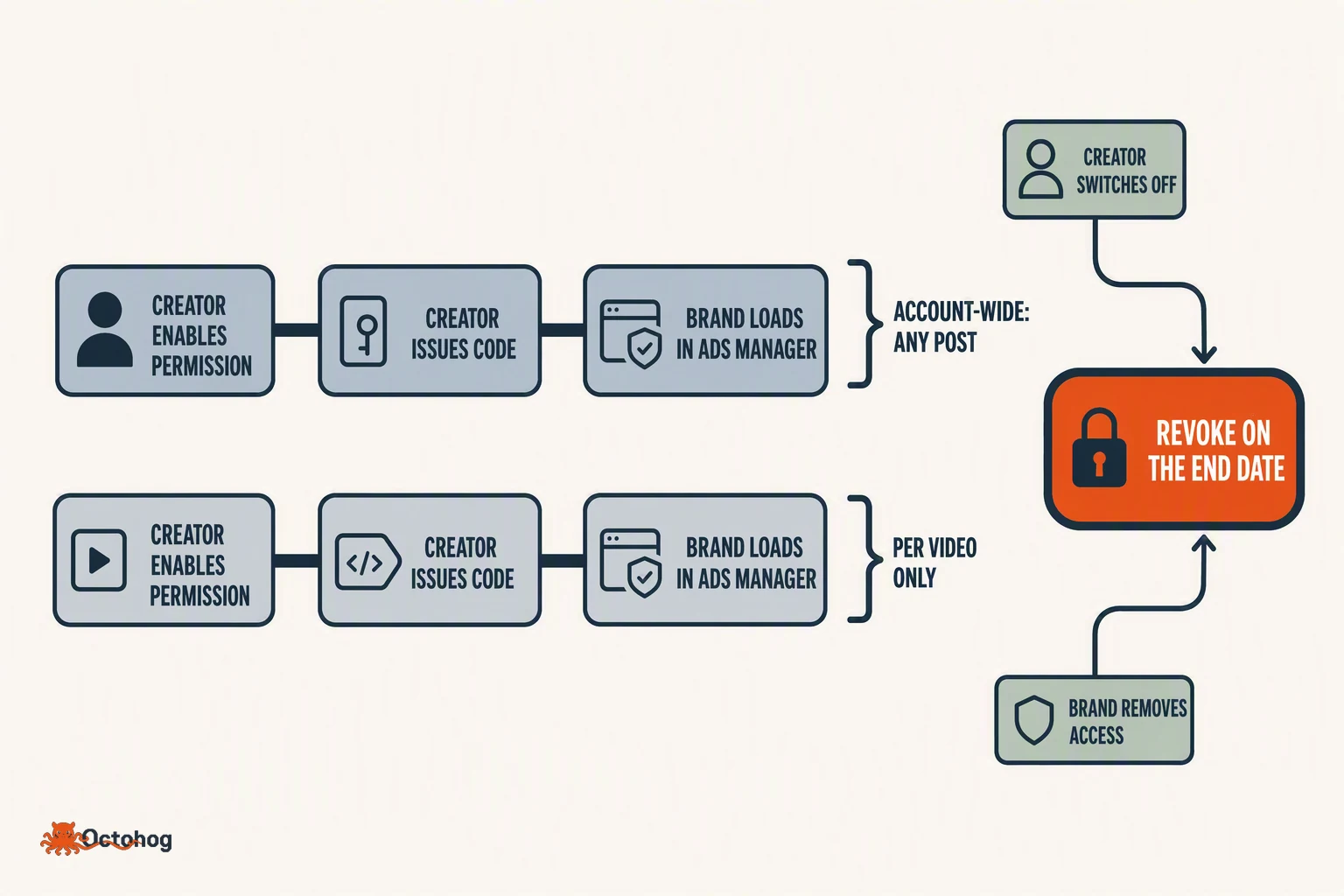
Set the permission up before you agree the fee, because the setup path decides what the deal is actually worth. On Instagram, whitelisting runs through Meta's partnership ads: the creator generates a code, the brand loads it into Ads Manager, and the ad goes live under the creator's own byline. On TikTok it runs through Spark Ads authorization, granted per video. Same outcome, different plumbing.
- Ask the creator to enable partnership ads permissions for your brand in their Instagram settings.
- Have them generate a partnership ad code, per post or account-wide, and set its expiry.
- Load that code into Meta Ads Manager at ad level, then confirm the preview shows their handle.
- On TikTok, ask the creator to switch on ad authorization under Creator Tools.
- Collect the Spark Ads video code plus its authorization window, then load it in TikTok Ads Manager.
- Verify the creative is live under their handle before you release payment.
The two paths are not worth the same money. An account-wide Meta code lets a brand run any post from that handle for as long as the code lives. A Spark Ads code covers one video and dies with it. A brand asking for account-wide access on Instagram is asking for a broader license than a per-video TikTok deal, and the rate should say so.
Write the account offboarding into the contract while everyone is still friendly. Name who revokes what, and when: the creator switches off ad authorization in the app, the brand removes partner access in Business Manager. Nobody does this by default. That is how brands end up with live advertising permissions on handles they stopped paying long ago, and how creators end up seeing their face in an ad they thought expired.
Ask for a screenshot of the code and its expiry before the first invoice. If the creator cannot produce one, the setup has not happened yet and neither has the deal.
Run this negotiation script when the brand says 'this is usually free'
Set your opening number before the call, then read the script line by line. It works because it moves the conversation off "usually" and onto what the brand is actually buying: media permission on your handle, for a defined window.
Open with the rate, not the rationale. "Organic posting is one fee. Running that video as a partnership ad from my handle is a separate license — here's my rate for a 30-day window at your stated spend." You have priced a deliverable. The brand now has to counter a number instead of a principle.
When the reply is "this is usually free," answer the substitution, not the insult. Whitelisting swaps the brand's own ad account for a creator's identity, and that identity is the asset the ads are borrowing. Try: "Creator exposure is what I get from the organic post, and I already counted it in that fee. The ad license is separate because it runs on my name, on your budget, for as long as you want." Then stop typing. Silence does more than a paragraph of justification.
Concede on term, never on rate. "I can hold the rate if we cap it at 45 days and one product line, with renewal at the same price." A term-limited concession protects creator revenue on the second campaign, which is where usage rights negotiation is usually lost.
The same script from the brand's side
Brands should open the same way, because vague offers get vague creators. Name the spend range, the window, and the ad accounts in the first message: campaign agreements written that way close faster and get re-signed. When a creator's number is high, buy less rather than paying less — 30 days instead of 90, one placement instead of all of them. Trading term for price keeps creator fees honest and keeps the creator willing to renew.
Write both openings into your rate sheet today, one for each side of the table.
Octohog
The spreadsheet was never the campaign.
Briefs, shortlists, outreach and replies live in one workspace, with creator evidence attached to every decision you make.
Open the workspace7-day free trial
Six clauses that silently double the deal (and when to walk)
Read the term sheet for six clauses before you read the fee, because each one can double what the deal costs you in practice. A "perpetual, worldwide" grant is the most expensive line in most whitelisting contracts and the least negotiated.
- Perpetual or unlimited-term grants. Replace with a dated window. Ask for 30, 60, or 90 days with a named renewal price.
- Undefined spend caps. A license with no ad-spend ceiling lets the brand run six figures through a creator's handle at a one-video rate. Cap the spend or tier the fee to it.
- No offboarding date. Account offboarding needs to be a clause, not a favor: partnership access and Spark Ads codes revoke on the end date, in writing.
- Missing FTC disclosure language. The contract should name who applies the paid-partnership label and who carries liability if it is missing. FTC disclosure is the brand's exposure and the creator's account risk.
- Creative-veto imbalance. A content approval process that lets the brand recut the video while the creator has no sign-off on the final ad puts a stranger's edit on the creator's handle. Both parties get one review pass.
- Exclusivity smuggled into the license. Exclusivity agreements are a separate fee. If the deal blocks competitor work for six months, it is priced like six months of work, not like one video.
Two more contract mistakes worth naming: no dispute resolution clause, and no stated jurisdiction. Neither costs money until something breaks, then they cost all of it.
When to walk
Walk when the brand wants perpetual rights at a one-off rate and will not date-stamp the grant. That refusal is the whole answer. On the brand side, walk away from whitelisting entirely below roughly $2,000 a month in paid social spend — under that budget, the license fee eats the media, and buying 6-month organic rights on the same video gets more mileage. Whitelisting pays off when there is enough spend behind it to find the winning creative, not before.
Pull up your last two creator contracts and search them for "perpetual" and "worldwide." Fix whichever one comes back a hit.
Frequently asked questions
How much do influencers charge for whitelisting?
Influencers charge for whitelisting as a separate license on top of the content fee, priced by window and spend rather than by follower count. Common structures: a flat fee per 30-day window, a percentage of the ad spend running through the handle, or a bundled rate that covers organic plus a capped paid term. Ask for the window and the spend cap before quoting.
How to whitelist influencer content?
Whitelist influencer content through the ad platform's own permission flow, not by reposting. On Instagram, the creator generates a partnership ads code in their professional account settings and the brand loads it in Meta Ads Manager. On TikTok, the creator issues a Spark Ads authorization code per video. The brand then builds the ad against that code.
What are examples of whitelisting?
Whitelisting examples fall into three shapes. A DTC skincare brand runs a creator's testimonial video as a partnership ad from that creator's Instagram handle. An apparel brand boosts a TikTok review through Spark Ads with the creator's authorization. An agency runs the same creator asset from four different creator handles to test which identity converts.
Is being whitelisted a good thing?
Being whitelisted is good for a creator when the license is dated, capped, and paid separately from the organic fee. Paid spend behind a creator's handle can bring follower growth and inbound brand interest at no cost to the creator. The bad version is a perpetual, uncapped grant at a one-video price, where the brand keeps buying and the creator stops earning.
References
- Whitelisting Social Media — billo.app
- Influencer Marketing Pricing in 2026: What Brands Are Actually Paying Per Asset — socialnative.ai
- How Do Influencers Charge for Whitelisting and Usage Rights? — lumanu.com
- Instagram Whitelisting: The Brand's Guide to Creator Ad Permissions — archive.com