How Much to Charge for UGC as a Beginner (2026 Rates)

· Updated · 13 min read

Most UGC creators starting out should charge $150 to $350 per deliverable, and the number is set by what you hand over, not by how many followers you have. That $150-$350 band is where intermediate creators — the bulk of the market — sit as of the July 2026 rate data [3], and beginners who price under it are usually pricing a hobby, not a half-day of production work. Usage rights sit on top: creators commonly add 20-50% over the base rate for them [4]. Below: what a beginner rate covers, why 2024 ranges are stale, the hourly-floor arithmetic, the rights line item, a six-video budget model for brands, payment terms, platform-by-platform spreads, and the four mistakes that cost both sides money.
What a beginner UGC rate is (and what it is not)
A beginner UGC rate is a per-deliverable production fee: the price of shooting, editing, and handing over one piece of content the brand then owns. It is not a sponsorship. Someone making UGC charges for the asset, not for distribution to an audience, which is why a 400-follower creator and a 40,000-follower creator can quote the same number for the same video.
Two things sit outside that fee. The license, which decides where and how long the brand may run the asset, is its own line item. Revisions past the first one are the other. Bundle either into the base price and you have quoted a number nobody can compare to anything.
That is also the whole of the influencer-versus-UGC pricing split. An influencer prices reach: their fee buys a post on their handle, in front of their followers. Someone making UGC prices output: their fee buys a file. When a brand asks a beginner "what's your rate," the honest answer is a rate card with a per-video row and a usage-rights row, not a single figure.
Follower count belongs nowhere on that card. Your portfolio, your turnaround, and your hook quality are what a brand is buying.
Octohog
You know what to pay. Octohog finds who to pay.
Rank creators against your brief, check the brand work behind every name, and send the invites from your own inbox. Brief to booked in one flow.
Start a campaignGmail-native outreach
Beginner rates rose in 2026, and the number you were quoted in 2024 is stale
Beginner rate ranges published in 2024 no longer describe what brands pay in 2026, and quoting one against a current brief costs a creator real money. The ranges written before the 2025-2026 demand wave were set when brands bought UGC as a cheap test line. They now buy it as the default creative for paid social, and the pricing moved with the use case.
Three forces did the moving. Brands shifted UGC out of the organic budget and into the ads budget, which raised what a single asset is worth to them. Creator supply grew, which should have pushed rates down and mostly did not, because brands started filtering hard on editing quality. And AI-generated UGC arrived as a floor-setter: it took the bottom of the market, the raw-and-cheap tier, and left human creators competing on the thing a model still does badly.
That last one matters more than it reads. AI video ate the demand for a plain talking-head clip with a script the brand wrote. What survived, and what pays better than it did two years ago, is the creator who brings the hook angle, shoots in a real kitchen, and delivers three variants the brand did not think of.
Here is the test for whether a published range is usable. Check its date. If the number was written before 2025, it predates both the paid-social shift and the AI floor, and it is describing a different market. A range from the first half of 2026 is negotiable. Anything older is history.
Creators quoting from a 2024 blog post are anchoring themselves to the cheap-test era. Brands citing a 2024 range in a negotiation are doing the same thing on purpose. Ask which year the number comes from before you agree to it.
Set your floor from the deliverable, not from your follower count
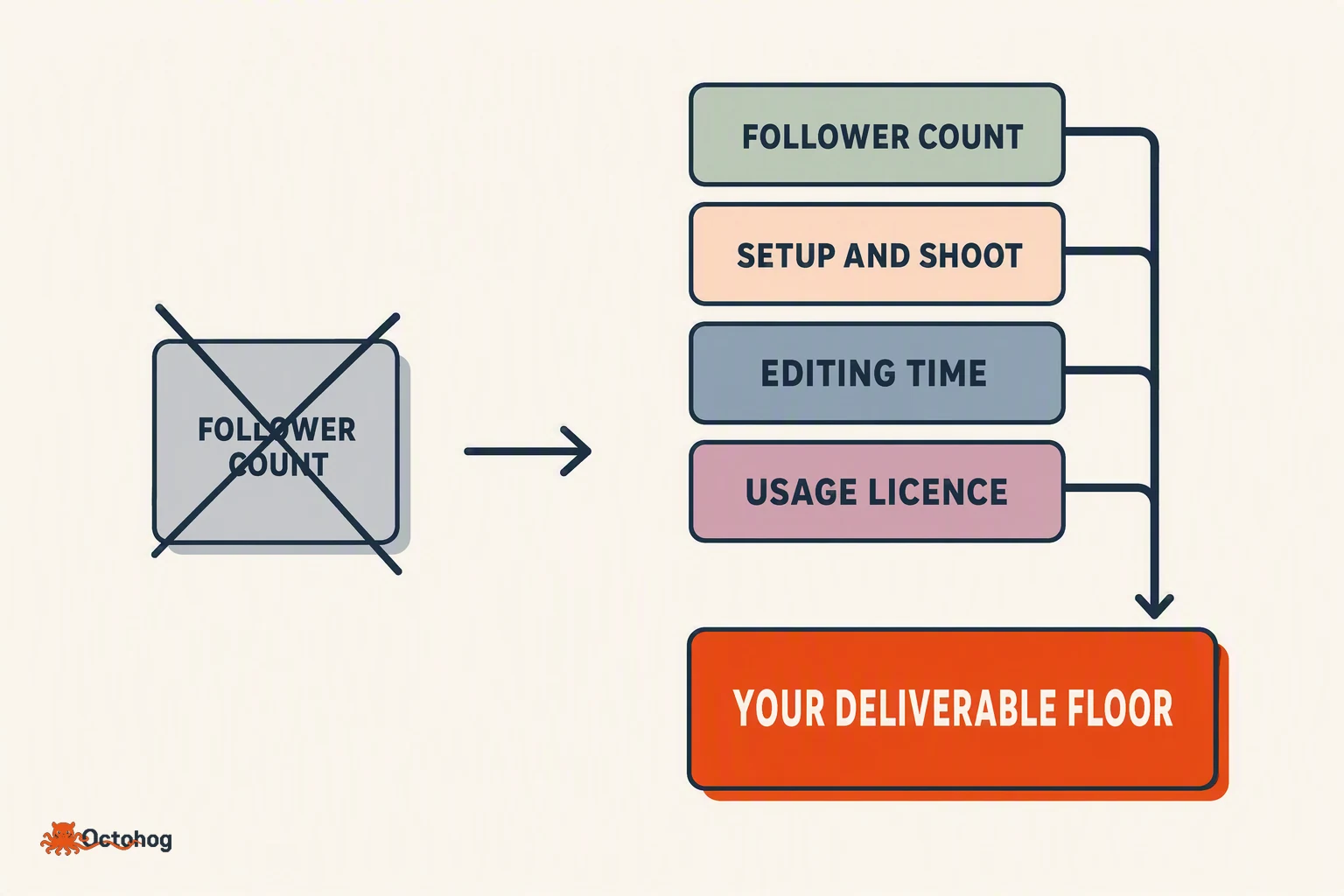
Your floor is a function of what you hand over and how long it takes you to make it. Start from an hourly number you would accept, then work forward: a single 30-second video with a written script, one location, and one revision is a half-day of work once you count setup, shooting, re-shoots, editing, and export. Multiply the hourly rate you would accept by the hours that half-day actually takes, and you have a floor for that deliverable. That is arithmetic a brand can argue with only by arguing you work faster than you do.
Price each deliverable as its own row, not as a discount off a package:
| Deliverable | What it includes | Relative to your base video rate |
|---|---|---|
| Short-form clip, up to 30 seconds | Script, one location, one revision | Base (1x) |
| Clip, 60 seconds | More shot coverage, longer edit | 1.5x base |
| Photo set, 5 images | Same setup, no edit timeline | 0.5x base |
| Hook variations | Alternate first 3 seconds, same body | 0.25x base each |
| Raw footage | Unedited files, no license change | 0.5x base |
| Script writing | Concept and copy the brand did not supply | 0.25x base |
Hook variations are the row beginners give away, and it is the most profitable one on the card. You are already on set, already lit, already in the outfit. Three extra hooks cost you 20 minutes and give the brand three ad tests instead of one. Charge for all three.
Raw footage is the row to hold firmest. Handing over unedited files means the brand's in-house editor can cut ten assets from your shoot, and your edit was half the value you delivered. Price it at half your base and only alongside a finished cut, never instead of one.
Content complexity moves the base, not the multipliers. Cooking, kids, pets, anything with a second person on camera, or a product that needs demonstration takes longer to shoot and should carry a higher base rate for every row beneath it. Set the base first. The table does the rest.
Charge usage rights as a second line item, never as a bundled discount
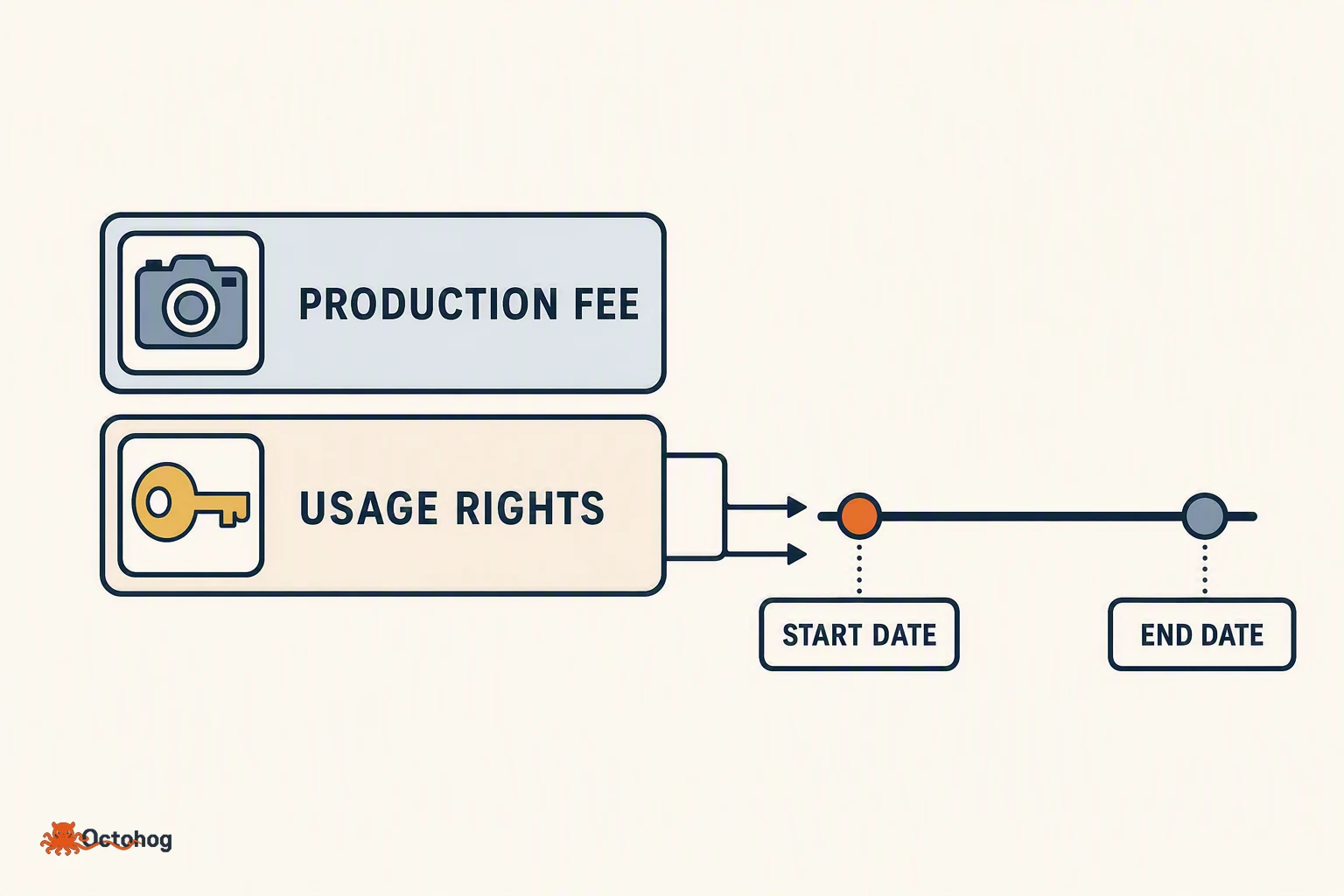
Charge for usage as a separate percentage on top of the production fee, quoted per license term, and never as a "bundled rate" that hides which half the brand is buying. Vague UGC pricing is almost entirely this: one number covering both the shoot and an undefined right to run it forever. Split them and both sides can negotiate the part they care about.
Price the license against your base production fee:
- Organic only, brand's own channels: no additional fee. The brand posts it; nobody boosts it.
- 3-month paid-ads license: add 25% to 50% of the base fee. The asset runs as an ad on one platform for a defined window.
- 12-month paid-ads license: add 75% to 100%. A year of paid usage is worth as much as the shoot.
- Whitelisting / Spark Ads: add 50% or more, because the ad runs from your handle and uses your identity, not just your footage. 51% of influencers charge a fee for whitelisting, boosting, or amplifying their content as paid ads [1].
- Category exclusivity, 6 months: add 30% to 50%. You are giving up every competitor in that category for the window.
- Raw footage license: add 50%. Unedited files let the brand cut new assets you will never be paid for.
Whitelisting is a paid-ads setup where a brand runs ads from the creator's own handle, so your account is the identity on the ad. That is why it prices above a plain paid-ads license. At larger scale, whitelisting sometimes gets quoted as a percentage of ad spend instead of a flat premium, on the order of 4%, which turns a $50,000 promotion budget into roughly $2,000 in creator fees [1]. Beginners should stay on the flat-percentage model. Percentage-of-spend deals require you to see the brand's ad account, and you will not get that access on a first contract.
Every license gets a start date and an end date in writing. "Perpetual, all media" is a phrase that costs you every future renewal, and brands who want it should pay a multiple, not a discount.
Related reading
Brands: build the first-campaign budget as deliverables × rights × volume
Three inputs decide a first UGC campaign budget, and none of them is follower count: deliverables, rights term, volume. Set the per-video anchor first. Intermediate creators, the bulk of the market, charge roughly $150 to $350 per video [3], so a six-video first campaign sits between $900 and $2,100 before rights (6 × $150, 6 × $350). Rights and volume move it from there.
Volume comes from your test plan, not your content calendar. Brands spending under $50,000 a month on Meta ads should be running three to five distinct creative concepts per test window [2]. Two hook variants per concept puts you at six to ten videos, which is also the order size where bundle pricing starts to matter. Most creators discount a six- or ten-video bundle against their one-off rate. Ask for the bundle discount in the same message as the brief, not after the quote lands.
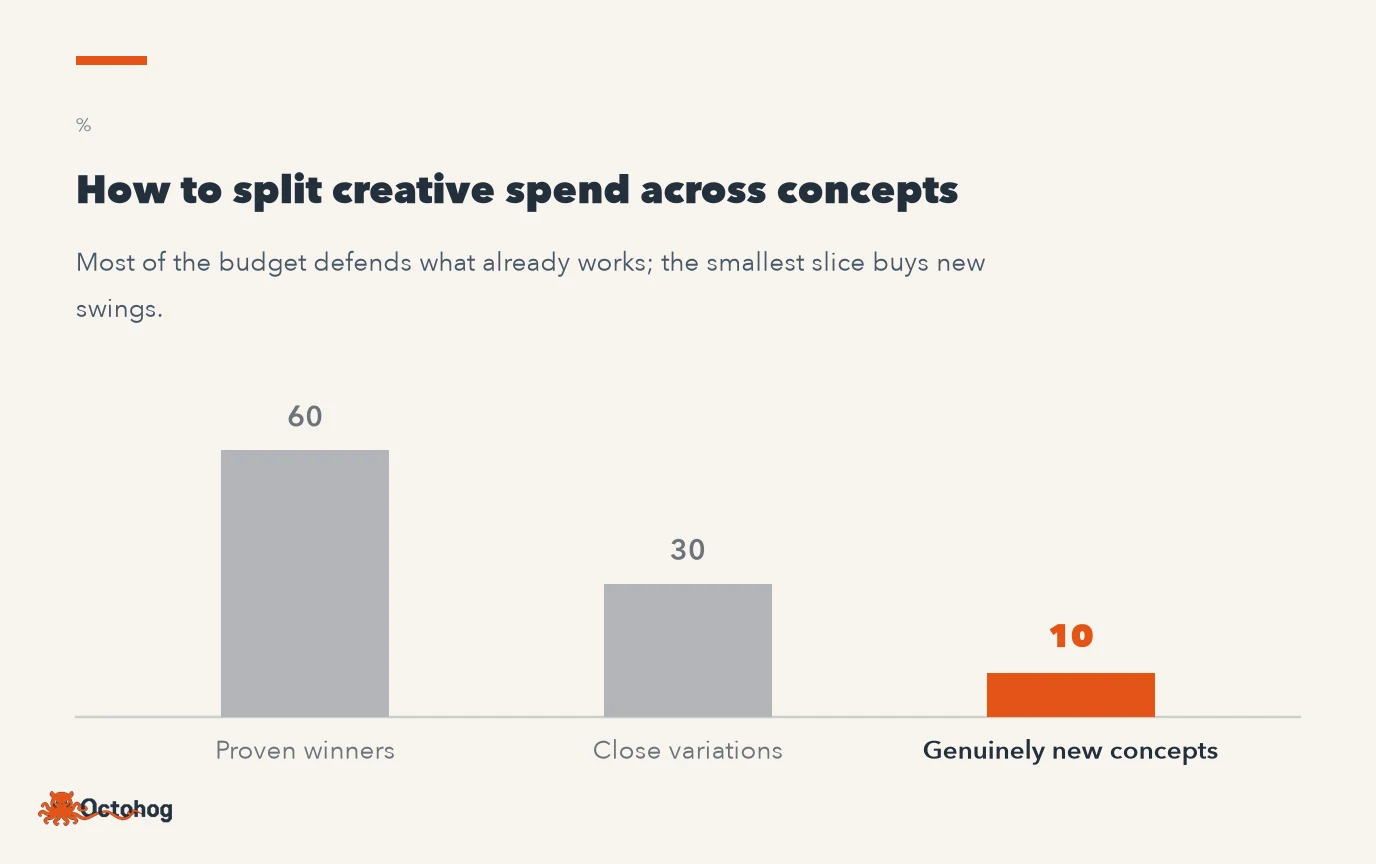
Allocate across those concepts the way you allocate ad spend: 60% behind proven winners, 30% behind close variations of those winners, and 10% on genuinely new swings [2]. That framework was written for Meta creative testing, and it transfers to commissioning without modification. Your 10% row is where an untested creator gets their first paid brief.
Two structures will be offered to you. A retainer pricing model, four to eight videos a month at a fixed fee, beats one-offs the moment you are ordering monthly: cost per creative drops, and briefing time drops further. Buying through an intermediary — a sourcing shop or a managed marketplace — adds a sourcing and QA markup on top of the creator's own rate, which is defensible on a first campaign and hard to justify by the third.
A quote well under the band is omitting something. Usually the license.
Agree payment terms, revisions, and turnaround before the first draft
Terms decide whether a fair rate survives the first invoice. Agree these six lines in writing before anyone opens a camera app.
- Payment split: half on signature, half on delivery, for any first project between parties who have not worked together.
- Payment window: name the calendar day the invoice is due. Fifteen or thirty days, stated, not "standard terms".
- Revision rounds: two included in the base rate, each further round quoted. One round means one consolidated set of notes.
- Turnaround: counted from the day the product arrives, never from the day the brief is signed.
- Rush fee: a flat percentage on top for anything under a week, written into the quote rather than raised later.
- Fees and tax: the invoice total is what the creator receives, so PayPal, Wise, and platform fees sit on the payer's side.
A kill fee belongs in the same paragraph. If the brand cancels after the shoot day, the production half is already spent and should already be paid.
One page covers all of it: deliverables, license term, payment split, revision count, turnaround, kill fee. Contract templates from creator platforms are fine as a starting point, but read the license clause, because that is the line they write in the platform's favor. Most payment disputes are not bad faith. They are two people who never agreed on what "delivered" meant.
Chasing a late invoice costs a beginner more hours than the deposit they were too polite to ask for.
TikTok, Instagram Reels, and Amazon: the same video is not worth the same money
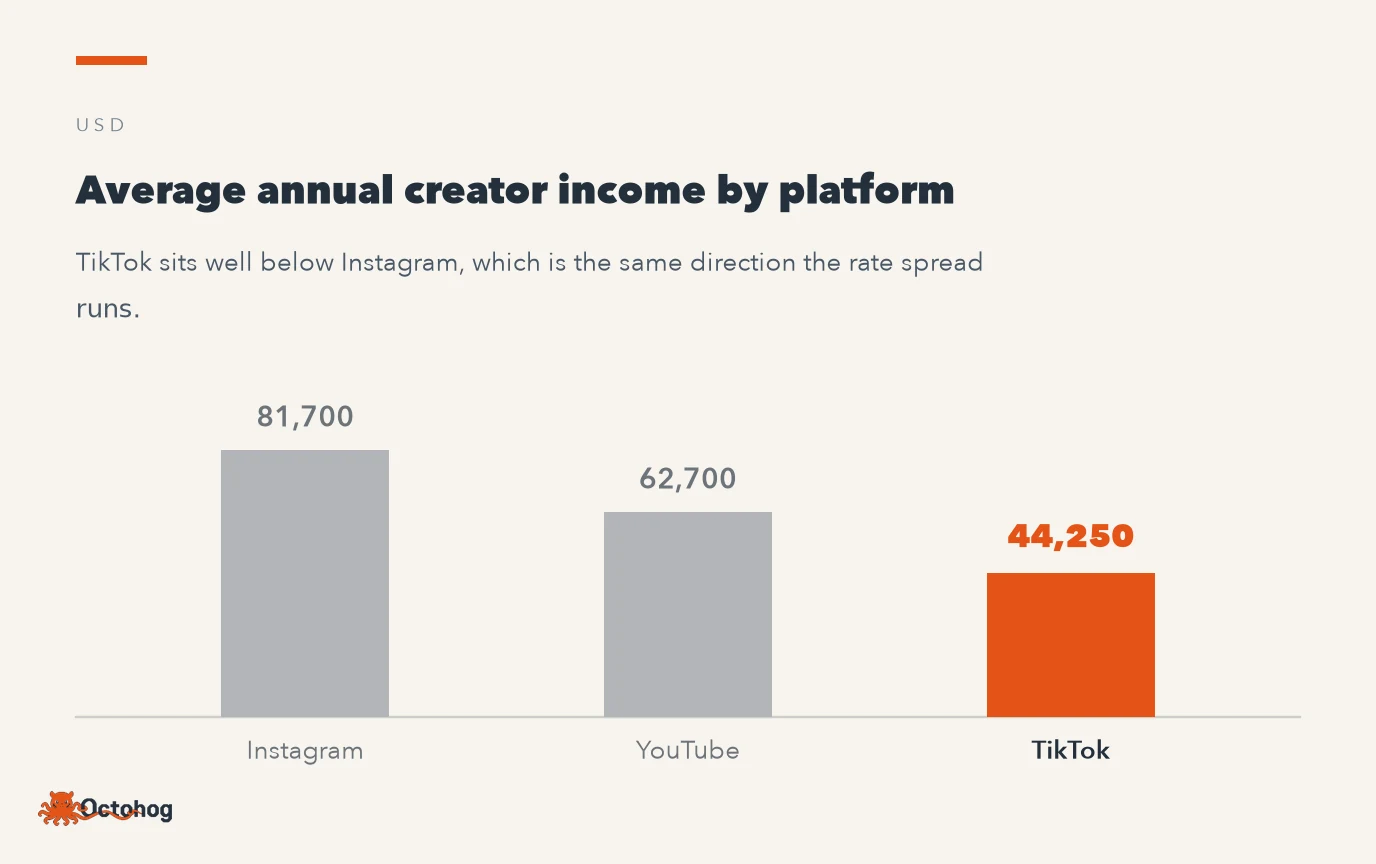
The same video is not worth the same money on every platform, and the gap is measurable. TikTok creator content runs 20-30% cheaper than Instagram for comparable audiences as of mid-2026 [4]. That spread is not a talent difference. It is what each platform's ad system does with the file after delivery, and how much recutting the creator has to do to hand over something the brand can actually run.
Below: what each platform's standard brief covers and what the paid-usage step is called there.
| Platform | What the base brief covers | Rate position | Paid-usage mechanism |
|---|---|---|---|
| TikTok | One vertical video, native audio, creator-led hook | 20-30% below Instagram [4] | Spark Ads, run from the creator's handle |
| Instagram Reels | One vertical video plus a still frame for feed | Market baseline | Partnership Ads, creator handle as identity |
| Amazon | One shoppable video plus one static post or Story | $100-$500 per post at 1,000-10,000 followers [5] | Creator Connections, on-platform only |
Source: the June 2026 creator-partnership cost analysis [4] and Amazon's Creator Connections program terms [5].
Price the recut, not just the shoot. A brand asking for vertical, square, and a captioned cutdown is asking for three edits off one shoot day, and each one should carry a line on the invoice.
Whitelisting is where the platform choice pays for itself. Whitelisted creator content run as paid partnership ads delivers 2-3x better ROAS than brand-owned creative on the same audience [4], which is the argument for paying the rights uplift rather than negotiating it away.
Geography moves the number too. A creator invoicing from the US quotes above a creator invoicing from Manila or Warsaw for an identical deliverable, and brands buying in volume know it.
Octohog
You know what to pay. Octohog finds who to pay.
Rank creators against your brief, check the brand work behind every name, and send the invites from your own inbox. Brief to booked in one flow.
Start a campaignGmail-native outreach
Where beginners underprice and brands overpay
Four mistakes account for most of the money lost on a first deal, and three of them are the same mistake seen from opposite ends of the invoice.
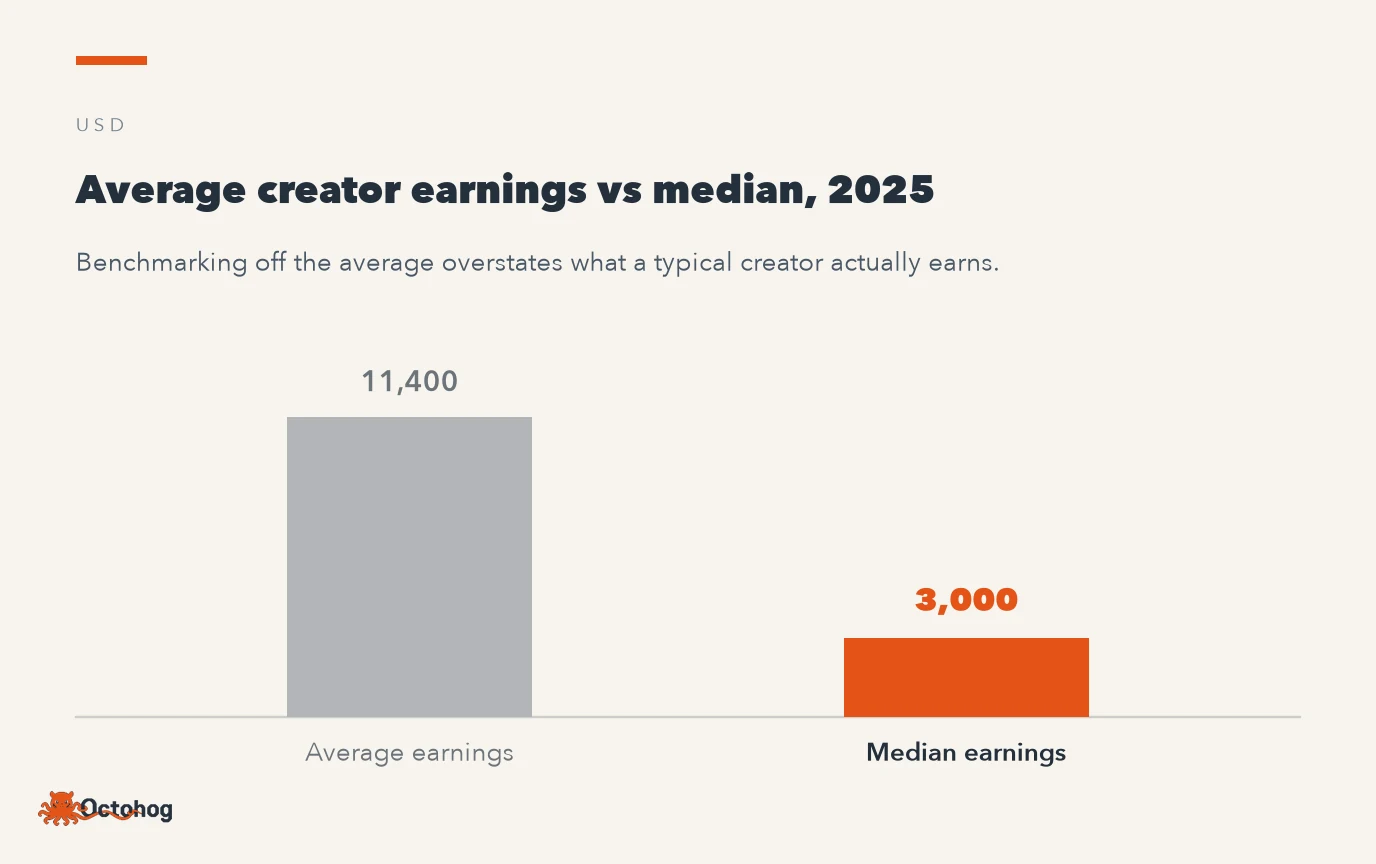
Benchmarking off the average. Average creator earnings rose to $11,400 in 2025 while median earnings fell to $3,000 [6], so a beginner who quotes against the average is pricing against a handful of full-timers pulling the mean up. Price against the median and the deliverable.
Folding rights into the base rate. Creators who itemize add 20-50% on top of their base for usage and whitelisting [4]. Quote the video and the license as two lines from the first invoice, and the brand negotiating you down on one cannot quietly take the other.
Staying on gifted terms. Trade product for the first video or two to build a portfolio, then move to paid on the third, no exceptions. A brand still paying in product after it has run your footage as an ad is buying rights for the price of a sample.
Never reviewing the rate. Review after every ten deliverables or every quarter, whichever lands first, and raise on the next brief rather than mid-project.
How to start UGC with no experience: shoot three spec videos for products already in your bathroom cabinet, treat your phone and a window as the entire equipment budget, and quote the first paid brief at the bottom of the beginner band with rights priced separately. Your break-even is a shoot day plus an edit, so anything that clears the cost of the product plus two hours of editing is profitable work.
Frequently asked questions
How much does a beginner UGC creator make?
A beginner making two to four paid deliverables a month at 2026 floor rates earns a few hundred dollars to somewhere over a thousand dollars monthly, working off the $150 to $350 per-video band [3]. Annualized, that is part-time money, not a salary. 73% of creators earn below $30,000 annually [6].
How much does a UGC creator charge?
A UGC creator charges two separate line items: a production fee per deliverable and a usage-rights fee stacked on top. Production for the bulk of the market runs $150 to $350 per video [3]. Rights add 20-50% to that base when the brand runs the footage as paid ads [4]. TikTok-only briefs price 20-30% under Instagram for comparable audiences [4].
How much should I charge for UGC usage?
Charge usage as a percentage uplift on your production fee, not a flat add-on: 20-50% over base is the going band for paid-ads rights [4]. Scale it by channel count, term length, and whether the brand whitelists your handle. 51% of influencers charge a fee for whitelisting, boosting, or amplification [1]. Large budgets sometimes price it as roughly 4% of ad spend instead [1].
How do you start UGC with no experience?
Start UGC with no experience by shooting three spec videos for products already in your apartment, then pitching those brands directly. Amazon's Creator Connections program pays $100-$500 per post at the 1,000-10,000 follower tier and takes creators with zero brand deals [5]. Price your first two paid jobs at the floor, not free. Raise to median after campaign three.
References
- How Do Influencers Charge for Whitelisting and Usage Rights? — lumanu.com
- Meta Ads Creative Testing Framework for DTC Brands — topgrowthmarketing.com
- How much do UGC creators make? — hubfluence.io
- The Cost of Creator Partnerships in 2026 (And Why More Brands Are Making Room in Their Budget) — topgrowthmarketing.com
- Amazon Influencer Program 2026: Requirements & Pay — hubfluence.io
- 27 Creator Economy Income Distribution Statistics Every Brand Should Know in 2026 — archive.com