Review
Insense review 2026: strong ops, sticky billing
Ask DTC ad buyers about whitelisting workflows and Insense comes up first, deservedly. Ask whoever pays the invoices about the $650 trial that upgrades itself into quarterly billing, and the tone changes. We read every fee page and both ends of the reviews. Verdict: 3.8 out of 5.
By Chloe Morgan, creator partnerships lead at Octohog. Updated July 9, 2026. Facts and prices checked on each vendor's live pages and public review sites.
TL;DR
- Insense is the strongest campaign-ops marketplace we reviewed: briefs, contracts, rights, payments, and Spark/Partnership Ads permissions in one flow. Our score: 3.8/5
- No monthly plan: a $650 one-month trial auto-upgrades into $500/mo quarterly billing, plus 7-20% fees on creator payments
- Older reviews still cite a $500 trial; we verified $650 on the live pricing page July 9, 2026
- Best alternative: Octohog, evidence-first sourcing with agent-run outreach on monthly billing, $249/mo with no fees on creator pay
Third-party averages: G2 ~4.5 (about 365 reviews); Trustpilot ~3.8 (about 184 reviews) with mixed creator-payment sentiment (checked July 9, 2026).
The most complete campaign-ops layer among UGC marketplaces, and the most commitment-heavy pricing. Whitelisted-ads teams get real value; everyone else pays for plumbing they may not use.
Good fit if you
- Run Meta Partnership Ads or TikTok Spark Ads at meaningful volume
- Want contracts, rights, chat, and payments handled in-platform
- Can commit to quarterly or annual billing
Look elsewhere if you
- Want month-to-month flexibility or a cheap trial
- Dislike percentage fees stacked on creator payments
- Need deep creator vetting beyond audience demographics
How we reviewed Insense
- Loaded and screenshotted insense.pro, its live pricing page, and the managed-service pricing page on July 9, 2026
- Read the FAQ and help docs, comparing the three different fee descriptions Insense publishes
- Sampled Trustpilot with one-star and five-star filters and screenshotted both sides, plus the G2 aggregate (4.5 across ~365 reviews)
- Verified the $650 trial and quarterly billing terms directly on the pricing page, where older reviews still cite $500
| Creator vetting depth | 3.3 | Moderation-team verification plus demographics and engagement; independent reviews call analytics surface-level. |
|---|---|---|
| Pricing transparency | 2.8 | Tiers are published, but fees are stated three different ways and the trial auto-upgrades. |
| Workflow automation | 4.4 | Briefs, contracts, rights, payments, and ad permissions genuinely automated. |
| Trust signals in reviews | 3.7 | G2 ~4.5 (365 reviews) vs Trustpilot ~3.8 with auto-renewal and payment complaints. |
What is Insense?
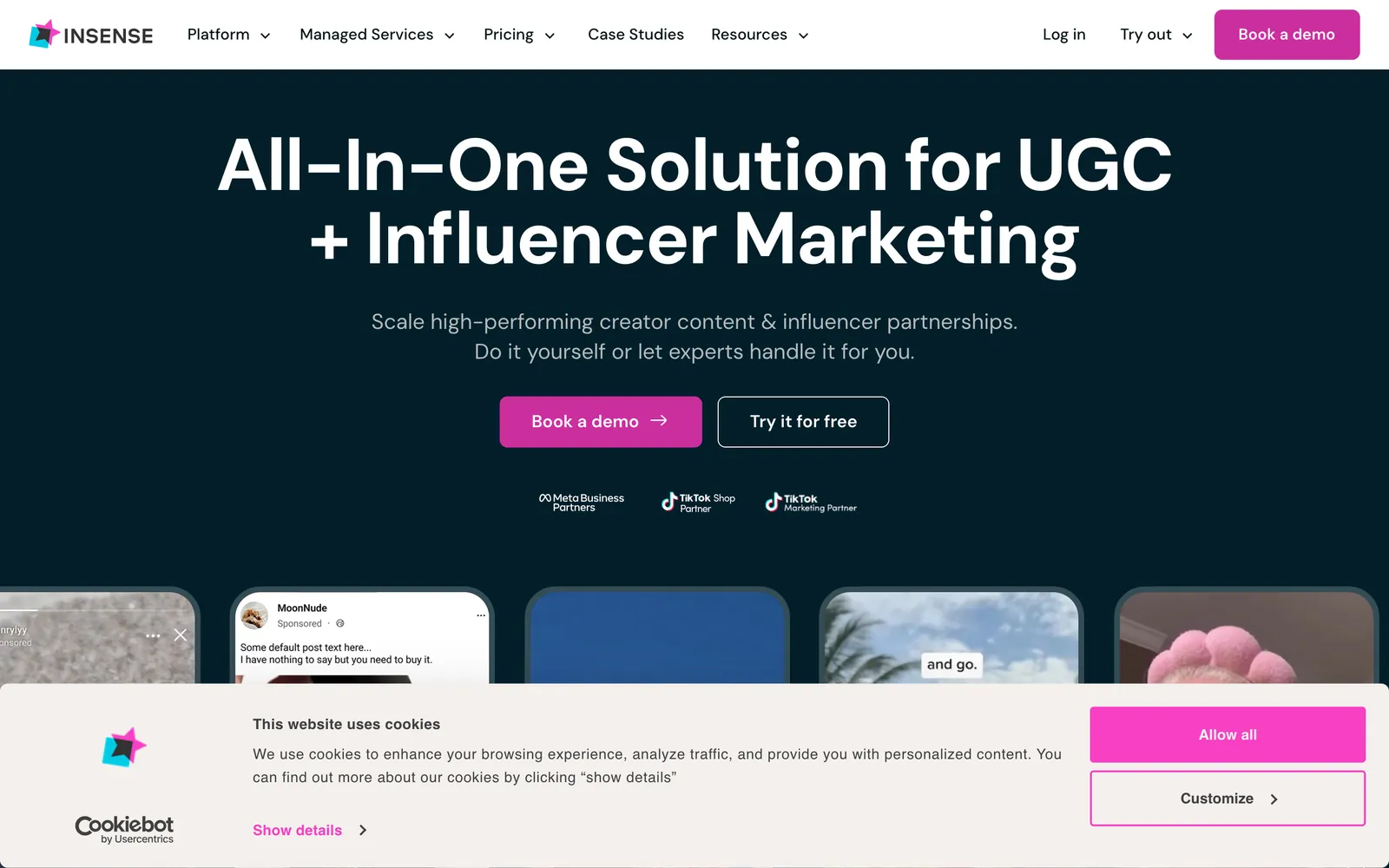
Insense is a UGC and influencer marketplace with campaign management built in. Brands publish a creative brief; the platform pushes it to matching creators from a claimed pool of 100K+ across 35+ countries; applications typically arrive within 48 hours; and everything downstream, chat, automated contracts, content rights, payments, runs in-platform. Product seeding works through a Shopify integration, and a managed-service tier (from $2,500/mo) hands the whole operation to Insense's team.
The differentiator is advertising plumbing: creator permissions for Meta Partnership Ads (formerly whitelisting) and TikTok Spark Ads are first-class workflows rather than email chains. For DTC teams whose UGC exists to feed paid social, that alone can justify the platform.
Insense pricing: read before you swipe
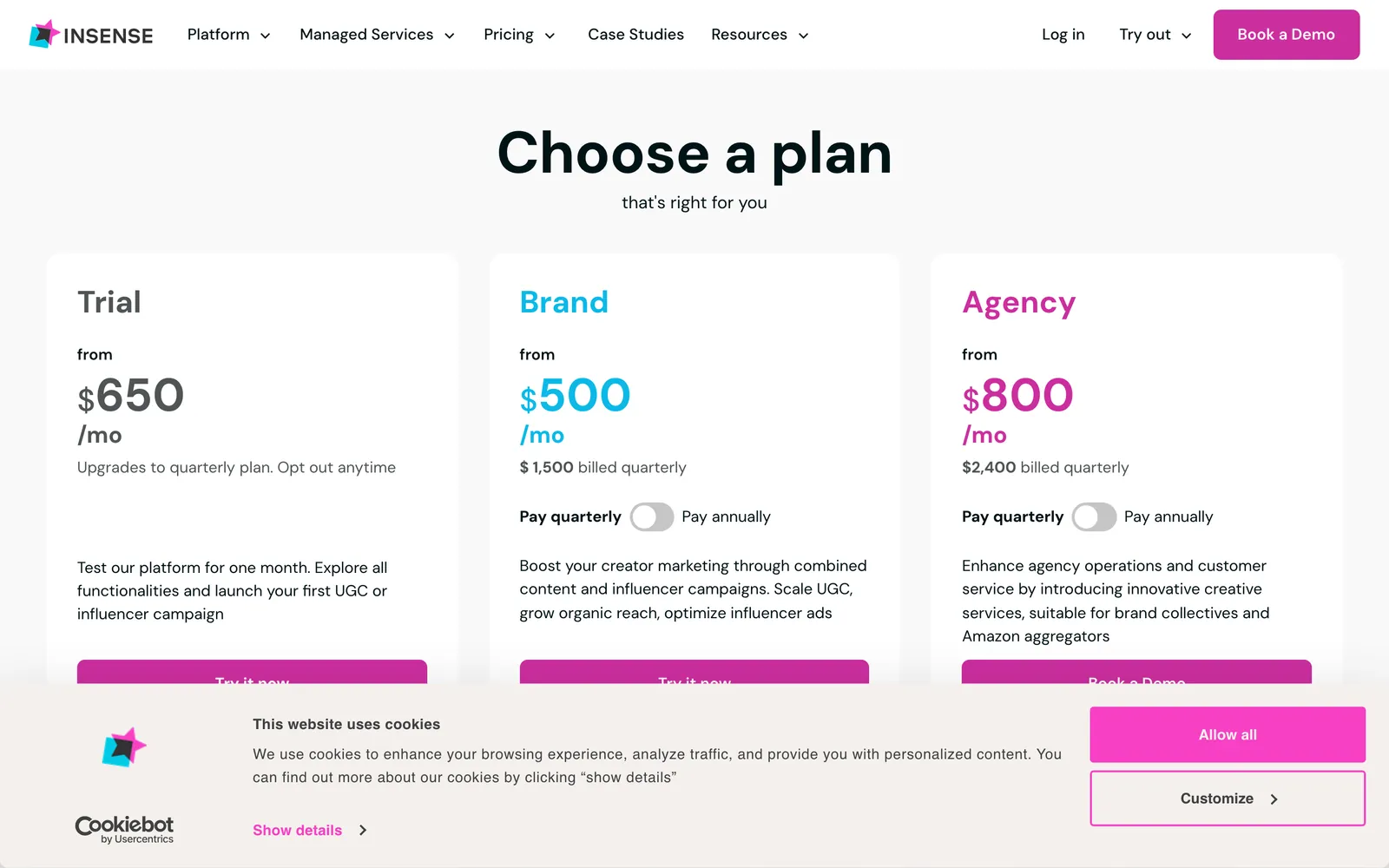
As of July 9, 2026: entry is a $650 one-month trial (up to 10 creators, 20% marketplace fee) that auto-upgrades to the Brand plan unless cancelled 48 hours ahead. Brand is $500/mo billed quarterly, $1,500 per quarter, or $400/mo billed annually, with a 10% marketplace fee. Agency is $800/mo quarterly with 5 brands and a 7% fee. There is no month-to-month plan. Note that widely read older reviews still describe a $500 trial; the live pricing page showed $650 when we verified it on July 9, 2026.
Creator payments sit on top, and the fee language varies by page: the pricing page describes 5-10% payment facilitation plus 5-10% service fees, while the FAQ cites 15-20% on produced content. Whichever applies to your plan, budget the subscription plus roughly a tenth to a fifth of every creator dollar. G2 carries multiple reports of renewals charged after missed cancellation windows with refunds refused, so calendar the dates.
| Plan | Price | Billing | Marketplace fee |
|---|---|---|---|
| Trial | $650 for one month | Auto-upgrades unless cancelled 48h ahead | 20% |
| Brand | $500/mo ($400/mo annual) | Quarterly ($1,500) or annual | 10% |
| Agency | $800/mo ($640/mo annual) | Quarterly ($2,400) or annual | 7% |
| Managed service | From $2,500/mo + creator costs | Custom | Custom |
Insense features, walked through
Briefs and the marketplace loop. You build a brief with product details, content specs, and targeting parameters; Insense pushes it to matching creators in its 100K+ vetted pool, and applications typically land within 48 hours, each with the creator's rate. A Browse Creators search lets you invite specific people instead of waiting. Every applicant profile carries moderation-team verification plus automatic audience demographics (geo, gender, age, interests), engagement rate, and cost-per-engagement, solid mid-depth vetting, if short of performance evidence.
Campaign operations. This is the platform's real product: in-app chat with deadline tracking, automated contracts and content-rights handling, and a prepaid balance from which creator payments release only after you approve content. First content typically arrives in about 14 days. For product seeding, a Shopify integration ships orders to selected creators and tracks them, and TikTok Shop workflows are supported for affiliate-style motion.
The advertising layer. Insense is a Meta Business Partner and TikTok Marketing Partner, and it shows: creator permissions for Meta Partnership Ads and TikTok Spark Ads are structured flows rather than DM favors, with up to 10 connected ad accounts on the Brand plan and unlimited on Agency. Live metrics cover both organic posts and the ads running through those permissions. If whitelisting is your growth engine, this is the most complete implementation among the tools we reviewed.
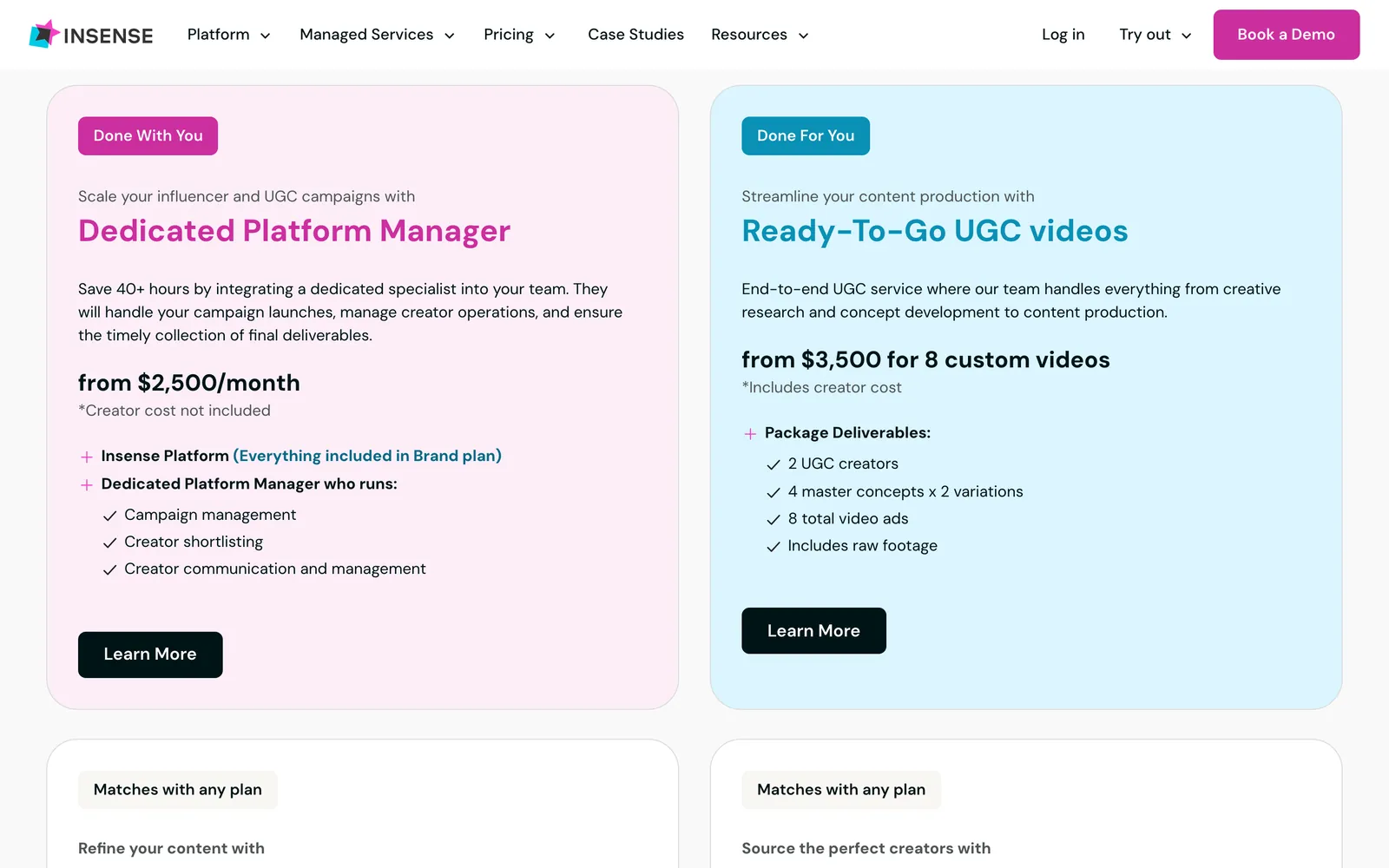
Beyond self-serve. A managed service (dedicated platform manager from $2,500/mo, creator costs separate) runs the whole operation, with productized bundles like eight ready-to-go UGC videos from $3,500 and post-production packages from $500 for 15 videos. There is also an AI-assisted outreach feature that extends beyond the marketplace, pitching your brief to a claimed 7M+ influencers through a Gmail integration, closer to cold email than marketplace matching, and worth testing before relying on.
Who Insense is actually for
DTC teams spending meaningfully on Meta and TikTok ads are the core fit: if every UGC video you buy ends up behind a Partnership Ads or Spark Ads permission, Insense compresses brief, production, rights, and permission into one pipeline that justifies its price. Agencies running several brands get real value from the multi-brand Agency tier and lower fees.
It is a poor fit for month-to-month experimenters: the $650 trial auto-upgrades into quarterly billing, and the fee stack on creator payments punishes high-volume, low-ticket buying. Brands whose bottleneck is finding the right creators rather than operating them will find the inbound applicant pool no sharper than any other marketplace; the ops excellence does not fix selection quality.
What Insense does well
The operations layer is real, not brochureware: briefs go out, applications come back fast, contracts and usage rights generate themselves, payments clear without procurement tickets, and ad permissions land inside your ads manager. The 3,500+ brand logos and a 4.5 G2 average across 365 reviews say the core loop satisfies most buyers. For teams scaling from founder-DMs to a repeatable UGC-for-ads pipeline, Insense compresses a lot of coordination overhead.
Where Insense falls short
Selection quality is the ceiling. Inbound applications select for creators actively hunting marketplace work, vetting tops out at demographics and engagement stats, and reviewers repeatedly flag inconsistent quality in niche categories. There is no evidence layer proving a creator's videos sell product; you learn that after paying, not before.
And the commercial mechanics generate their own complaint stream: the auto-upgrading trial, quarterly lock-in, no-refund posture, and creator-side Trustpilot reports of delayed or disputed payouts. None of it is hidden, but all of it favors Insense over the customer when something goes wrong.
Insense pros
- End-to-end campaign ops: briefs, chat, contracts, rights, payments in one place
- Native Spark Ads and Meta Partnership Ads permission workflows
- Fast inbound: applications typically within 48 hours
- Product seeding via Shopify integration; managed-service option exists
Insense cons
- No monthly billing: quarterly or annual only, after a $650 auto-upgrading trial
- 7-20% marketplace fees on creator payments, plus facilitation fees
- Reviews report rigid auto-renewal and strict no-refund handling
- Inconsistent creator quality in niche categories; surface-level analytics
What Insense reviewers say
G2 ~4.5 (about 365 reviews); Trustpilot ~3.8 (about 184 reviews) with mixed creator-payment sentiment (checked July 9, 2026).
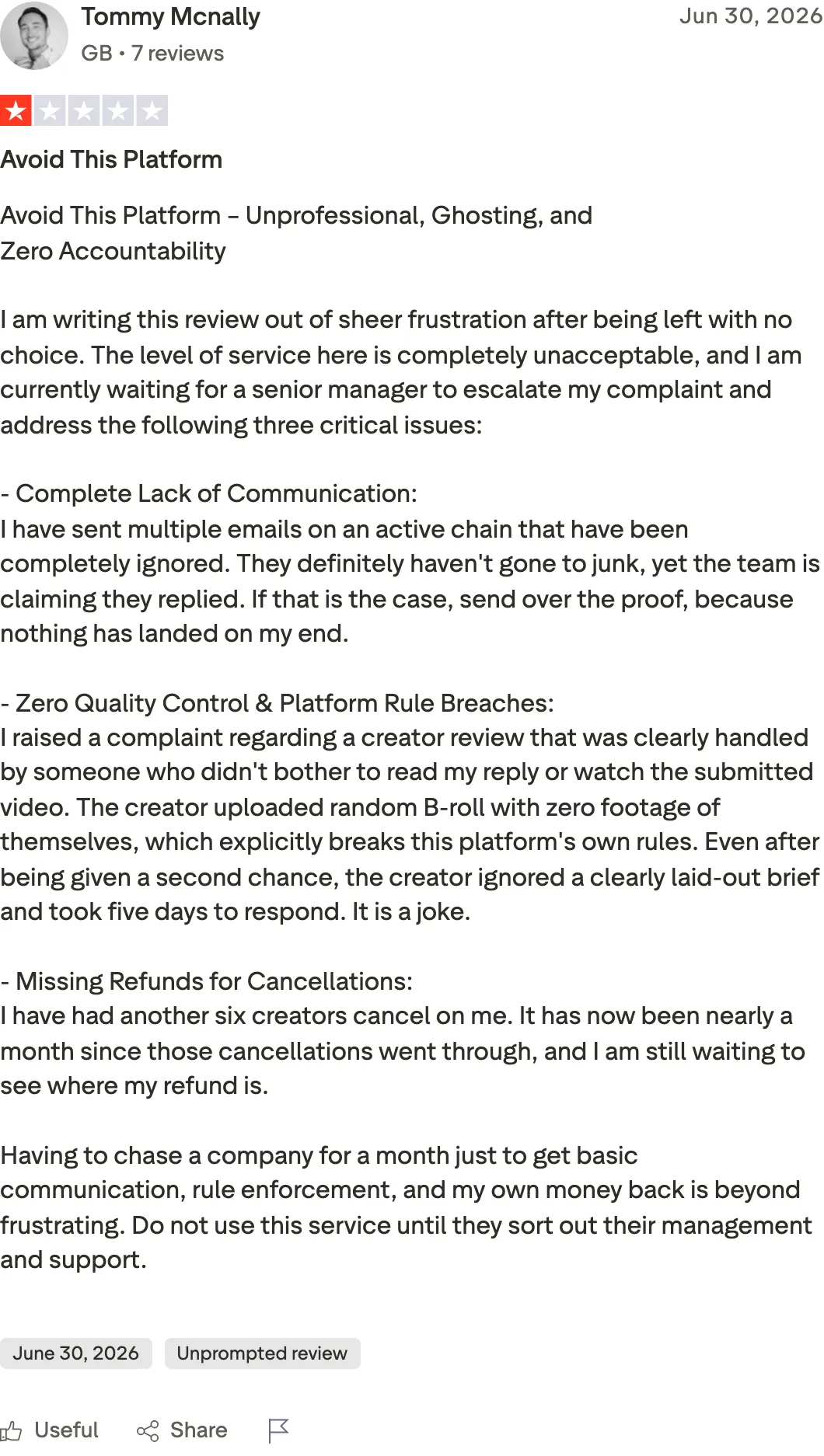
Tommy Mcnally, June 30, 2026, via Trustpilot
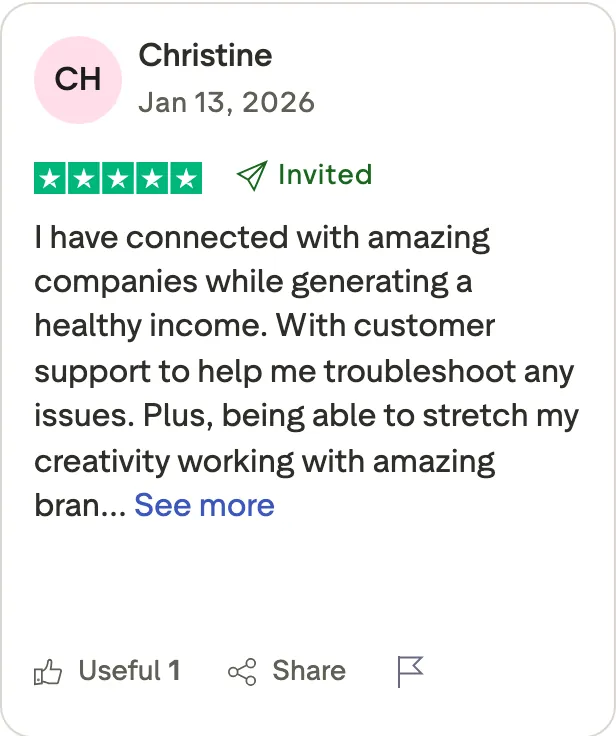
Christine, January 13, 2026, via Trustpilot
Insense alternatives
If Spark and Partnership Ads permissions are your core need, Insense stays on the shortlist despite the billing. If the sourcing quality is what bites, Octohog inverts the model: a 177,000+ UGC creator index, ranking by verified brand work, agent-run outreach, monthly billing at $249 with zero fees on creator payments. Billo covers cheap finished videos; Collabstr and SideShift cover transactional volume. We compared all five with screenshots and live pricing.
| Insense | Octohog | Billo | |
|---|---|---|---|
| Model | Marketplace + campaign ops | AI agent working from your brief | Video marketplace, creators apply |
| Starting cost | $650 trial, then $500/mo quarterly | $249/mo flat, 7-day trial | ~$99/video via prepaid packs |
| Billing flexibility | Quarterly or annual only | Monthly | Prepaid credits, 12-month expiry |
| Ad permissions | Spark + Partnership Ads built in | Not built in | Add-on, priced per creator |
| Third-party ratings | G2 ~4.5, Trustpilot ~3.8 | New product, no review wall yet | Trustpilot ~4 (creator-heavy) |
Read the full guide: the 5 best Insense alternatives in 2026
The better alternative: Octohog
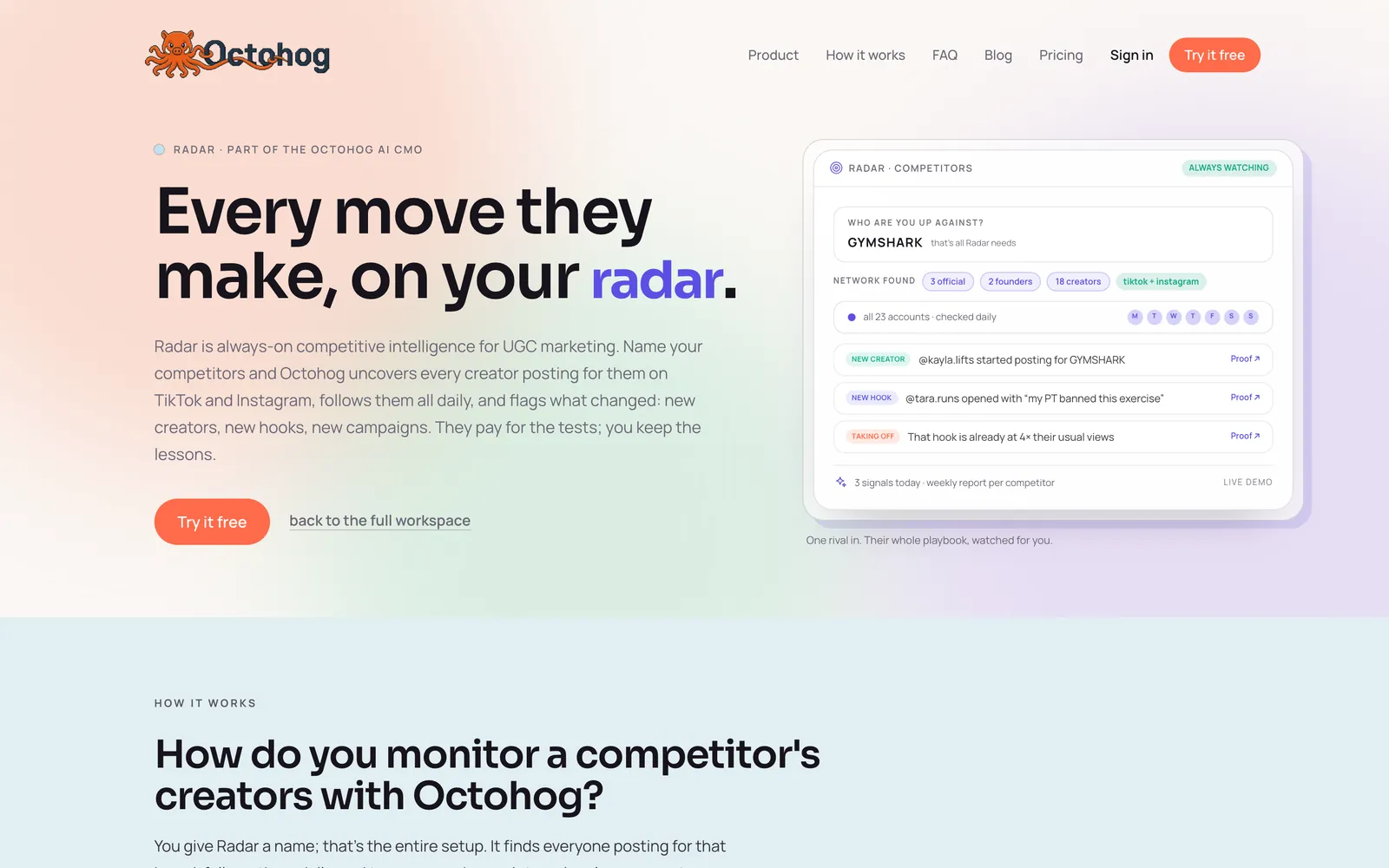
Insense operates campaigns well; what it cannot do is prove a creator sells before you book them, or let you leave without a quarterly commitment. Octohog attacks both. Having watched over a million UGC videos, its engine maintains an index of 177,000+ UGC creators, including the ones who never joined a marketplace, ranks them by verified brand work against your brief, and the agent runs invites, follow-ups, and booking. Billing is monthly from $249 with a 7-day trial, and no percentage sits between you and the creator.
You also gain the layer Insense does not have: market intelligence. Radar monitors your competitors' creator programs daily, so the whitelisting budget you manage in your ads account gets pointed at creators with evidence behind them, not just fast applicants. Many teams keep their ads manager and let Octohog fix the top of the funnel.
Sources
Checked July 9, 2026: insense.pro/pricing · Insense FAQ · G2 · Trustpilot.