UGC Examples Sorted by Deliverable and License

· Updated · 22 min read

Last updated: 2026-08-24
Twenty-three UGC examples below, sorted by what the creator physically hands over rather than by which brand campaign went viral. Each one carries the license it normally implies, the usage window that comes with it, and whether the file can legally be put behind paid spend. Price a brief off the deliverable, not the vibe.
Ordered by deliverable complexity, from a single testimonial file to a full whitelisted ad object, because complexity is what drives both the fee and the contract length. The entries are grouped by what gets filmed: video formats first, ad permissions second, software recordings third, then portfolios. If you already know the format and only need the paperwork, skip to the contract clause section and the five terms every example on this page reduces to.
Where the guidance below is not carried by a cited source, it comes from one place: how creator deals in this market are actually written and where they break. That is a weaker tier of evidence than a platform's published policy, and it is labeled as such throughout. Anything about platform behavior — what a moderation system does, what an ad permission object is — is either a documented platform mechanic or a cited source, and the two are kept apart on purpose.
| Group | Deliverable the creator hands over | License it carries by default | What changes when spend goes behind it |
|---|---|---|---|
| UGC video examples | Testimonial, unboxing, try-on, problem-solution files | Organic use, brand's own channels | Needs a paid-usage term added, priced separately |
| UGC ads examples | A platform ad permission object, not just a file | Time-boxed, platform-specific | The permission is the product; expiry kills the creative |
| Tech UGC examples | Screen recordings made inside your own account | Footage of your product, ownership unstated | Account access and NDA terms enter the brief |
| Examples of UGC portfolios | Sample reels, rate card, spec sheet, turnaround | Nothing licensed; it is a sales document | Nothing. It is the creator's proof, not your asset |
The default pick for most buyers is the problem-solution video with paid rights bought upfront. It survives the cut into paid media without a reshoot, which is the failure mode that costs the most money.
One line on where UGC stops being an asset: moderation. Platform-level checks have shifted toward crowd-sourced review, with X making Community Notes the bedrock of its moderation for organic posts and allowing notes on paid ads too [1]. Write your rejection standard before the first file lands.
The deliverable-to-license map: what each UGC example costs before rights
Sort the list by what the creator physically hands over, and the pricing stops being a negotiation about vibes. Every row below is a deliverable, not a campaign idea. The license column is what that format normally carries when nobody negotiates it, and the last column is what changes the moment the brand puts spend behind the file.
Base rate buys the shoot and the edit. License buys the right to keep using it.
| Deliverable | What the creator ships | License it normally carries | What paid usage adds |
|---|---|---|---|
| Static photo set | Edited stills, brand channels | Organic-only, fixed window | Paid social term, renewed per window |
| Testimonial video | One vertical cut, captions burned in | Organic-only, brand handles | Paid term plus ad-account use |
| Unboxing video | One cut, no raw files | Organic-only, brand handles | Paid term, raw files priced separately |
| Try-on video | One cut plus alternate hooks | Organic-only, brand handles | Paid term, likeness clause in the contract |
| Problem-solution video | One cut, script approved before shoot | Organic-only, brand handles | Paid term, exclusivity billed apart |
| Hook pack | Multiple openers, one body | Paid-ready on delivery | Term length, not permission |
| Whitelisted creative | The same video plus posting rights | Creator's own handle | Ad code or ad-account access, timed |
| Portfolio-only sample | Spec work, no brand approval | Creator's own use | Nothing; not licensed to a brand |
The "license it normally carries" column is a market default, not a legal rule. It describes what a creator assumes when a brief is silent — and silence is the norm, which is why the column exists. Nothing in it survives a contract that says otherwise. The two columns that are not a default are the whitelisting row and the hook pack row: those describe platform mechanics, and they hold regardless of what either party assumed.
Read the table by column, not by row. The deliverable sets the base. The license sets the multiplier. Two brands paying wildly different totals for a comparable video are usually buying the same shoot under different terms, and the term is the part that moves.
Whitelisting sits in its own row because it is not a video at all. UGC whitelisting is a permission granted on the creator's account, so the brand runs ads from that handle and the creator's name stays on the ad. A brand that already owns the file still cannot whitelist it. That right lives with the account, and it expires. This one is checkable rather than assertable: open the permission surface in Business Manager or TikTok's Creator Center and the grant is a dated object with a revoke button, separate from any file.
One rule survives every deal on this list: price the license term before you price the video. Write the window, the placements, and the renewal into the UGC contract at brief stage, not after the file lands in the shared Drive folder.
Octohog
Reading about UGC is the slow way to get UGC.
Write the brief once. Octohog finds the creators who fit it, shows their real brand work, and runs the outreach that books them.
Start with a brief7-day free trial
UGC video examples: testimonial, unboxing, try-on, and problem-solution
A UGC example is a piece of content a customer or hired creator shot themselves, on their own phone, in a format the platform reads as native rather than as an ad. The four below are the video formats brands actually commission. They differ by what gets filmed, what gets delivered, and whether the file survives being cut into paid media without calling the creator back for a reshoot.
Good examples of UGC content share one trait: the camera belongs to a person, not a production. Everything else is format choice.
- Testimonial video. The creator talks to camera about a result, names the product, and lands one claim. Delivery is one vertical cut with burned-in captions. This is the format that most often dies in paid media, because a testimonial claim recorded loosely turns into a compliance problem the second there is spend behind it. Approve the claim in writing before the shoot.
- Unboxing video. Hands, packaging, first reaction, first use. Delivery is one cut, usually with no raw files unless the brief asks. Unboxing videos age fast, since the packaging in the shot has to match what ships today. Reshoot on every packaging change.
- Try-on video. The creator wears or applies the product, then shows it in motion or at hour eight. Delivery is one cut plus alternate hooks, because try-on footage is the easiest to recut against a new opener. Try-on is also the format where likeness matters most, so the UGC contract needs a likeness clause with the same window as the media term.
- Problem-solution video. The creator states the annoyance, then shows the product ending it. Delivery is one cut against a script approved before the shoot. This is the strongest of the four for paid, because the structure carries the ad logic instead of relying on the creator's charisma.
Which of these four survives paid media
Problem-solution and try-on move into paid with the fewest reshoots. Testimonial moves too, but only when the claim was pre-approved and the creator did not improvise a superlative. Unboxing is the weakest candidate: it depends on packaging that changes, and the payoff arrives late in the cut, which is exactly where a paid viewer leaves.
That ranking is a judgment about reshoot risk, not a measured result, and the mechanism behind it is the part worth checking against your own account rather than taking on faith. Two of the three reasons are structural and verifiable without any data: an unboxing's payoff sits behind the packaging reveal, and packaging changes on a schedule your ops team can name. The third — that the late payoff is where paid viewers leave — is a retention claim, and yours is the only retention curve that settles it. Pull the drop-off graph on one unboxing cut and one problem-solution cut in your own ads manager before you reweight a budget on this paragraph.
Raw files are the quiet line item across all four. A single delivered cut cannot be reframed, resubtitled, or trimmed to a new length without going back to the creator. Ask for raw files at brief stage, price them there, and store them where your media buyer can reach them. A brand that owns only the export owns one ad. A brand that owns the raws owns a library.
Brief for the format, not for the aesthetic. The aesthetic is the creator's job.
UGC ads examples: Spark Ads, Partnership Ads, and whitelisted creative
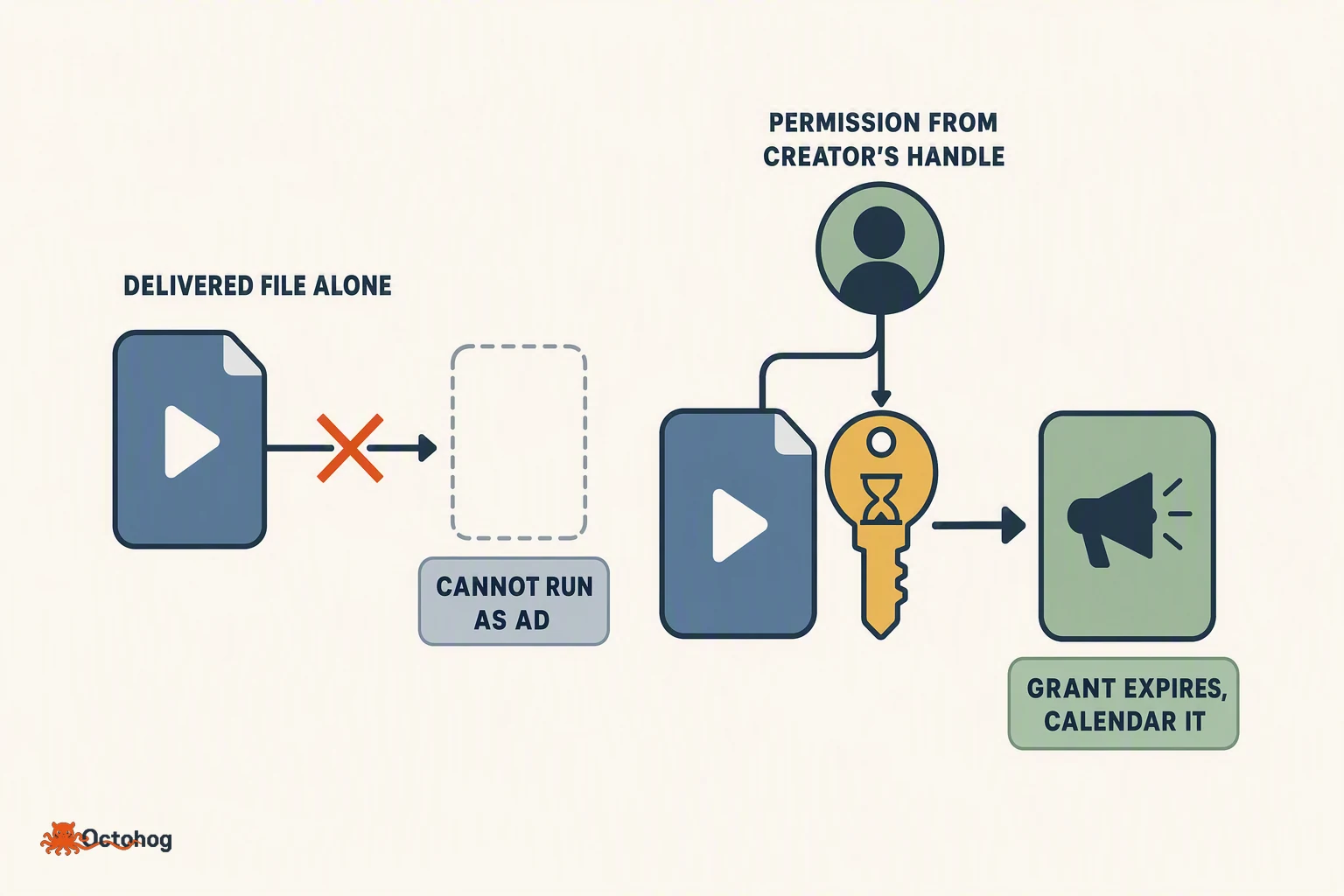
A UGC ad is a permission, not a look. The video can be identical to the organic one; what makes it an ad is a specific object the creator generates and hands over, and each platform names that object differently. Buy the wrong one and the creative sits in a folder, fully paid for and unrunnable.
Everything in this section is a documented platform mechanic rather than an opinion, which makes it the most verifiable material on this page and the fastest to go stale. Each of the three arrangements below exists as a named surface inside the platform's own ads tooling; check the current help documentation for the platform you are buying on before you write the clause, because these objects get renamed and their default durations get changed without notice.
Three arrangements cover almost everything a brand will hire:
- TikTok Spark Ads. The creator generates an authorization code against a specific post in TikTok's Creator Center and sends it to the brand. The brand runs the ad from the creator's own handle, keeping the original likes, comments, and follower link. The code has a duration set by the creator, so a UGC video approved for a short window goes dark mid-flight when nobody tracked the expiry. Ask for the longest window the creator will grant and calendar the renewal.
- Meta Partnership Ads. The creator produces a partnership ad code from their own account, or grants the brand standing permission through Business Manager. The ad runs with both handles attached. Standing permission is the version worth negotiating: per-post codes mean a new request every time your media buyer wants to test a new cut.
- Ad-account whitelisting. The creator grants the brand direct access to post from their handle, usually through a partner or Business Manager link rather than a per-post code. This is the widest permission and the one creators price highest, because they are handing over their identity, not a file. Treat it as a separate line item with its own start and end date.
What "UGC approved" actually means on an invoice
UGC approved is a status on a specific asset, not a blanket relationship. It means: this file, these placements, this window, this handle. Change any of the four and the approval no longer covers what you are running. Brands get caught here when a video licensed for organic-only gets boosted by a media buyer who never saw the contract.
Two checks before spend goes live. First, confirm the permission object exists and is in your hands, whether that is a code, a partnership grant, or account access. Second, confirm its expiry date matches or outlasts your flight dates.
Pull your current creator roster and list which permission object you hold for each one. The names with a blank in that column are the ads you cannot legally scale next month.
Tech UGC examples: SaaS screen recordings, hardware unboxings, and app walkthroughs
Software has no unboxing moment. The camera points at a screen instead of a box, and what the creator hands over is a recording of your own product, made from inside an account you gave them. That single fact rewrites the brief. A physical-product brief never has to say who owns the footage of the software.
Four deliverable types cover nearly everything sold as tech UGC:
- Sandbox screen recording: a creator completes one task end to end in a seeded demo account, narrating in Loom-style voiceover with the cursor visible and no jump cuts.
- App walkthrough, device-native: vertical phone capture using iOS Screen Recording or the Android recorder, thumb in frame, shot for Reels and TikTok rather than for a docs page.
- Hardware unboxing: the one tech format that still behaves like beauty UGC, because there is a physical object and a first-reaction shot.
- Problem-then-product tutorial: the creator shows the manual workaround first, then the feature that replaces it, and never names a price.
- Setup or migration diary: onboarding filmed as it actually went, including the step where they got stuck.
The last one converts better than the polished demo and almost nobody commissions it. Founders hate watching a stranger fumble their onboarding. That fumble is the proof the reel version cannot fake. Treat "converts better" as a hypothesis to test rather than a finding to adopt: it is a pattern the market repeats, not a number anyone here measured, and it is cheap to check — run one migration diary against one polished demo in the same ad set, same budget, same week, and let your own cost per acquisition rule on it.
Three clauses change the moment the product is software. First, screen recording rights: your UGC contract has to grant the creator permission to capture the interface and grant you back the right to distribute that capture, because the UI on screen is your IP, not theirs. Second, the sandbox account: give the creator a seeded environment with fake data, named in the brief, so nothing on screen belongs to a real customer. Third, an NDA scoped to unreleased features only, never to the whole engagement.
A blanket NDA is the standard mistake here. It reads as prudent and it quietly bans the creator from posting the video to their own portfolio, which is the exact behavior you were paying for. Scope the confidentiality to the beta build and the roadmap slide. Leave the shipped product free to talk about.
One more line belongs in every tech brief: whether the creator may show billing screens, seat counts, or admin panels. Most product demonstrations wander into settings by accident. If your Stripe checkout or a real invoice lands in frame, the file is legally unusable and you will pay for a reshoot to remove eleven seconds. The unusable part is not a matter of taste — real customer data or live payment details in frame is a privacy exposure your own counsel will stop, which is why this belongs in the brief rather than in the review queue.
Brief tutorial UGC on the task, not the feature list. "Import a CSV and build your first view" produces a usable video. "Show what our platform can do" produces a tour, and tours do not convert.
Related reading
Examples of UGC portfolios that get creators booked
A UGC portfolio is a pricing document that happens to contain video. Buyers scan it to answer one question: can this person deliver a usable file, on spec, without three rounds of explanation. Four elements answer that. Everything else is decoration.
- Format range, labeled: one hook variant set, one talking-head review, one voiceover-over-b-roll, each captioned with what it is rather than which brand it was for.
- A named rate: a rate card on the page, with organic-only and paid-usage priced separately, because a buyer who has to email for pricing usually emails someone else.
- Delivery spec: aspect ratios, file format, raw footage yes or no, revision count, turnaround in business days.
- One licensed piece: a single example that ran as a real ad, with the brand's permission to show it, proving the creator has cleared usage before.
- Contact and rights terms in the same view: what the base rate licenses, stated in one line, so the buyer prices the brief without a call.
This list is written from the buyer's side of the table — what a brand scanning a portfolio is actually trying to rule out. It is not survey data, and a creator whose work comes through referral rather than cold inbound can reasonably ignore half of it, because a referred buyer has already had the questions above answered by someone they trust.
The named rate is the one creators skip and the one that books work. Pricing display is a filter, not a ceiling. A buyer with budget reads a rate card and briefs; a buyer without one reads it and leaves, which is the outcome you wanted.
How to start UGC as a beginner?
Start a UGC portfolio without experience by shooting spec work for products you already own. Pick three brands you use, film one hook and one thirty-second review each, and label them clearly as unpaid spec pieces. Post them to a public Notion page or a Google Drive folder with your rate card. Nobody in this market requires a client list. They require proof you can hold a frame and hit a spec.
Two portfolio signals predict a usable deliverable better than production quality. The first is captions written by the creator rather than auto-generated, because it shows they watched their own edit. The second is a stated revision policy. A creator who has written down what counts as a revision has been burned by scope creep and has fixed it. Both are inferences about a creator's process from an artifact, which is exactly as reliable as that sounds — they are cheap screens for a first call, not a substitute for one, and neither survives contact with a creator who simply had a good week.
Skip the Canva reel of logos. A wall of brands the creator touched once tells a buyer nothing about the file that will land in their Drive on Thursday. Show the file.
The UGC contract clause each example above implies
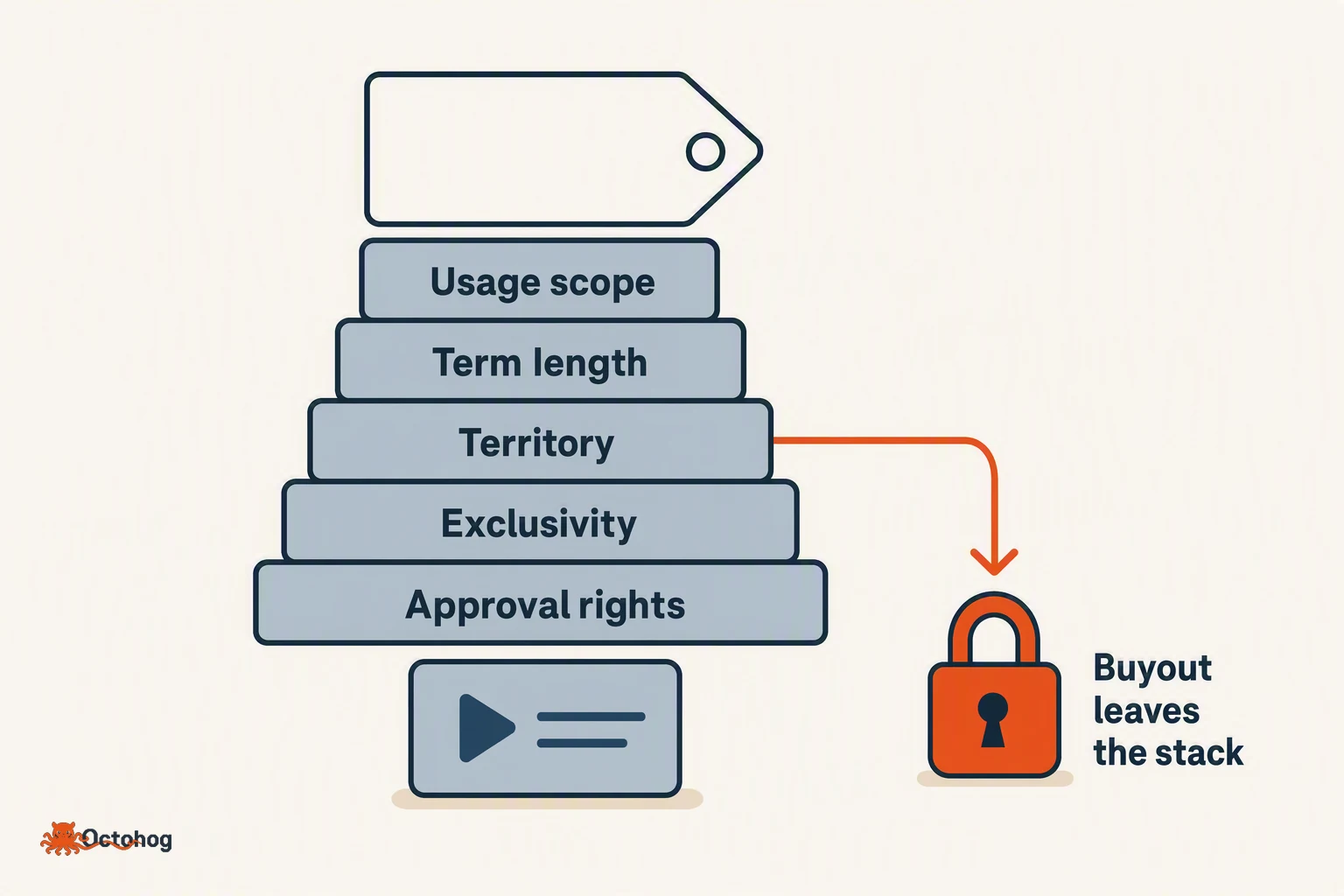
Every example on this page reduces to five clauses, and the price of the example is set by how they are filled in. Usage scope, term, territory, exclusivity, approval rights. A brief that names all five gets one quote. A brief that names none gets a low quote and an invoice later.
- Usage scope: the channels the video may run on. Organic on the brand's own account is the floor; paid social, whitelisting from the creator's handle, email, retail screens, and connected TV each price separately.
- Term: how long the license runs. Three months, twelve months, or perpetual. Perpetual is not a formality; it is the single largest multiplier in most quotes.
- Territory: where the ad may serve. Domestic-only and worldwide are different products, and worldwide costs more even when the brand only ships to one country.
- Exclusivity: whether the creator may work with competitors, and for how long after delivery. Category exclusivity for a quarter is normal. Blanket exclusivity forever is a buyout wearing a license's clothes.
- Approval rights: who signs off, on what, and within how many business days. Without a deadline, "pending approval" becomes a permanent state and the creator carries the cost.
These five are the standard shape of a creator licensing agreement, not a statutory list, and none of this is legal advice — jurisdictions differ on likeness and on what a waiver can actually waive, and a lawyer in yours is the one to ask. What is safe to take from this section is the checklist function: a brief missing any of the five is underspecified, whatever the governing law turns out to be.
The vague clause that causes most overruns is scope written as a platform name. "For Meta" reads specific and is not: it covers organic posts on the brand page, paid ads from the brand account, and whitelisted ads from the creator's handle, which are three prices. Name the ad account that will run the file. That one line settles it.
UGC licensing and a buyout are different transactions and get confused constantly. A license rents the footage for a scope and a term. A buyout transfers ownership, usually with a waiver on the creator's likeness. If a brand wants footage it can re-cut into a new campaign in two years without a second conversation, it is buying, not licensing, and should say so in the brief.
Whitelisting deserves its own line rather than a mention inside scope. UGC whitelisting means the ad serves from the creator's handle with their name and follower count attached, so the creator is renting identity, not just footage. That is why it prices above standard paid usage. It also needs a revocation clause: what happens to live ads if the creator asks to be removed.
One practical habit closes the gap between a UGC approved deliverable and a paid one. Put the license summary in the file name and the delivery email, not only in the contract. Brand-perpetual-worldwide-paid tells the media buyer in eighteen months what they are allowed to do with a file whose contract nobody can find.
Before the next brief, pull your last three creator agreements and check whether each one names a territory. If any of them says only "social media", that is the clause that overran your budget.
Budget and timeline: what a 12-video UGC campaign runs end to end
Budget a twelve-video run as five lines, not one sticker price: creator fees, product and shipping, licensing, revision rounds, and the internal hours somebody spends briefing and reviewing. Content production costs are the line most teams get right on the first pass. Licensing is the line they discover later. A creator who delivers in a week and a creator who delivers in a month can quote identical creator pricing and behave nothing alike, so put turnaround in the brief next to the fee.
The table below maps the same campaign twice: as a spend line and as a calendar phase, so you can see which weeks are actually paid weeks. There are no rates in it on purpose. Creator fees move by category, market, and follower tier fast enough that any number printed here would be wrong by the time you read it, and a made-up benchmark is worse than none — the columns tell you what to ask a quote to itemize, and the quote supplies the figures.
| Phase | What you pay for | What must be locked before it starts | Where it slips |
|---|---|---|---|
| Sourcing | Platform fee or agency retainer; minimum spend if the marketplace sets one | Deliverable count, hook count per video | Vetting against last quarter's buyers, not follower count |
| Product seeding | Units plus tracked shipping | Address collection, customs terms for cross-border creators | Sample arrives after the shoot date |
| Shoot | The creator fee itself | Shot list, aspect ratios, "Meta Ads Manager" versus organic cut | Vertical-only delivery, then a landscape placement appears |
| Revisions | Included rounds, then per-round overage | Number of rounds and what counts as one | Feedback arriving in three separate Slack messages |
| Licensing | Usage scope, term, territory, exclusivity | The five clauses, priced before the video exists | Renewal quoted at the original rate |
The "where it slips" column is the load-bearing one, and it is the one with the weakest evidence behind it: each entry is a recurring failure pattern in creator campaigns, not an incidence rate. Read it as a pre-mortem checklist — five things to have an answer for before the phase starts — rather than as a ranked list of what will go wrong on your run.
Product seeding is a cost with a schedule attached, not a freebie. Ship samples before contracts are countersigned only if you can afford to lose the units.
Two rounds of revisions is a workable default. The reasoning behind that number is the part to check, because the number itself is a convention rather than a measured optimum: two rounds covers one pass on the cut and one on the fixes that pass surfaced, and a third round is usually correcting something the brief never specified — a hook direction, a claim, a placement ratio — rather than something the creator got wrong. That is why paying the overage tends to beat litigating fault: the overage is a known figure on the rate card and the argument is not, and the brief is the artifact you can actually fix before the next run. Where this default breaks is regulated categories. If claims go to legal or medical review, build three or four rounds into the contract from the start, because the extra pass is a compliance step, not a sign the brief failed.
UGC is still a thing in 2026, and the reason is boring: paid social still eats creative faster than a studio can produce it, and the format that refreshes cheapest wins the slot. What changed is the paperwork, not the demand. Rates now move with license terms rather than with production polish.
Build the calendar backwards from your ad launch date, add a full week between final cut and first spend for licensing sign-off, and price the term before you price the video.
Octohog
Reading about UGC is the slow way to get UGC.
Write the brief once. Octohog finds the creators who fit it, shows their real brand work, and runs the outreach that books them.
Start with a brief7-day free trial
When UGC turns against you: moderation, brand safety, and takedown
Set a rejection standard in writing before the first submission lands, because rejecting a video after you have seen it reads as taste and rejecting it against a published standard reads as process. Three things justify a rejection: audio that clips or drops, a claim the product cannot support, and a background that shows a competitor's packaging. Everything else is a revision request, not a rejection. Say which is which in the brief.
Those three are a starting standard, not a complete one — they are the failures that are objective enough to survive an argument with a creator, which is the only property that matters in a rejection clause. Add your own category's version before you publish the list, and keep the test the same: could a third party looking at the file agree it failed, without knowing what you wanted?
Moderation and filtering split into two different problems, and teams keep treating them as one. The first is content quality, which a review queue and a checklist solve. The second is the creator becoming the liability while the footage stays fine. A morality clause covers the second: it lets you stop running an asset when the person in it does something you cannot be seen paying for, without arguing about whether the video itself broke any rule.
Platform-side brand safety has moved toward crowd-sourced correction rather than internal review. X now treats Community Notes as its main moderation layer for organic posts, and notes can attach to paid ads as well [1]. That is a documented platform change on one platform, cited above, and it should not be read as an industry-wide shift — extend it to the platform in the source and no further. What it does establish is a planning assumption worth holding generally: plan for your ad creative to be annotated in public by people who do not work for you or for the platform.
Write the takedown procedure as a named sequence with an owner on each step: pull the asset from every ad account, revoke the whitelisting permission on the creator's handle, delete the raw files from the shared "Brand Assets" folder, and send written notice of termination. Whitelisting is the step people forget, and it is the one that keeps spending money after the contract ends — and unlike most of this page, that one is checkable in an afternoon: open the permission surface on any handle you have stopped working with and see whether the grant is still live.
Negative UGC about the brand is a separate job from this. Do not answer it with the takedown process; a legal notice against a real customer review costs more reputation than the review did.
Frequently asked questions
What is an UGC example?
A UGC example is a piece of content made by a customer or a hired creator rather than by the brand's own studio, then used by the brand in its marketing. A phone-shot unboxing clip a skincare brand runs as a paid ad is one. So is a customer photo reposted to a product page, or a TikTok Shop review video the seller licenses for ads.
Is UGC still a thing in 2026?
UGC is still standard practice in 2026, mostly because paid social burns through creative faster than in-house teams can produce it. What has shifted is the contract, not the format: buyers now price the usage window and whitelisting rights separately from the shoot, and creators quote accordingly. Volume moved from one-off gifting deals to retained creators shipping monthly. That last shift is an observed direction of travel in how deals are structured, not a measured share of the market — treat it as a description of where the paperwork is heading rather than a statistic.
What are some good examples of UGC content?
Good UGC content examples fall into repeatable deliverable types: unboxing clips, before-and-after sequences, testimonial-to-camera videos, tutorials shot in the customer's own kitchen or bathroom, review photos on product pages, and problem-solution ad cuts. The strongest ones name a specific objection and answer it in the first three seconds. Polish helps less than specificity.
How to start UGC as a beginner?
Start by making three unpaid videos for products you already own, in one format, so a brand can see a repeatable style rather than a range. Publish them as a portfolio with your rates, turnaround, and included revision rounds stated. Then pitch small brands directly by email. Rate cards beat follower counts at this stage.
References
- Social media brand safety in 2025: A new era in content moderation — emarketer.com