UGC Model Rates and Rights: What Brands Pay in 2026

· Updated · 12 min read

Last updated: 2026-10-07
A UGC model is a UGC creator: a paid creator who films short-form video with a brand's product, which the brand then owns and runs, most often as paid-ad creative [1]. Not a fashion model. Per-video rates run $50 to $400 for raw footage and $150 to $1,000 for cleanly edited, performance-ready content. Those bands come from the 2026 rate guide published by Insense, a creator marketplace that offers them as a general benchmark with no disclosed sample [2]. Read them as a budgeting frame, not a market rate. The fee buys the asset.
Below: the brand-side definition, 2026 per-video rates, the usage-rights and exclusivity terms that break quotes, portfolio vetting and revision caps, and the split between a UGC model, a UGC influencer and a UGC agency.
What is a UGC model? A creator paid to appear in brand-owned footage
A UGC model is a paid creator who films short-form video with a brand's product. The brand owns the footage and uses it, most often as paid-ad creative [1]. Unlike an influencer, a UGC creator is paid for the asset alone and does not post it to their own audience [1][4]. The video is the deliverable.
Traditional and UGC models differ in what the brand buys. Fashion modeling sells a look inside someone else's production. UGC work sells authentic-looking branded video that the brand then owns. Hubfluence's 2026 guide for brands draws the line against fashion models the same way [1].
Search results blur the term because "UGC" also labels user-made 3D items, such as Roblox accessories and other UGC 3D models built by players. Casting pages, meanwhile, use "model" in its runway sense. Neither is the hire this guide prices. On the brand side, the user-generated content definition narrows to one thing: footage a creator shoots and a brand licenses.
Judge a UGC model the way you would judge an ad: by the hook, and by how the product looks on screen. Follower count belongs to influencer deals.
UGC is still a budget line in 2026, but buyers now pay for rights instead of reach
UGC is still a thing in 2026, but the purchase has changed shape. A brand hiring for a UGC campaign is buying footage to run as paid creative, either from its own ad account or, under a whitelisting license, from the creator's own account identity [6]. It is not buying a post on a creator's feed. Reach is the platform's job. The creator's job is the asset. The platforms around that work are still growing, too, according to a Fortune Business Insights forecast that a January 2026 statistics roundup relays secondhand rather than from the original report [3].
Production effort sets the base rate, and licensing adds to it [2][6]. Once the video runs as an ad, the creator's follower count says little about what the footage is worth to the brand. What matters is how long the brand may run it, where, and whether it runs from the creator's handle. Price every quote from the license outward, and use follower count only as a tiebreaker.
What that means for buyers:
- Briefs: write for conversion-focused ads, with a hook, a product moment and a call to action. The footage has to earn its spend in an ad auction.
- Sourcing: UGC gigs posted on a creator marketplace are priced per asset. Compare quotes per video, not per follower.
- Measurement: UGC business impact shows up in cost per acquisition and hook retention inside the social ad account, not in likes on an organic post.
- Contracts: the license clause carries the money. A cheap video with an unpriced perpetual license turns out to be the expensive one.
Most marketing teams already hold the evidence. Open the last campaign's ad account and sort creator videos by spend. The ones the algorithm kept funding show which licenses were worth paying for.
Price the video before you post the brief: 2026 per-video rates by deliverable
Raw footage with minimal editing is listed at $50 to $400 per video in Insense's 2026 UGC rate guide, and cleanly edited, performance-ready content at $150 to $1,000 [2]. Both bands come from a creator marketplace's own blog post, framed as a general benchmark with no sample size or methodology disclosed. They set a budgeting frame, not a market rate [2]. Billo, a second vendor, also prices UGC per video in its 2026 comparison guide and puts it below influencer posts, again without a disclosed sample [4].
The table maps those two bands onto the deliverables a brief asks for. The guide's tiers follow editing quality, not deliverable type, so two rows have no listed price [2].
| Deliverable | Listed band (Insense, 2026) | Tier in the guide | Sample disclosed |
|---|---|---|---|
| Raw clip, minimal edit | $50-$400 per video | Beginner | None |
| Edited ad, performance-ready | $150-$1,000 per video | Mid-level | None |
| Hook variation | No band listed | Not split out | None |
| Photo set | No band listed | Not split out | None |
Source: Insense's 2026 UGC rate guide [2]
Take a hypothetical brief for three raw clips and three edited ads, priced at the beginner and mid-level bands in the table. That brief costs between $600 (3 × $50 + 3 × $150) and $4,200 (3 × $400 + 3 × $1,000). The top is seven times the bottom ($4,200 / $600 = 7). A range that wide gives you a budget ceiling. It does not price your shoot.
Close the gap with the brief, not with guesses. Ask each creator for one number per deliverable: the base video, each extra hook cut from the same footage, and a still set from the same session. Testimonials and unboxing videos go on the same sheet, quoted by editing scope, because editing scope is how the table's tiers are split.
Neither band covers performance-based fees. A creator who offers a bonus tied to cost per acquisition is proposing terms no benchmark here can check. Accept one only with the metric, the attribution window and the cap written into the brief.
Once every creator quotes per deliverable, the prices become comparable. Line each quote up against the table, and ask anyone above the mid-level ceiling what the extra money buys for your product.
Related reading
Write usage rights and exclusivity into the quote, or the quote is fiction
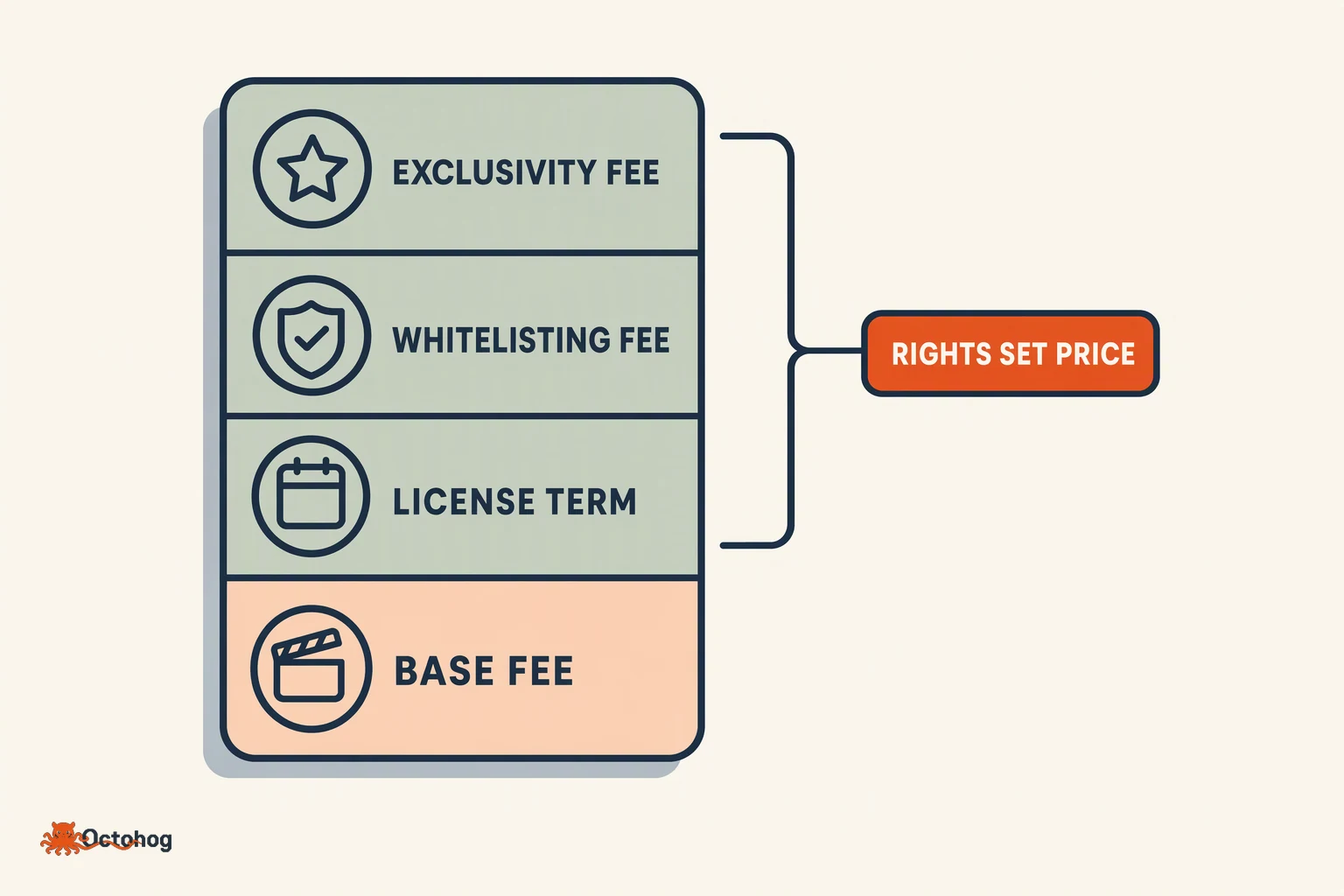
Usage rights add to a UGC quote on top of the base fee, and a quote that leaves them out prices the wrong thing. A creator who agrees to a flat fee for "content" has priced an organic post. A brand that then runs that content as paid media for a year has bought something else. In Billo's 2026 usage-rights guide, paid-ad licensing and whitelisting each add a premium on top of the base rate, and exclusivity costs a multiple of the standard licensing fee [6].
Price three rights as separate line items:
- Licensing and distribution rights: name the duration, the channels (organic, paid social, website, email) and the territories. "Perpetual, all media" is the most expensive phrase in a UGC collaboration contract. Price it on purpose or strike it.
- Whitelisting: Billo's usage-rights guide defines whitelisting as the brand running ads from the creator's own account identity, and prices it at a higher premium than standard paid-usage licensing [6]. The creator lends their identity as well as their footage, so price whitelisting access separately, with an end date and a way to revoke it.
- Exclusivity: a category lock stops the creator from shooting for competitors. Define the category narrowly and keep the term short, because the creator turns down paid work for as long as the lock lasts.
Settle disclosure in the same contract, whichever rights you buy. Name the party responsible for labeling the video, and keep that duty in place when the footage moves from an organic post into a paid placement. Use the platform's paid-partnership label where one exists, and keep the disclosure intact when the footage runs from the creator's handle.
Send the next quote request with four blanks for the creator to fill in: base fee, license term, whitelisting fee and exclusivity fee. A creator who leaves the last three blank has quoted an organic post.
Vet the portfolio and cap revisions before the product ships
Vet the portfolio before any product ships. A creator who cannot hold attention on another brand's product will not suddenly manage it on yours. Before a larger commitment, pay several creators for a few test videos each, the approach PixelPanda's 2026 hiring guide recommends [5]. Ship product only after a creator passes, and put the revision terms in the brief before the box leaves the warehouse. After delivery, a revision clause becomes a negotiation.
When you browse a creator's portfolio, judge the videos they shot for other brands, not their personal posts:
- Hook: the product or the problem appears in the opening seconds, before any greeting or intro.
- Lighting: faces and product labels read clearly, with no glare washing out the packaging.
- Audio: the voice is clean over room noise, and the captions match what is said.
- Platform fit: native vertical edits for TikTok Shop and Instagram Reels, not one cut resized for every feed.
- Range: work in more than one product category, so the style is a choice, not a limit.
- Raw files: the creator can deliver raw footage alongside the finished edit.
Treat a per-video quote far under the beginner band as a red flag. The same hiring guide calls creators at that end of the market almost always inexperienced [5].
None of the sources behind this guide publishes a standard revision count or turnaround time, so write your own policy and state it in the brief. Here is a clause that holds up: "Revisions cover changes needed to match the brief as written. New creative direction is a new order." Put a number on the rounds you will accept, and define what counts as one round. Vague revision terms are where a fair quote goes wrong.
UGC model, UGC influencer or UGC agency: choose by who owns the footage and the audience
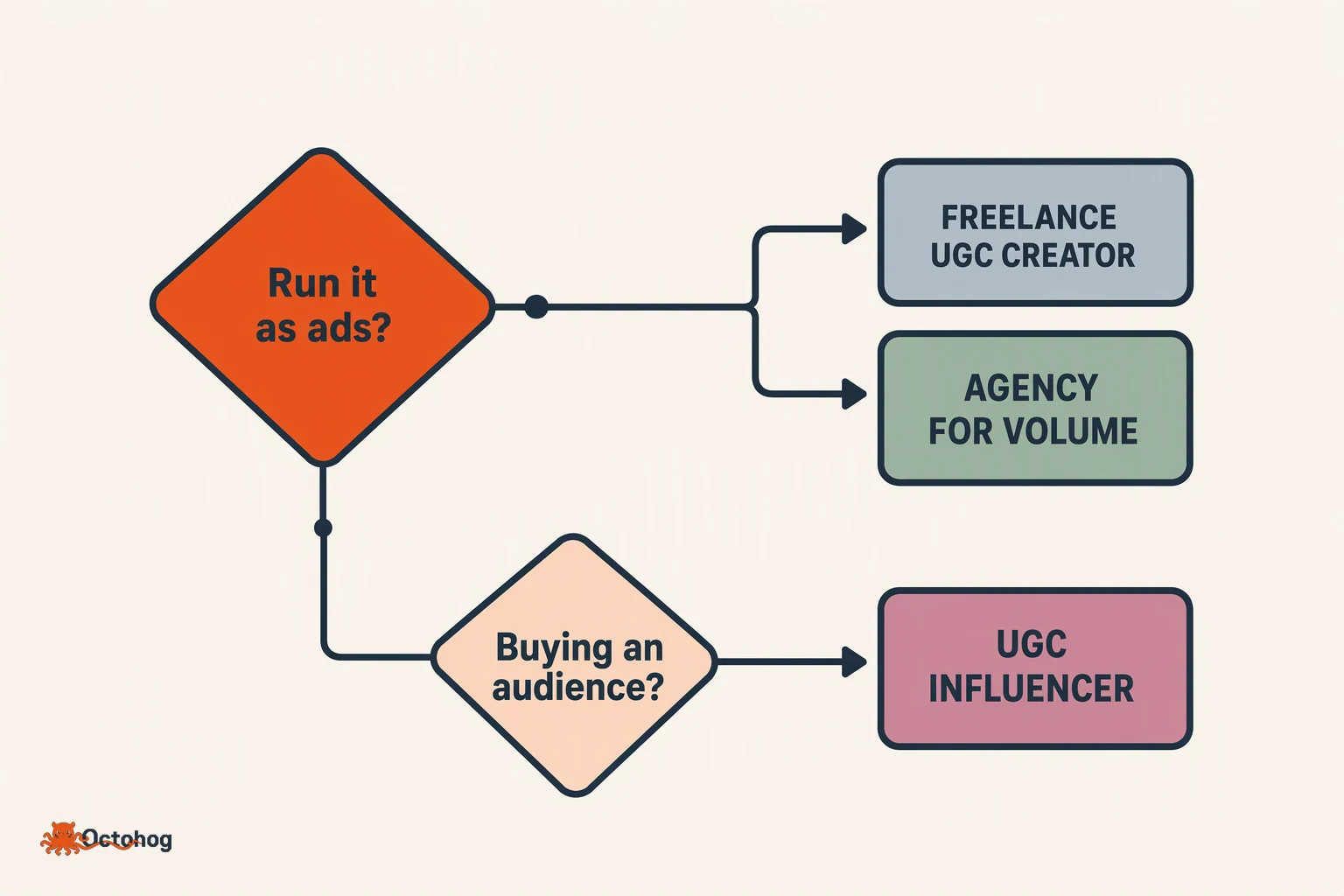
The three hiring routes split on two questions: who distributes the video, and what the fee pays for. A UGC creator, sometimes called a UGC model, hands footage to the brand and charges for production. A UGC influencer posts to their own audience and charges for access to that audience [4]. Influencer rates follow "Follower count and engagement rate," not production effort, in Insense's 2026 rate guide [2].
The table below compares the freelance, influencer and agency routes on distribution, pricing basis, default rights and fit.
| Route | Who distributes | Pricing basis | Rights default | Best fit |
|---|---|---|---|---|
| Freelance UGC creator | Brand | Flat fee per video, $50-$400 beginner to $500-$3,000+ premium [2] | Not stated in the source; set in the brief | Paid-ad testing with your own ad account |
| UGC influencer | Influencer's own account [4] | Follower count and engagement rate [2] | Footage stays on the influencer's account [4] | Reach into an audience you lack |
| UGC agency (Brighter Click Standard) | Brand | $4,500 for 12 edited videos from 4 creators [8] | Unlimited usage rights [8] | Volume across several creators, 10-14 business days [8] |
Source: Insense's 2026 rate guide [2]; Billo's 2026 comparison guide [4]; Brighter Click's published package terms [8]
The agency row is a list price before negotiation, published by Brighter Click for its own Standard package [8]. It works out to $375 a video ($4,500 / 12), a figure that describes Brighter Click's offer only.
The table leaves out an in-house hire. None of the sources behind this guide publishes a salary benchmark for that role, so the comparison cannot price it.
Pick by ownership. If you need footage to run as ads, choose a freelance creator or an agency. Influencer marketing makes sense only when the audience is what you are buying. Agencies and creator network platforms charge for matching brands to creators, and marketplaces bill for it too: Insense's published brand plans pair a monthly subscription with a marketplace fee added to every creator payment [7]. At volume, that matching is worth paying for. On a first test, it is mostly overhead.
Skip the hire if you cannot run the footage as ads
A UGC campaign earns its fee when the footage runs as paid ads. If the brand will only ever post organically, buy organic-only rights or skip the hire. Billo's usage-rights guide bundles organic posting rights into the base fee [6]. Paying for a paid-ad license you will never use wastes money. Running ads you never licensed costs more: Billo names unlicensed paid use as a frequent and costly error for brands, with exposure of up to $150,000 per work in statutory damages [6]. That figure is a general US copyright ceiling, not a UGC-specific ruling.
The other leak is agency margin on a one-video test. A single test video tells you whether a hook works. It needs no creator network and no bundled package. Hire one freelance creator, license the video for paid use, and run it. Move to an agency only once a hook clears your CPA target.
Frequently asked questions
What should a UGC collaboration or partnership contract include?
A UGC collaboration contract should set six terms: deliverables, a revision cap, how long the footage can be used and on which channels, any exclusivity window, when payment is due, and who handles ad disclosure. Price exclusivity as its own line. In Billo's usage-rights guide, an exclusivity clause costs 3 to 10 times more than a non-exclusive deal, though the guide gives no sourcing for that multiplier [6]. A UGC partnership without these terms leaves every dispute to memory.
Where does UGC fit in a paid social UGC strategy?
A UGC strategy for paid social treats creators as a source of ad creative, not as a brand channel. The footage is content the brand owns and runs, "most often as paid-ad creative," in Hubfluence's definition of the role [1]. Buy several hooks per product at a test fee, then pay for longer whitelisted runs only on the hooks that win. A losing hook costs you the test fee and nothing more.
Is UGC content legal?
UGC content is legal when the brand holds written rights for every channel and time period it uses the footage. A UGC creator sells the content itself, not distribution to their own audience [4], so the license is what the brand is actually buying. Organic-only rights do not cover paid ads, and ad-disclosure duties belong in the contract. Treat this as a checklist, not legal advice, and have counsel review the contract.
How do I become a UGC creator?
Start with sample videos shot on products you already own. Price per video, not per follower. Beginner work sits at $50 to $400 per video for basic filming or raw footage in Insense's 2026 rate guide, a single marketplace's benchmark rather than a market rate [2]. Pitch brands with hooks, not audience size.
References
- What is a UGC creator? A brand's guide — hubfluence.io
- UGC Creator Rates Explained: Real 2026 Pricing & How to Budget for Scale — insense.pro
- 21 UGC Impact on E-commerce Sales Statistics Every Brand Should Know in 2026 — archive.com
- UGC Creators vs Influencers: What's the Difference? — billo.app
- How to Hire UGC Creators: Platforms, Pricing, and Red Flags — pixelpanda.ai
- Mastering UGC usage rights: what brands need to know about licensing creator content — billo.app
- Choose Your Ideal Plan for Influencer & UGC Campaigns, Insense — insense.pro
- How Much Does A UGC Agency Cost In 2026 — brighterclick.com