UGC Agency Pricing: Flat-Rate vs Per-Creator vs Retainer

· Updated · 11 min read

Last updated: 2026-08-12
The cheapest UGC agency model in 2026 is the flat-rate marketplace: Billo assigns a creator and delivers a finished video for $99, one upfront fee with no add-on charges layered on afterward [1]. Subscription platforms charge before a single video exists, starting at $500 a month on top of every creator payment [2]. Managed agencies are worth their markup only if nobody in-house will write the briefs and chase revisions. Volume decides the rest.
Four buying models, compared on the five questions a buyer asks before signing: cost per finished video, what the base price leaves out, vetting, licensing, and turnaround.
| Model | Best for | Price (checked Aug 2026) | Hard limit | Rights and posting add-on |
|---|---|---|---|---|
| Flat-rate marketplace (Billo, JoinBrands, Influee) | Brands buying under 10 videos a month | From $99 per video, one upfront fee [1] | Base rate buys footage, not a creator post | Creator posting runs about $350 on TikTok and $364 on Instagram [4] |
| Per-creator subscription (Insense, Trend) | Rosters running 10-40 videos a month | From $500/mo self-service; from $2,500/mo with a dedicated platform manager [2] | Creator payments are never included in the subscription | 15-20% platform fee on every creator payment [8] |
| Full-service managed agency (Cohley, Hashtag Paid, theugc.agency) | Teams with no in-house creator ops | 15-25% management fee on top of creator rates [6] | Rate cards not published; every quote is bespoke | Licensing term negotiated per campaign, not published |
| TikTok retainer plus Spark Ads (whitelisting) | Brands running paid TikTok year-round | 20-25% of the creator's base content fee per 30-day flight [3] | Ad permission expires with the flight, not the video | Flat Spark Ads code at $500 a month; a 60-day flight adds $1,000 [3] |
How we compared
Four buying models sit on this page: flat-rate video marketplaces, per-creator subscription platforms, retainer studios, and full-service managed agencies. Each one is judged on the same five questions a buyer asks before signing: what a single finished video costs, what the base price excludes, how creators get vetted, what usage rights licensing adds, and how many days pass between brief and delivery.
Every price in the table is the vendor's own published figure, current as of 12 August 2026. Nothing was lifted from a competitor's ranked list, because those pages carry no cost structure worth checking. Where a vendor publishes no number — and several publish none for managed tiers — the cell reads "not published" rather than an estimate reverse-engineered from a sales call. That distinction matters more than it sounds. An estimate dressed as a fact is how a $4,000 quote turns into a $9,000 invoice.
Pricing transparency is itself one of the criteria. An agency that quotes only after a discovery call is not automatically worse, but it is harder to budget against, and the table marks it.
Creator vetting is scored on what the vendor documents about its own process, not on the size of the roster it advertises. Roster size is a marketing number. Rejection rate, application review, and whether a human watches a sample video before approval are the ones that predict whether your first three deliverables are usable.
Octohog
You know what to pay. Octohog finds who to pay.
Rank creators against your brief, check the brand work behind every name, and send the invites from your own inbox. Brief to booked in one flow.
Start a campaignGmail-native outreach
Flat-rate UGC video marketplaces: Billo, JoinBrands, Influee
Marketplace pricing is the only model where you can know the cost of a finished video before you write the brief. The entry point is $99 per video, billed as a single upfront fee with no add-on charges layered on afterward [1]. JoinBrands and Influee price the same way — one number per deliverable, paid before a creator is assigned.
That is the honest answer to how much UGC agencies charge at the entry tier: roughly $100 to $250 for one raw video from a vetted creator, ordered like a product. The base price buys the footage and nothing around it. Read what it excludes before you compare it to anything.
- Usage rights: organic-only by default. Paid ads and whitelisting are a separate purchase on every marketplace.
- Editing: raw or lightly cut footage. Hooks, captions, and B-roll assembly are your job or a paid upgrade.
- Revisions: usually one round, tied to the original brief. A new hook is a new order.
- Turnaround time: roughly one to two weeks from order to delivery, longer if the product ships slowly.
The risk of paying for a brief nobody wants to shoot is priced out at the entry tier too — the full fee comes back when no creator accepts the job [1]. Useful. It does not solve the volume math.
Flat-rate stops being cheapest somewhere around 15 to 20 videos a month. Past that, the per-video premium you pay for zero commitment exceeds a platform seat plus direct creator payouts, and you are buying the same UGC work twice.
Per-creator subscription platforms: Insense, Trend, Modash-style sourcing
Subscription platforms sell you access, not videos, and that single distinction breaks most budget spreadsheets. The self-service tier opens at $500 per month, charged on top of what you pay creators rather than including it [2]. Add a dedicated platform manager and the software line starts at $2,500 per month, still excluding creator payments [2]. Trend and Modash-style sourcing tools follow the same split: a seat fee for search, briefing, and contracts; a separate transfer for every UGC collaboration you actually run.
Model a ten-creator UGC campaign as two line items, always. Software is fixed — $500 a month buys the same seat whether you brief two creators or forty. Creator payouts are variable and are where the real money goes: ten creators at a typical $150 to $300 per video is $1,500 to $3,000, so a single month of that campaign lands near $2,000 to $3,500 all-in at the self-service tier. Run the arithmetic before the demo, not after.
The break-even is volume. Below roughly six videos a month, the $500 seat is a larger share of your spend than the creators are, and a marketplace order beats it outright. Above twenty, the seat is rounding error and the sourcing control pays for itself.
Watch the minimum campaign size too. Platforms that gate briefs behind a creator minimum turn a test into a commitment, and a roster you did not choose is not a roster.
Full-service UGC agencies: Cohley, Hashtag Paid, theugc.agency
Full-service agencies sell a staffed function, not a file. A UGC agency is a managed service that recruits creators, writes the briefs, runs the shoots, and hands back video files the brand owns outright — the roster and the project management are the product, not a software seat. Cohley, Hashtag Paid, and theugc.agency all sell that version of it.
The retainer floor sits high because filming is the cheap part. What the monthly fee actually buys is creator vetting, a content strategy that decides which hooks get tested before a single creator ships, casting against that brief, campaign management across a dozen simultaneous shipping addresses, and performance reporting that ties an individual asset back to a spend line. A per-video marketplace does none of that. You do it, or nobody does.
None of the three publishes a rate card. Every quote comes out of a scoping call, which is defensible for a genuine partnership and indefensible as a negotiating tactic — the difference shows up in whether the proposal itemizes creator payouts separately from agency fees.
Ask two questions on that call: which producer owns the account day to day, and what the deliverable count drops to if you halve the retainer. A shop that cannot answer the second one is charging for access, not output.
Related reading
TikTok UGC agency retainers and Spark Ads add-ons
Whitelisting is the line item that reprices a TikTok campaign after the videos are already delivered. Industry-standard TikTok whitelisting fees run 20-25% of a creator's base content fee per 30-day flight, so a $10,000 content fee adds $2,500 a month in ad-permission costs [3]. That is not production. That is rented permission to keep running what you already paid to shoot.
Spark Ads codes are priced on a different logic entirely. A flat TikTok Spark Ads code costs $500 a month regardless of ad spend, and extending the flight to 60 days adds another $1,000 to the total [3]. Spend-independent pricing favors the buyer at scale and punishes the small test: put $2,000 behind a code and the permission fee is a quarter of the media budget.
Spark Ads and partnership ads run the creative from the creator's own handle, so the comments, the follower count, and the social proof come with the ad. Whitelisting dark posting does the reverse — the brand runs variants that never appear on the creator's grid. Both need the code. Neither is included in a production quote unless the contract names the flight length.
Price the flight before you price the video. A per-asset rate that looks cheap in isolation becomes the second-largest line on a paid social content budget once thirty days becomes ninety.
What one UGC video should cost in 2026, line by line
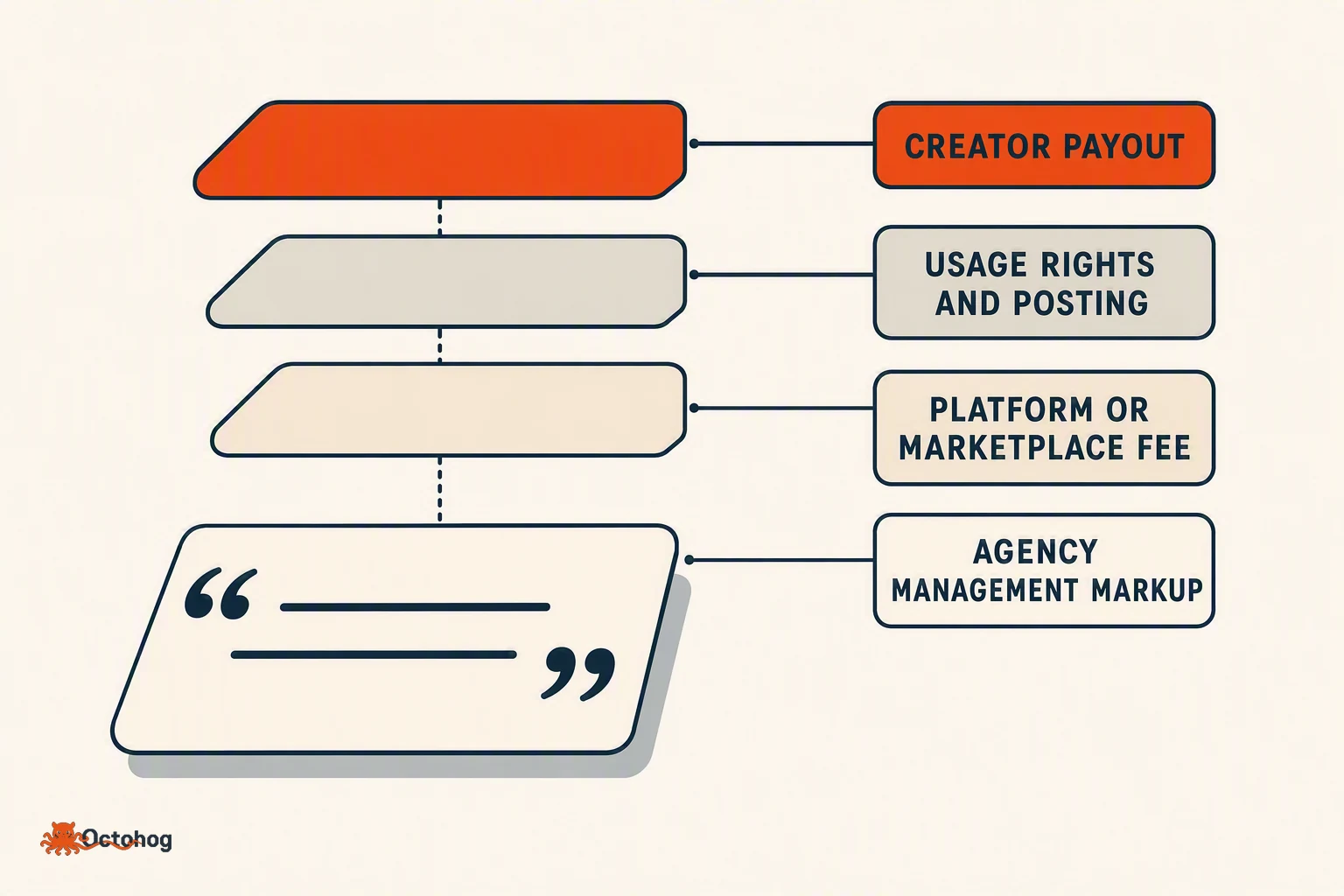
Every quote decomposes into five parts, and the parts are priced independently. The table below compares the 2026 rate for each line item that turns a creator payout into an invoice.
| Line item | 2026 rate |
|---|---|
| Entry-level creator payout | $50-$100 per video [4] |
| Typical short-form asset | ~$200 [4] |
| Established creator payout | $500+, before licensing [4] |
| Creator posts to own Instagram | $364 average [4] |
| Creator posts to own TikTok | $350 average [4] |
| Creator posts to own YouTube | $675 average [4] |
| Platform marketplace fee | 7-20% of creator payment, by plan tier [5] |
Marketplace fees stack on top rather than inside: the tier that charges 20% sits on a $650 Trial plan, 10% on a $500 Brand plan, and 7% on an $800 Agency plan, each billed separately from what the creator receives [5].
Creators can make money doing UGC, and the ladder is visible in those numbers. Entry-level work pays $50-$100 per video, the market midpoint sits near $200, and established creators clear $500 before licensing [4]. Granting your own audience roughly doubles it — $364 on Instagram against a $200 agency-only base [4]. Rights are the raise. Charge for the license term, not the shoot.
Seven red flags in a UGC agency quote
Seven omissions predict a bad engagement, and each one has a question that closes it.
- No revision cap. "Unlimited revisions" is either a lie or a rate padded to absorb the risk. Ask: how many rounds are included, and what does round four cost?
- No rights window. A quote with no license term means organic-only, and you find out when you try to boost the video. Ask for the term in days and the channels by name.
- No turnaround SLA. Turnaround times belong in the contract, not the pitch deck. Ask for the day count from brief approval to first cut.
- Markup folded into one line. Boutique agencies commonly add a 15-25% management fee on top of the creator's base rate, and a single line item hides it [6]. Ask what the creator receives and what the agency keeps.
- No minimum stated. Minimum campaign size shows up after you sign, as a four-video floor on a two-video need. Ask for the smallest order they will accept.
- No named creators before signature. Vetting after payment is vetting you paid for.
- No raw footage clause. Rights management gets expensive when you own the edit but not the source file.
Pricing transparency is a document test, not a vibe test. If the answers to those seven arrive in a follow-up email rather than the original quote, price that friction into every month you work together.
Octohog
You know what to pay. Octohog finds who to pay.
Rank creators against your brief, check the brand work behind every name, and send the invites from your own inbox. Brief to booked in one flow.
Start a campaignGmail-native outreach
Which one should you pick
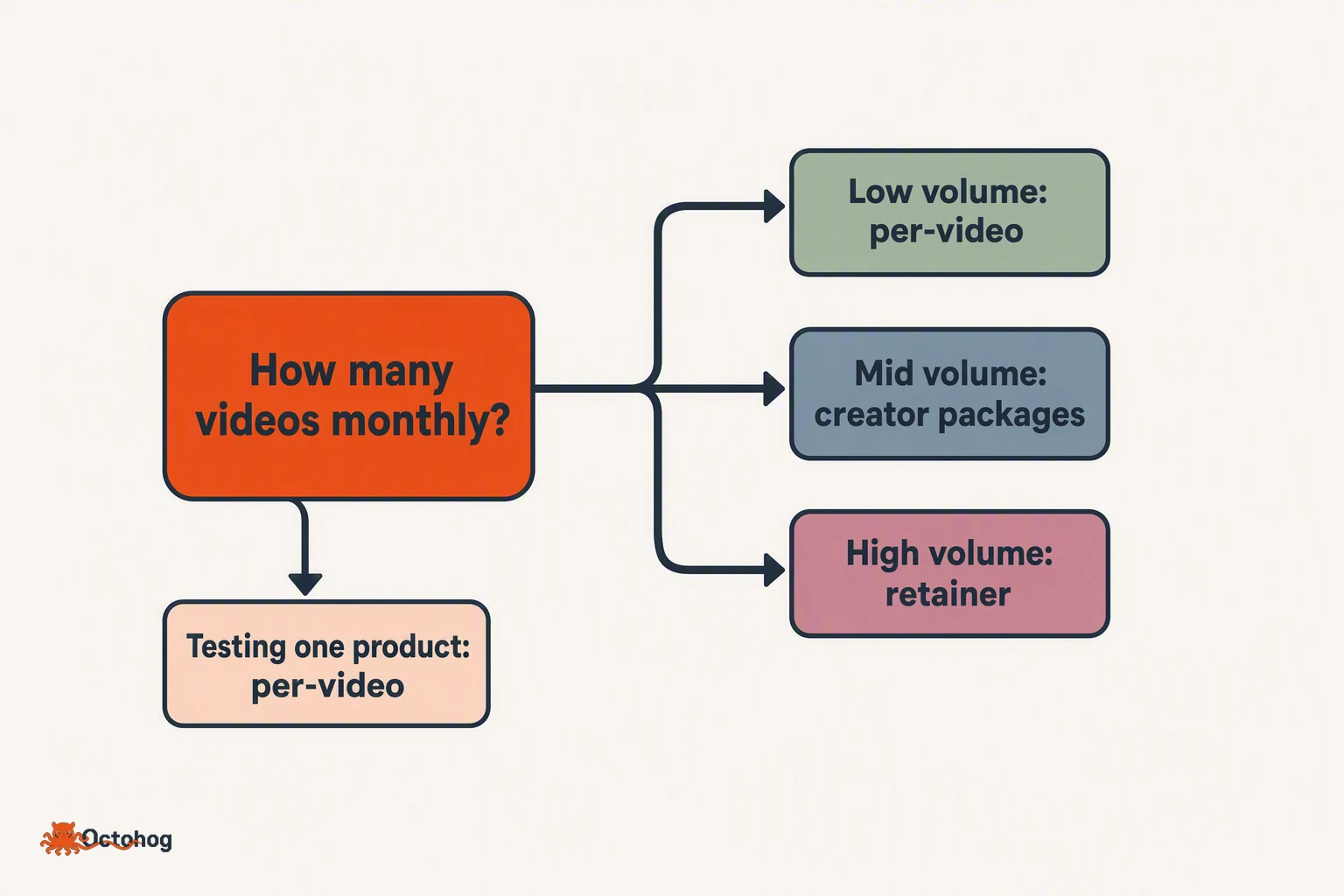
Map your monthly video count first, then your platform mix. Volume decides the model; everything else is preference.
- Under five videos a month, no in-house producer → per-video flat rate. You are buying assets, not a relationship, and a retainer you underuse costs more per usable clip than the sticker price suggests.
- Ten to thirty videos a month across TikTok and Reels → per-creator packages. This is the band where the same three creators learn your product and the briefs get shorter every cycle.
- Forty-plus videos a month with a paid team that iterates weekly → retainer. The value is the standing roster and the turnaround, not the unit price.
- Testing a single new product or market → per-video, always. Commit to volume after you know which hook works, not before.
The model almost nobody should buy is the managed marketplace with a percentage fee on every payment. It looks cheap at low volume and scales its cost with your success, which is backwards: the work of processing payment 200 does not exceed the work of processing payment 20. Buy it only if you have no one to manage creator relationships and no plan to hire one.
Switching costs are real in one direction. Leaving a retainer means re-briefing new creators from scratch, so negotiate a roster handover clause before you sign, not when you leave.
Frequently asked questions
- What is a UGC agency? A UGC agency is a service business that sources creators, briefs them, manages revisions, and delivers brand-owned video for paid and organic use. The agency holds the creator relationship and the contract; the brand receives finished files plus a license term. It differs from an influencer agency, which sells distribution on the creator's audience rather than footage.
- How much do UGC agencies charge? UGC agencies charge per video, per creator package, per month on retainer, or as a percentage of creator spend. A platform fee of 15-20% on every creator payment, plus a separate monthly subscription, is a common shape [8]. Ask which structure a quote uses before comparing two numbers.
- Can you actually make money doing UGC? Annual earnings for American creators working at this full time span roughly $24,000 to $120,000 and above, clustering between $48,000 and $72,000 [7]. The top of that band is repeat clients on retainer, not one-off gigs.
- How do I become a UGC creator? Shoot three spec videos for products you already own, publish them as a portfolio, and pitch brands directly. A UGC influencer sells audience; a UGC creator sells footage, so follower count is not the gate. Rates rise when you can deliver multiple hook variants from one shoot.
References
- Billo vs Insense: a detailed guide for choosing the right UGC platform for your brand — billo.app
- Scale Your UGC with Dedicated Platform Managers, from Insense — insense.pro
- Whitelisting & Spark Ads: Hand Over Paid Rights the Right Way — influencermarketinghub.com
- UGC Rates in 2025: What Brands Actually Pay (and Why It Varies) — billo.app
- Choose Your Ideal Plan for Influencer & UGC Campaigns, Insense — insense.pro
- How to Hire UGC Creators: Platforms, Pricing, and Red Flags — pixelpanda.ai
- How Much Do UGC Creators Make in 2026? ($75–$1,000+ per Video) — ugcjobs.com
- FAQs - Answers to Your Most Common Questions About Insense — insense.pro