Alternatives
The 5 best Insense alternatives in 2026
Quarterly billing, a $650 trial that upgrades itself, and a fee on every creator dollar: Insense's campaign ops are excellent and its exit door is busy anyway. These five alternatives cover every reason brands walk, with prices read off live pages in July 2026.
By Chloe Morgan, creator partnerships lead at Octohog. Updated July 9, 2026.
TL;DR
- Best overall Insense alternative: Octohog, evidence-ranked sourcing with agent-run outreach on monthly billing, $249/mo and no fees on creator payments
- Need finished videos with ad permissions? Billo is the closest substitute. Cheap gigs: Collabstr. Inbound volume: SideShift. Reach programs: Modash
- Why brands leave Insense: no monthly plan, the $650 auto-upgrading trial, and 7-20% marketplace fees stacked on creator pay
- Every price in this guide was read off a live pricing page on July 9, 2026
How we researched this
We read every tool's live pricing page and help docs, pulled reviews from G2, Capterra, Trustpilot, Reddit, and the App Store, and screenshotted what we found. All facts and prices were checked on July 9, 2026; plans change, so verify before you buy. Every claim links to its source, and we note where each tool genuinely wins.
Why brands look for an Insense alternative
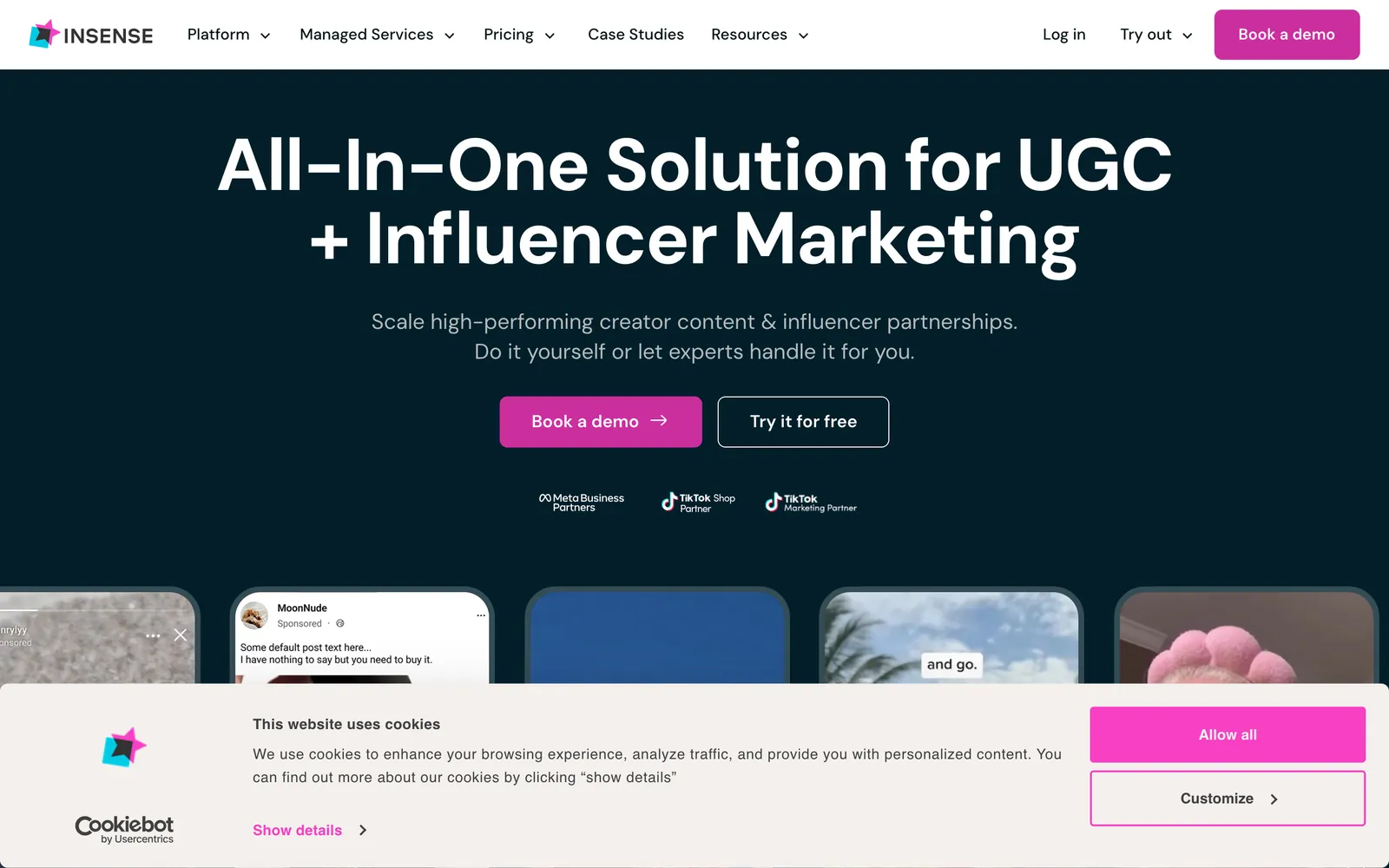
Insense bundles a creator marketplace with real campaign operations: briefs, chat, automated contracts, content rights, payments, and, most distinctively, permission workflows for TikTok Spark Ads and Meta Partnership Ads. When UGC exists to feed ad accounts, that plumbing saves genuine time, and its G2 average of about 4.5 across 365 reviews shows plenty of happy customers.
The exits tend to be about money mechanics rather than features. There is no month-to-month plan: entry is a $650 one-month trial that auto-upgrades into $1,500-per-quarter billing unless cancelled 48 hours ahead, and G2 carries reports of renewals charged minutes after missed windows with a strict no-refund stance. Creator payments add marketplace fees that Insense's own pages state three different ways, between 7 and 20 percent plus facilitation fees. Add surface-level analytics and inconsistent applicant quality in niche categories, and the shortlist below writes itself.
Insense alternatives at a glance
| Tool | Model | Starting price | Standout |
|---|---|---|---|
| Octohog | AI CMO workspace | $249/mo | Evidence-ranked sourcing, outreach, deep-dive analytics, and competitor monitoring in one |
| Billo | UGC video marketplace | ~$99/video (prepaid packs) | Fast finished ad videos |
| SideShift | Job-listing marketplace | $299/mo | High-volume inbound US creators |
| Collabstr | Gig marketplace | Free + 10% per hire | Pre-priced listings for one-off gigs |
| Modash | Influencer database | $299/mo (annual) | 350M-profile discovery and audience analytics |
Prices checked July 9, 2026 on each vendor's pricing page: insense.pro/pricing, Insense FAQ, billo.app, sideshift.app/pricing, modash.io/pricing.
1. Octohog
Best overall: evidence-ranked sourcing, outreach, and competitor intelligence in one
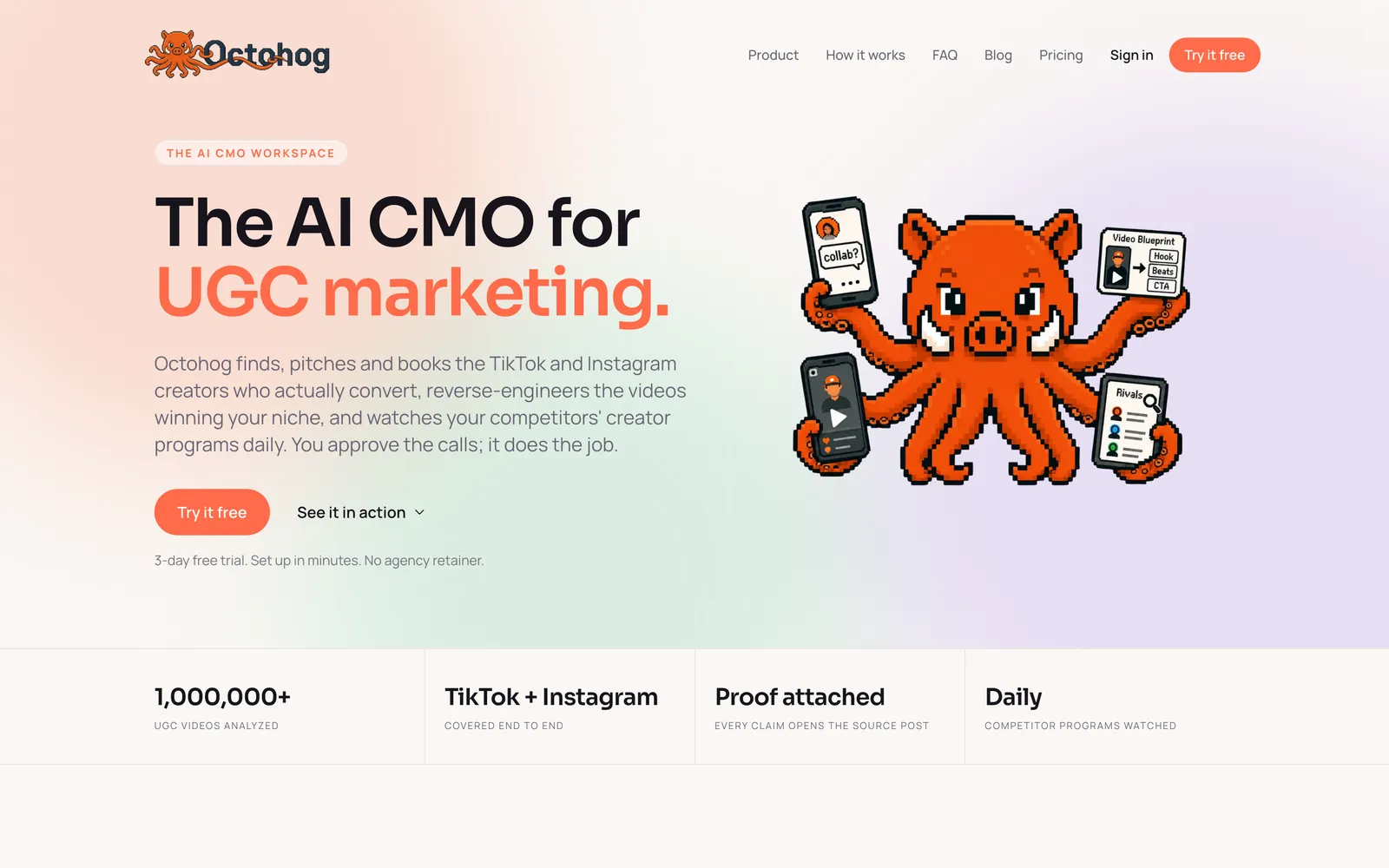
Octohog is an AI CMO workspace for UGC marketing, and the structural difference from everything else on this list is scope: the other tools each do one slice of the job, while Octohog runs the whole loop. Its engine is built on more than 1,000,000 analyzed UGC videos. Creator Match maintains an index of 177,000+ UGC creators, ranks them by verified brand work scored against your brief, and shows the receipts: the actual videos each creator made for brands like yours. Approve the shortlist and the agent runs the outreach itself: invites, follow-ups, booking.
Around that core sit the tools marketplaces and databases make you buy separately. TikTok Deep-Dive x-rays any public account before you spend: posting cadence, real median views, engagement quality. Brand Network maps the creators already posting for any brand, including your competitors. Video Blueprints breaks winning UGC videos down shot by shot so briefs start from proven structure. And Radar watches your competitors' TikTok and Instagram marketing daily: new creators, new hooks, campaign launches, reported with proof.
Pricing is a flat subscription from $249 per month with a 7-day trial. There are no per-hire fees, no expiring credit packs, and no metered profile opens; creator rates are negotiated directly through the agent's outreach. A set of free tools (transcript generators, engagement calculators, fake-follower checkers, profile analyzers) covers the quick checks other platforms gate behind plans.
Octohog pros
- Creators ranked by verified brand work, not follower counts or self-listings
- Outreach, follow-ups, and booking run by the agent; you approve the shortlist
- Radar competitor monitoring: rival accounts, creators, and campaigns tracked daily
- TikTok Deep-Dive account analytics and Brand Network competitor roster maps built in
- Video Blueprints turns winning UGC videos into shot-by-shot creative briefs
- Flat subscription: no per-order fees, no expiring credits, no metered unlocks
Octohog cons
- Focused on TikTok and Instagram; no YouTube coverage
- No built-in ad-permission (Spark Ads / Partnership Ads) workflow
Octohog pricing: From $249 per month with a 7-day free trial. Creator rates are negotiated directly through the agent's outreach, with no platform percentage on top.
2. Billo
Best for fast, finished UGC ad videos from a vetted applicant pool
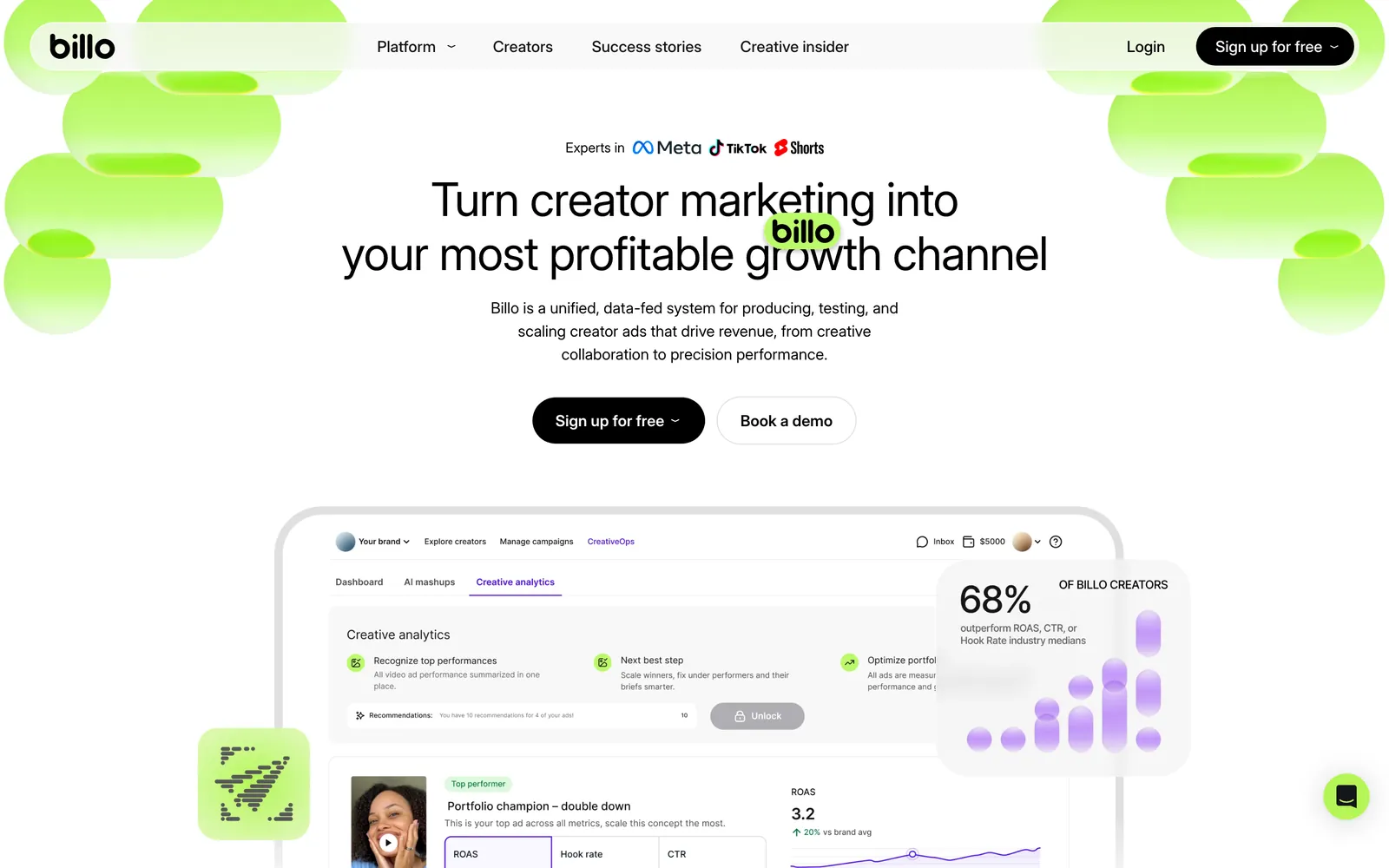
Billo is a UGC video marketplace built around finished output. You post a task, creators from its vetted pool (5,000+ in the US, UK, Canada, and Australia) apply, you pick, ship product, and edited videos come back through a quality check, typically in 7 to 14 days. Videos start around $99, paid through prepaid credit packs. In 2025-2026 Billo added CreativeOps, a data subscription with AI scripts and performance analytics ($300/mo for the first 3 months, then $500/mo).
The catches live in the fine print. Prepaid credits expire after 12 months and are non-refundable, and the public pricing page now redirects to a login, so real costs mostly live in help docs. At the application stage brands see a three-video portfolio, ratings, and self-selected tags, but no audience analytics, so fit is still a judgment call. G2 reviewers describe trial and error to find creators matching brand voice, and Trustpilot carries both creator-side pay complaints and brand-side pricing surprises.
Billo pros
- Fast path from brief to edited, ready-to-run video ads
- Simple per-video budgeting from about $99 through credit packs
- Creator pool is video-pitch vetted with a delivery quality check
- Add-ons for organic posting and Spark/Partnership ad permissions
Billo cons
- Prepaid credits expire after 12 months, non-refundable
- No audience analytics at the application stage; vetting is on you
- English-market creators only (US, UK, CA, AU)
- Reviews report inconsistent creator quality and pricing surprises
What reviewers say
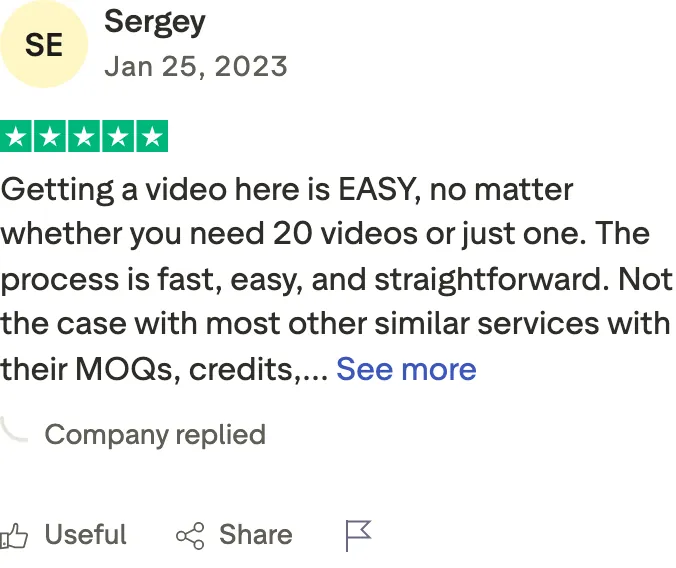
Trustpilot ~4 stars (~513 reviews, many creator-side); G2 4.2 from only 3 reviews (checked July 9, 2026).
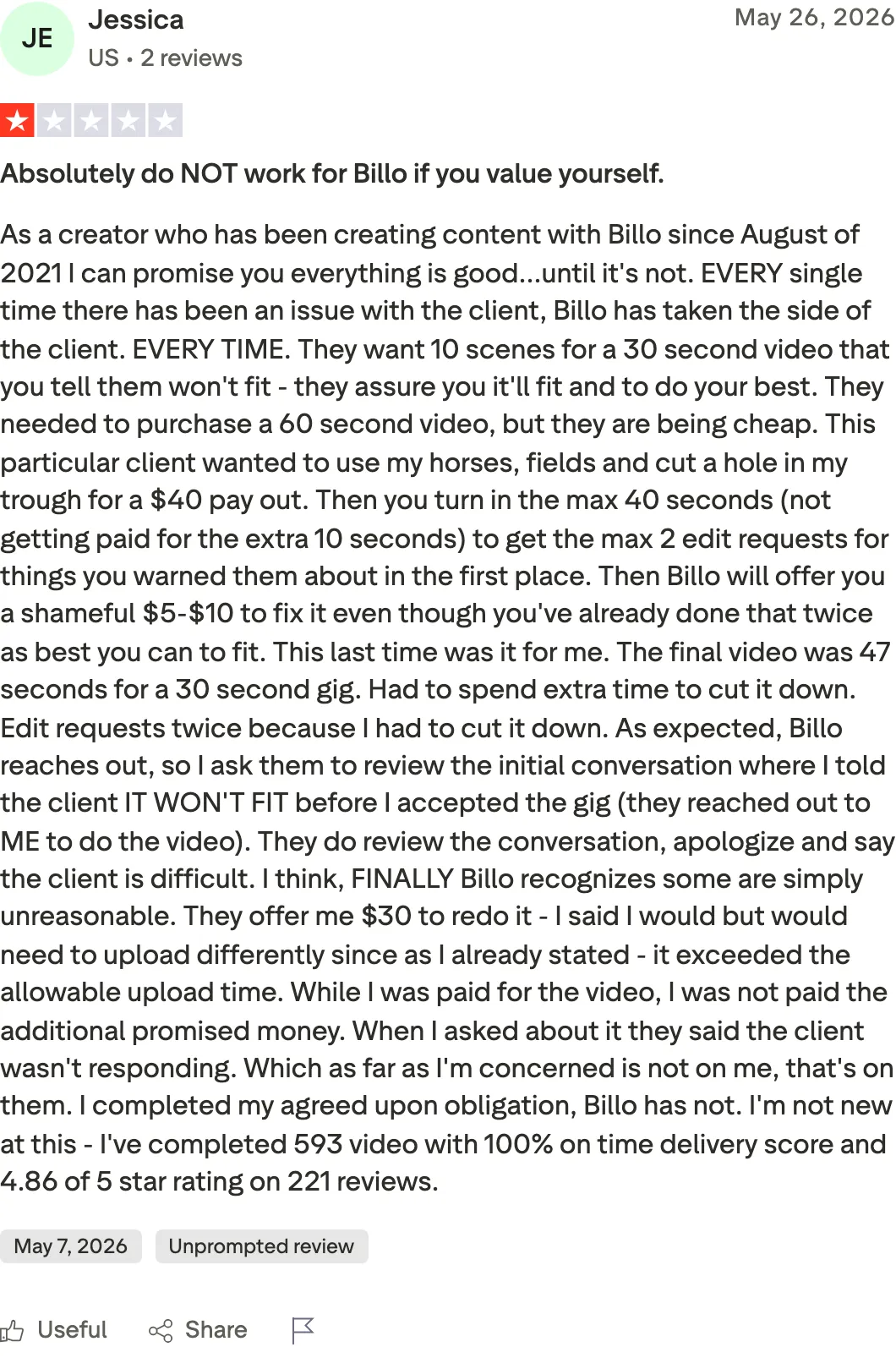
Jessica, May 26, 2026, via Trustpilot
Sergey, January 25, 2023, via Trustpilot
Billo pricing: Videos from about $99 via prepaid packs (funds expire after 12 months); CreativeOps analytics subscription $300/mo for 3 months, then $500/mo. Checked July 9, 2026.
3. SideShift
Best for high-volume inbound applications from US short-form creators
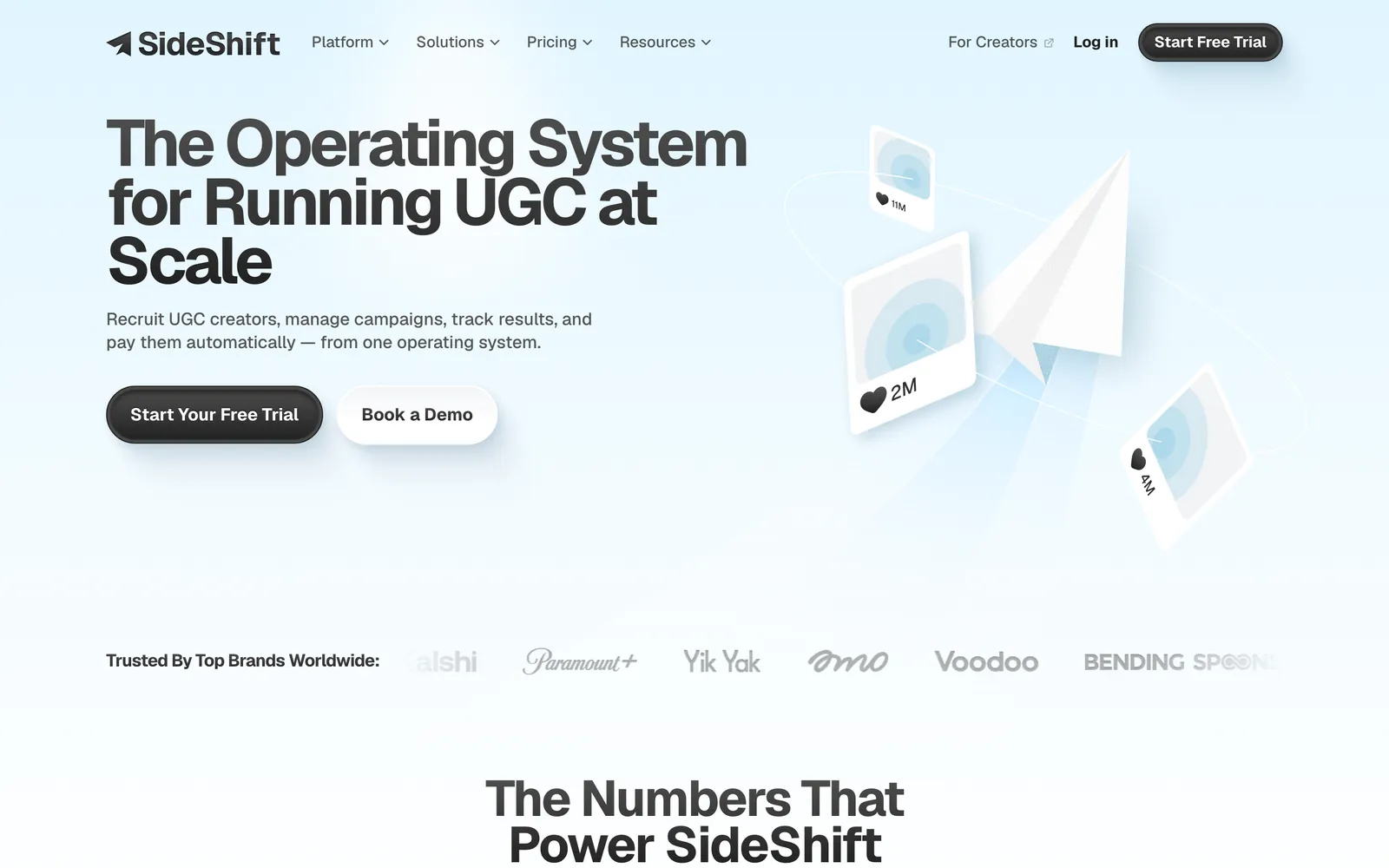
SideShift runs UGC like a job board. Brands post listings, creators from its large US pool apply (its own pages claim both 500,000+ and 700,000+ creators), and the platform handles screening, briefs, chat, approvals, and payouts, with full usage rights on delivered content. Self-serve tiers are flat: Starter $299/mo (1 listing, up to 5 hires), Growth $499/mo (2 listings, 15 hires), Scale $999/mo (unlimited hires), plus a custom-priced enterprise option; annual billing takes 30% off. Focus is squarely on TikTok and Reels-style short-form from US Gen Z creators.
Two things to weigh before subscribing. First, analytics cover your own campaigns (views, reach, engagement, conversions); there is no market or competitor intelligence, and vetting stays filter-based (demographics, engagement, follower counts). Second, public review sentiment is rough: Trustpilot carries creator reports of removed campaigns and unpaid work and brand reports of billing disputes, and when we filtered for five-star reviews on July 9, 2026, we found none to screenshot. The creator app holds 4.8 on the App Store, with payment-consistency complaints as the top negative theme.
SideShift pros
- Flat self-serve pricing from $299/mo with a 7-day trial (30% off annual)
- Very large inbound US creator pool; listings fill within days
- Finished short-form content with full usage rights included
- In-app pipeline from screening to payouts
SideShift cons
- Inbound-only: selects for creators hunting gigs, not proven brand performers
- No competitor or market intelligence; campaign metrics only
- Trustpilot reviews report creator payment disputes and brand billing issues
- US-only network; unsuitable for international campaigns
What reviewers say
App Store 4.8 (~26K ratings, payment-delay complaints as the top negative); Trustpilot rates significantly lower, and we found zero 5-star reviews to screenshot on July 9, 2026.
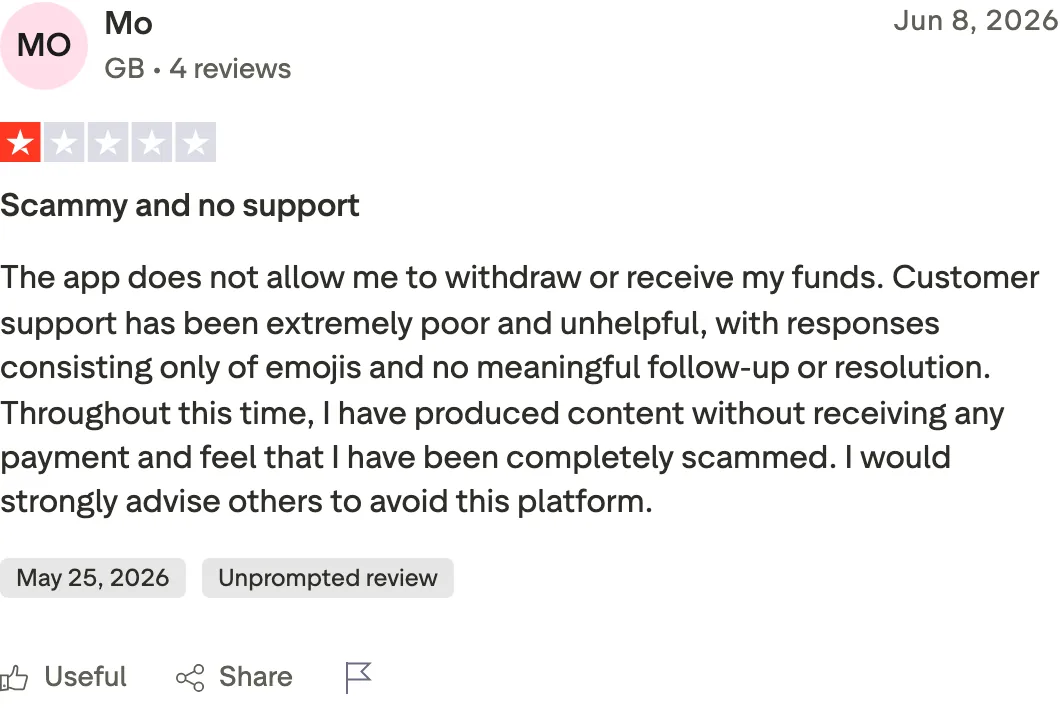
Mo, June 8, 2026, via Trustpilot
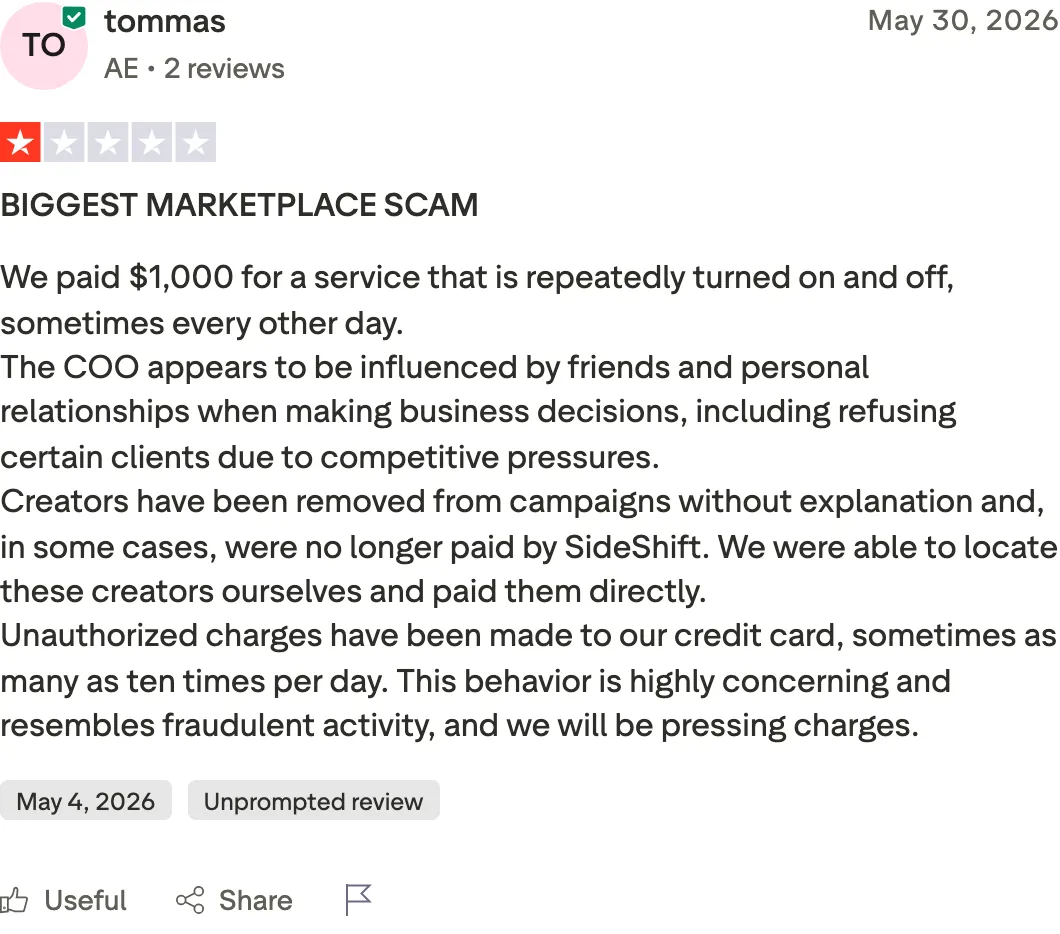
tommas, May 30, 2026, via Trustpilot
SideShift pricing: Starter $299/mo, Growth $499/mo, Scale $999/mo on monthly billing (annual saves 30%); enterprise is custom-priced; creator payments billed on top; 7-day trial. Checked July 9, 2026.
4. Collabstr
Best for quick self-serve gig purchases from pre-priced listings
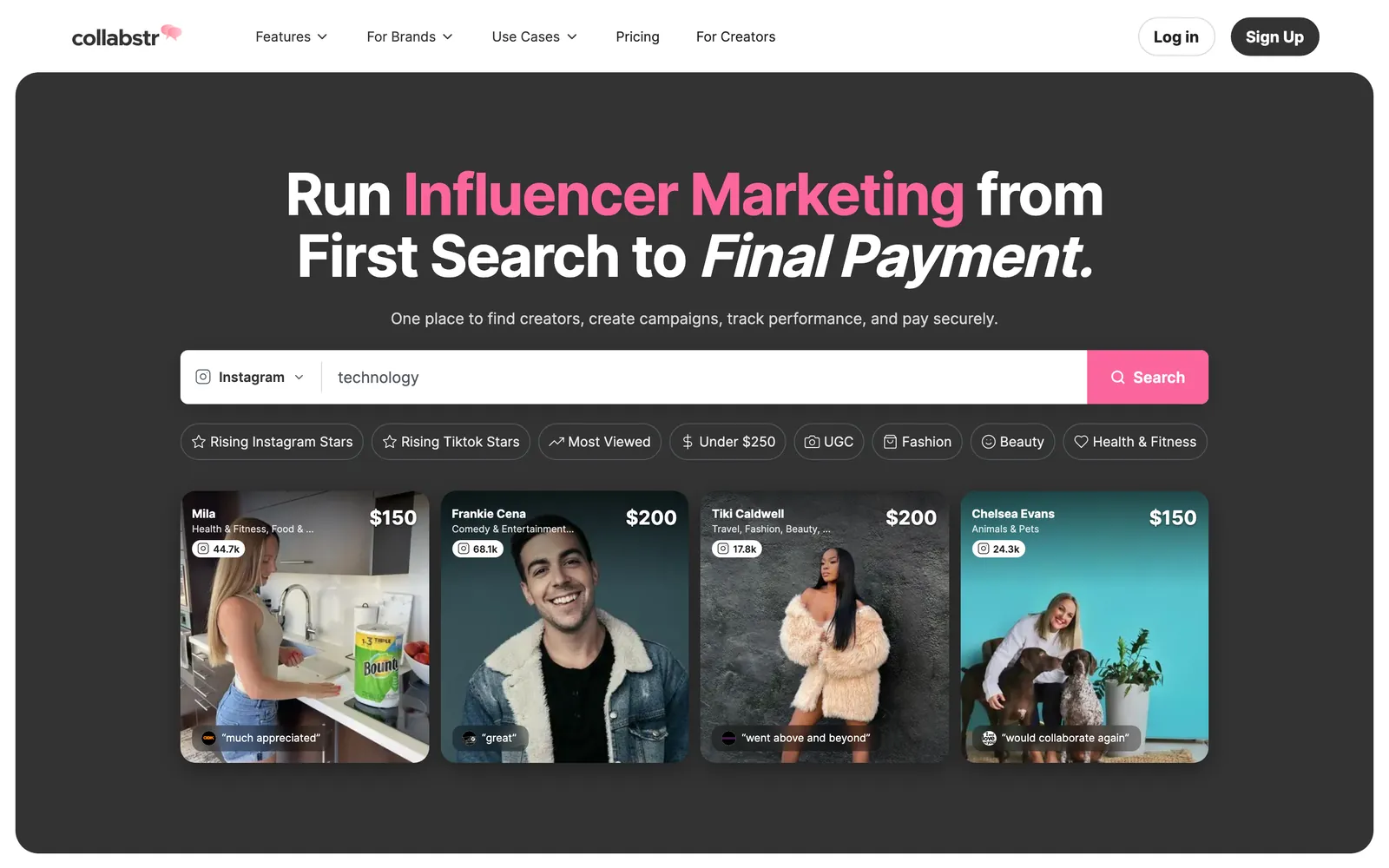
Collabstr is a self-serve gig marketplace. Creators list pre-priced content packages across Instagram, TikTok, YouTube, and UGC; brands browse, filter, and pay into escrow, which releases when the deliverable is approved. On paid plans you can also post a campaign brief and review inbound applicants. It starts free, which makes it the lowest-friction way to buy a single creator video today.
The trade-off is that judgment stays with you. Profiles show engagement and follower stats, but deeper audience reports are metered (20 per month on Pro, 50 on Premium), and independent reviewers note that spotting fake engagement is still largely the brand's job. Collabstr's own 2026 report says 80% of engagements close under $300, so the marketplace skews to small, short-term gigs. Every order also carries a 10% brand-side hiring fee (5% on Premium), and creators pay a separate 15% payout fee.
Review themes worth knowing: creators praise fast payouts when things work, while recent one-star reviews report payout delays and unresponsive support, and some brands describe disputes over creators who delivered no measurable results.
Collabstr pros
- Free to start; you only pay when you hire
- Pre-priced listings make budgeting a single gig trivial
- Escrow protects delivery; broad platform coverage including YouTube and Twitch
- Genuinely useful free tools (price calculator, fake-follower checkers)
Collabstr cons
- 10% hiring fee per order (5% on the $333/mo Premium), plus 15% creator-side fee
- Vetting is on you: audience reports are metered by plan
- Skews to sub-$300 gigs; weaker fit for repeat campaigns and niche categories
- Recent Trustpilot reviews report payout delays and slow support
What reviewers say
Capterra ~4.6 (about 135 reviews); Trustpilot mixed with recurring payout-delay complaints (checked July 9, 2026).
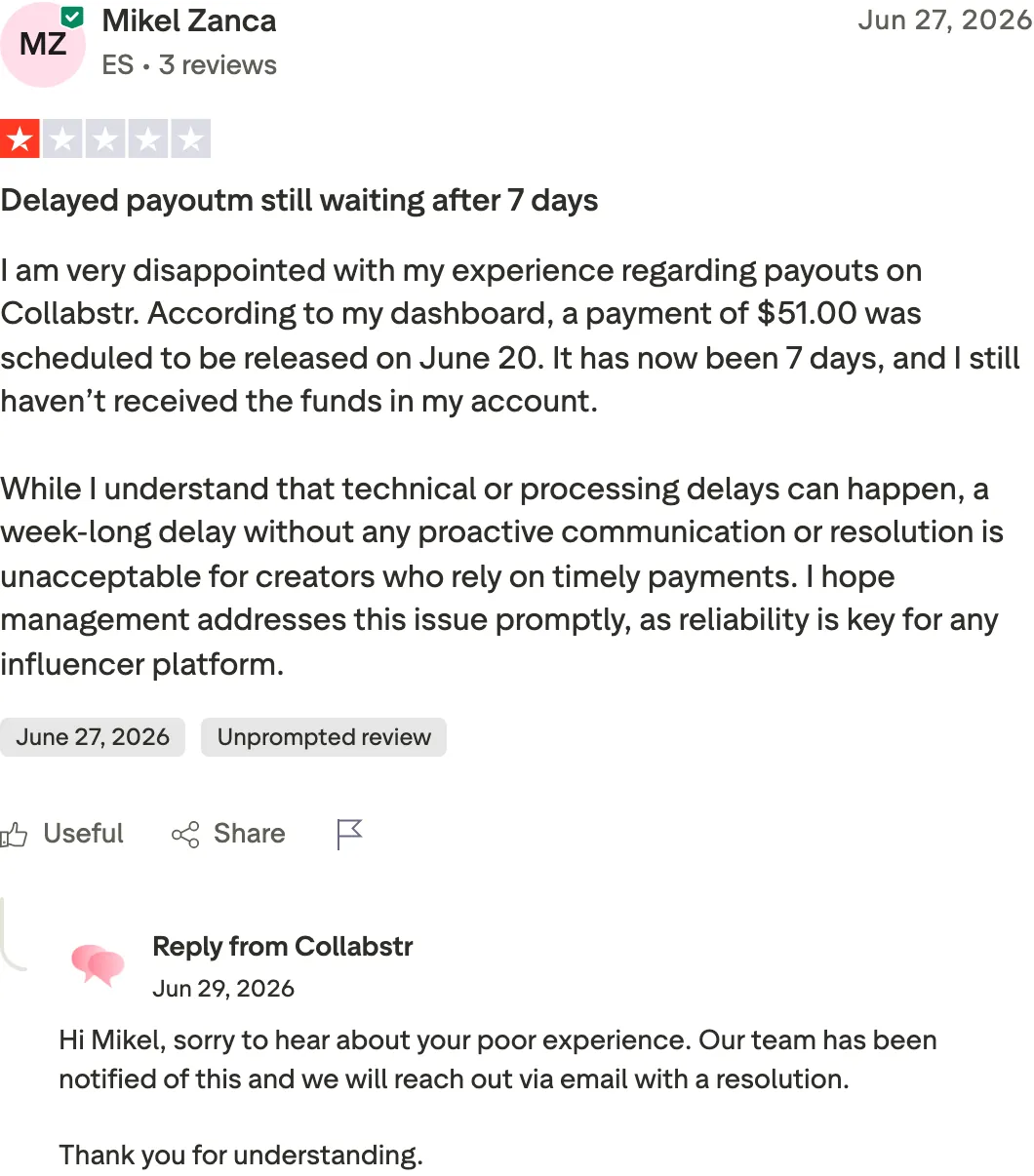
Mikel Zanca, June 27, 2026, via Trustpilot
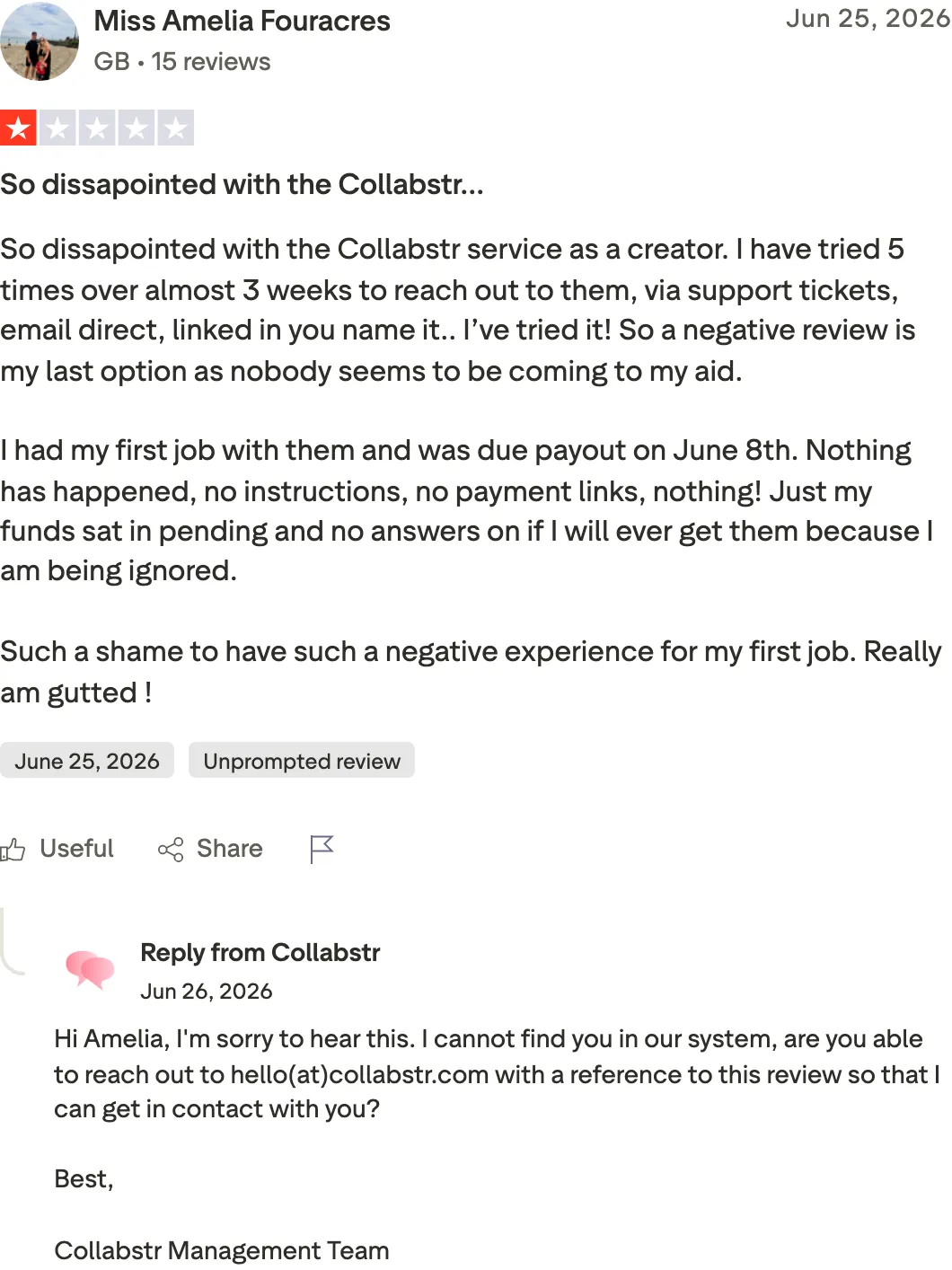
Amelia Fouracres, June 25, 2026, via Trustpilot
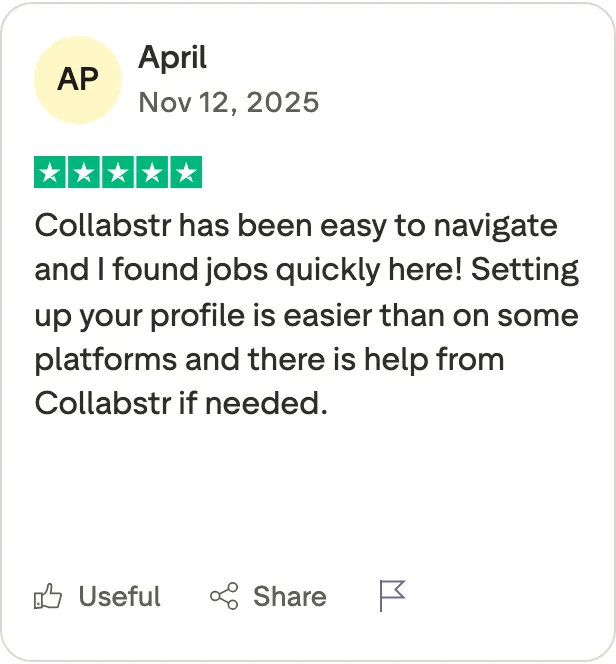
April, November 12, 2025, via Trustpilot
Collabstr pricing: Free plan with a 10% hiring fee per order; Pro $249/mo billed annually (about $299 monthly); Premium $333/mo annually with a 5% fee. Creators pay a separate 15% payout fee. Checked July 9, 2026.
5. Modash
Best for influencer discovery at database scale with in-house ops
Modash is the database play done properly: it indexes every public Instagram, TikTok, and YouTube profile above 1K followers (its own pages claim 350M+ creators) and layers campaign tracking, international payments, affiliate tooling, and an email outreach inbox on top. Audience analytics are the strong suit: demographics down to city level on Instagram, growth curves, and fake-follower detection.
It is influencer-generic rather than UGC-specific. The closest thing to brand-work evidence is a timeline of disclosed collaborations; there is no claim of verifying the undisclosed, native-style brand work that UGC buying runs on. Everything is also metered: the $399/mo Essentials plan (raised from $299 in H1 2026, $299 on annual billing) caps you at 300 profile opens, 150 email unlocks, and 100 tracked creators a month. Reviews are excellent on small samples (4.9 on both G2 and Capterra, roughly 15 reviews each), with recurring complaints about price at scale and reporting polish.
Modash pros
- Huge searchable index: every public IG/TikTok/YouTube profile over 1K followers
- Deep audience analytics with fake-follower detection
- Full ops stack: tracking, payments, affiliates, Shopify integration, email sequences
- Consistently strong review scores (on small review counts)
Modash cons
- Influencer-generic: no verified UGC brand-work evidence, only disclosed collabs
- Metered usage: 300 profile opens and 150 email unlocks/mo on Essentials
- Price raised in H1 2026; Reddit calls $299+ 'too much' for small teams
- You still do the vetting and run the outreach yourself
What reviewers say
G2 and Capterra both ~4.9 from roughly 15 reviews each; Reddit sentiment is positive on data, negative on price (checked July 9, 2026).
★★★★★“Modash is OKAY. It looks to be powerful, but highly restrictive.”
r/influencermarketing user, 2024, via Reddit
★★★★★“Modash is great but $299/mo minimum which is too much right now.”
r/influencermarketing user, 2025, via Reddit
★★★★★“The reporting presentation is not yet as visually polished or time-efficient as we would like.”
Regina K. (5-star review, quoting its cons), August 15, 2025, via Capterra
Modash pricing: Essentials $399/mo monthly or $299/mo billed annually; Performance $699/$599; Enterprise from $14,700/yr. 14-day free trial. Checked July 9, 2026.
Which Insense alternative should you pick?
If Spark Ads and Partnership Ads permissions are the reason you came to Insense, weigh carefully before leaving; none of these alternatives rebuilds that workflow natively. Billo covers the finished-video half with add-on ad permissions, and it is the closest functional substitute for ad-creative pipelines. SideShift and Collabstr trade ops depth for simpler, cheaper transactions. Modash is the pick when the program is reach-driven rather than content-driven.
Octohog is the alternative for the sourcing half of the job: instead of waiting for marketplace applications, it finds creators with verified brand work inside its index of 177,000+ UGC creators, shows the evidence, and books them, on monthly billing at $249 with no fees between you and the creator. Many teams pair that sourcing with their own ads manager and skip the middle layer entirely.