Review
Modash review 2026: the best database, now pricier
Every public creator above 1,000 followers on Instagram, TikTok, and YouTube, indexed and searchable: that is Modash's pitch, and it mostly delivers. What the other reviews miss is the 2026 price rise to $399 a month and the meters bolted to it. Verdict: 4.1 out of 5.
By Chloe Morgan, creator partnerships lead at Octohog. Updated July 9, 2026. Facts and prices checked on each vendor's live pages and public review sites.
TL;DR
- Modash is the best influencer database we reviewed: 350M+ profiles, city-level audience data, fake-follower detection. Our score: 4.1/5
- Pricing rose in H1 2026 to $399/mo monthly ($299 annual) with hard meters: 300 profile opens, 150 email unlocks a month
- It verifies reach, not brand work; UGC buyers are paying for the wrong signal. Prices verified July 9, 2026
- Best alternative for UGC: Octohog, evidence-ranked creators plus outreach done for you, $249/mo with no meters
Third-party averages: G2 and Capterra both ~4.9 from roughly 15 reviews each; Reddit sentiment is positive on data, negative on price (checked July 9, 2026).
Best-in-class discovery and audience data for reach-driven influencer programs. For UGC buying it answers the wrong question, and the meters make heavy use expensive.
Good fit if you
- Run audience-reach influencer campaigns with an in-house team
- Need audience demographics and fake-follower checks you can trust
- Want tracking, payments, and outreach in one operating stack
Look elsewhere if you
- Buy UGC on creator selling ability rather than reach
- Burn through profile views fast (300/month cap on Essentials)
- Balk at $399 monthly after the H1 2026 price rise
How we reviewed Modash
- Loaded and screenshotted the live Modash pricing page on July 9, 2026, capturing the post-rise $399/$299 prices most reviews still miss
- Walked the Discover and Analytics feature pages and screenshotted the product UI they expose
- Read Capterra reviews in full (15 as of July 2026) and sampled Reddit threads in r/influencermarketing
- Cross-checked plan meters (profile opens, email unlocks, tracked creators) against the pricing page tables
| Creator vetting depth | 4.3 | Excellent audience analytics and fake-follower detection; brand-work evidence limited to disclosed collabs. |
|---|---|---|
| Pricing transparency | 4.0 | Clear tiers and limits on the pricing page; the 2026 price rise made third-party articles stale. |
| Workflow automation | 3.8 | Email sequences, tracking, and payments exist; discovery and judgment stay manual and metered. |
| Trust signals in reviews | 4.2 | 4.9 on G2 and Capterra, small samples; Reddit's main gripe is price, not quality. |
What is Modash?
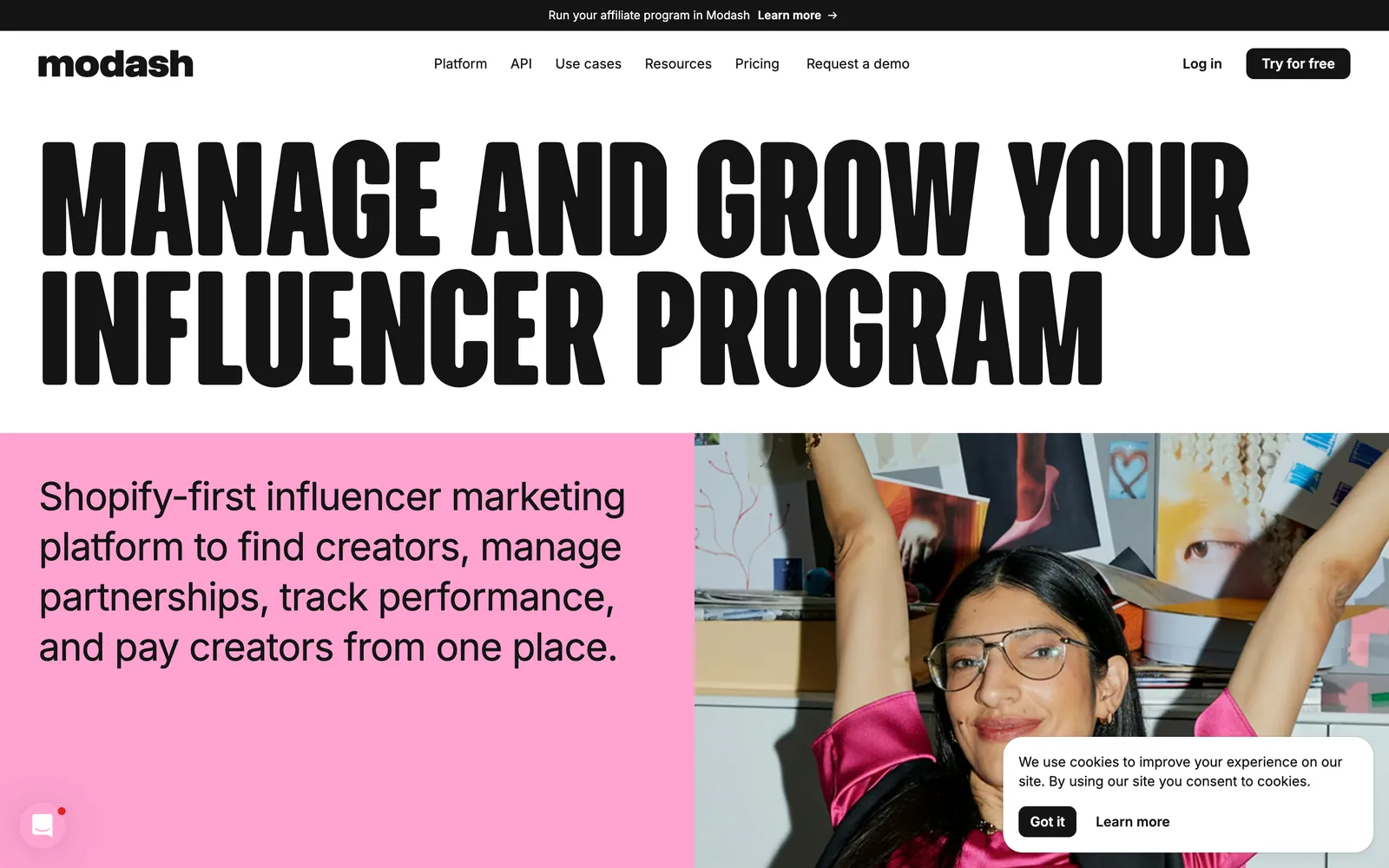
Modash is an influencer marketing platform built around a discovery database that indexes every public Instagram, TikTok, and YouTube profile with more than 1,000 followers; its pages claim 350 million creators (one page says 380 million). Around the database sit five modules: Discover (search), Manage (CRM), Track (auto-collected content and metrics with no creator opt-in), Pay (international payouts), and Email (an outreach inbox with sequences, synced to Gmail or Outlook). Shopify integration runs through all paid tiers.
The analytics are the reason to pay: audience demographics to city level on Instagram, language and interest splits, growth curves, engagement baselines, and fake-follower detection. For vetting whether an influencer's audience is real and relevant, this is about as good as tooling gets in 2026.
Modash pricing after the 2026 rise
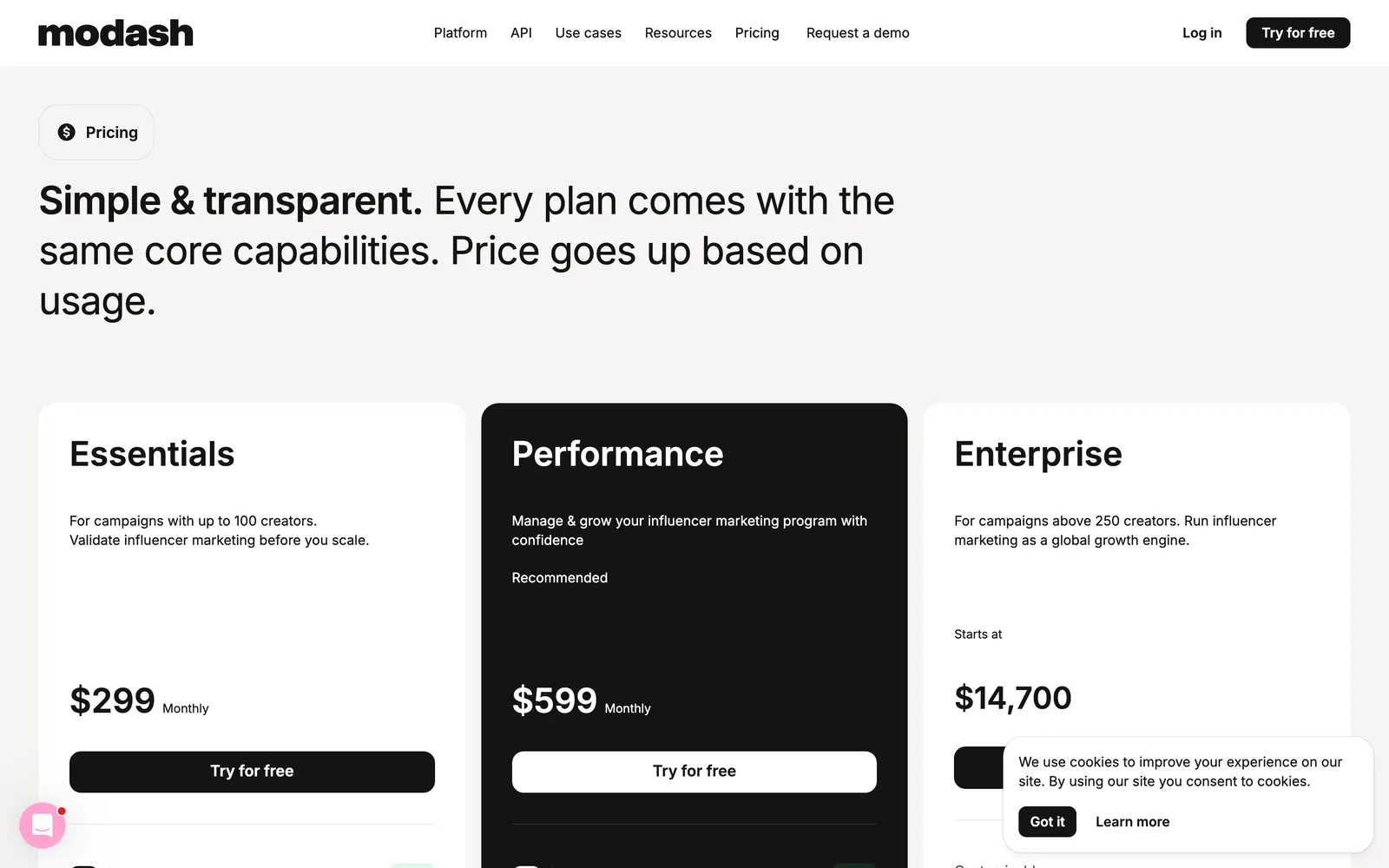
As of July 9, 2026: Essentials at $399/mo monthly or $299/mo billed annually with 2 seats, 300 profile opens, 150 email unlocks, and 100 tracked creators per month; Performance at $699/$599 raising those meters and adding payments and affiliates; Enterprise from $14,700 a year. A 14-day trial caps at 20 profile views. Third-party reviews from January 2026 still cite $199/$499 tiers, so treat most Modash pricing articles as stale.
The meters are the real price. Heavy discovery months blow through 300 profile opens quickly, and Reddit's recurring verdict ('powerful, but highly restrictive'; '$299/mo minimum is too much') is about exactly that: paying enterprise-adjacent money and still watching a counter.
| Plan | Monthly | Annual | Profile opens | Email unlocks | Tracked creators |
|---|---|---|---|---|---|
| Essentials | $399 | $299/mo | 300 | 150 | 100 |
| Performance | $699 | $599/mo | 800 | 400 | 250 |
| Enterprise | custom | from $14,700/yr | custom | custom | custom |
Modash features, walked through
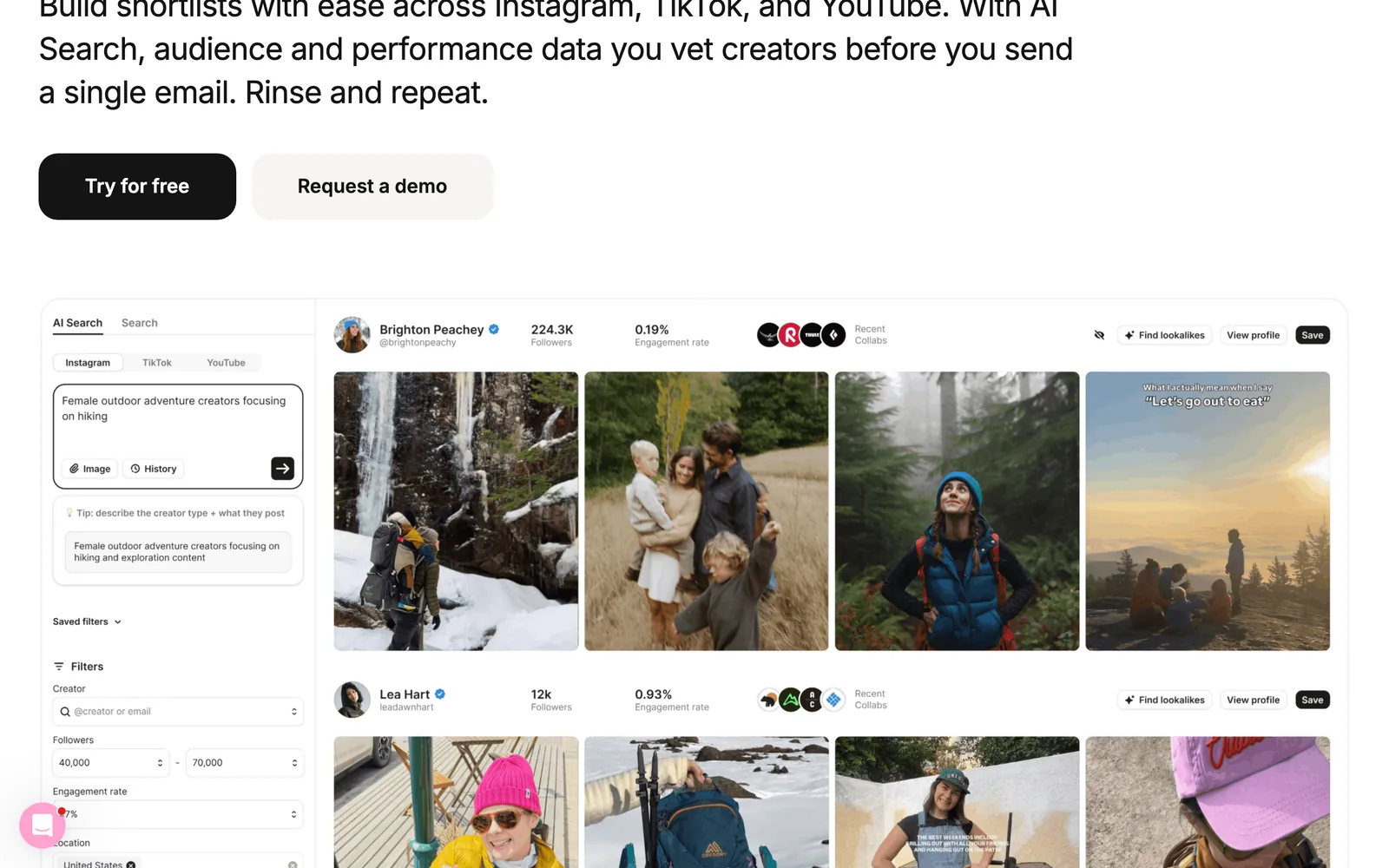
Discover, the database. Search runs over every public Instagram, TikTok, and YouTube profile above 1K followers with stacked filters: audience location (to city level on Instagram), audience age, gender, language, and interests; creator follower band, engagement rate, growth rate, and contact availability. A lookalike tool expands from a creator you already like, and an influential-fans feature (3,000 discoveries a month on Essentials, 6,000 on Performance) surfaces creators who already follow or buy from your brand, which is quietly one of its best sourcing angles.
Vetting and analytics. Each profile opens into audience demographics, fake-follower percentage, engagement baselines against similar accounts, growth curves, content-format splits (Reels vs posts, Shorts vs long-form), and a brand-collaborations timeline showing disclosed sponsored posts with their performance. This is the data layer reviewers rate 4.9 for: it answers is this audience real and relevant faster than anything else we checked. What it does not answer is undisclosed brand work, the native-style UGC that never carries a paid-partnership tag.
Workflow: Track, Pay, Email. Track auto-collects content and metrics for chosen creators with zero creator opt-in (100 slots on Essentials, 250 on Performance), which removes the beg-for-screenshots ritual entirely. Pay handles international creator payments with 0% fees up to plan caps ($10K/yr combined on Performance). Email unlocks addresses (150/400 a month by tier), syncs two-way with Gmail or Outlook, and since 2025 supports multi-step sequences with variables that auto-stop on reply. Shopify integration ties tracking to store data on all paid tiers.
Free tools. Modash gives away limited versions of its vetting stack: an Instagram fake-follower check, a multi-platform influencer analytics tool, an engagement-rate calculator, free search, a lookalike tool, and a sponsored-content examples library. They are honest teasers for the paid product and worth using even if you never subscribe.
Who Modash is actually for
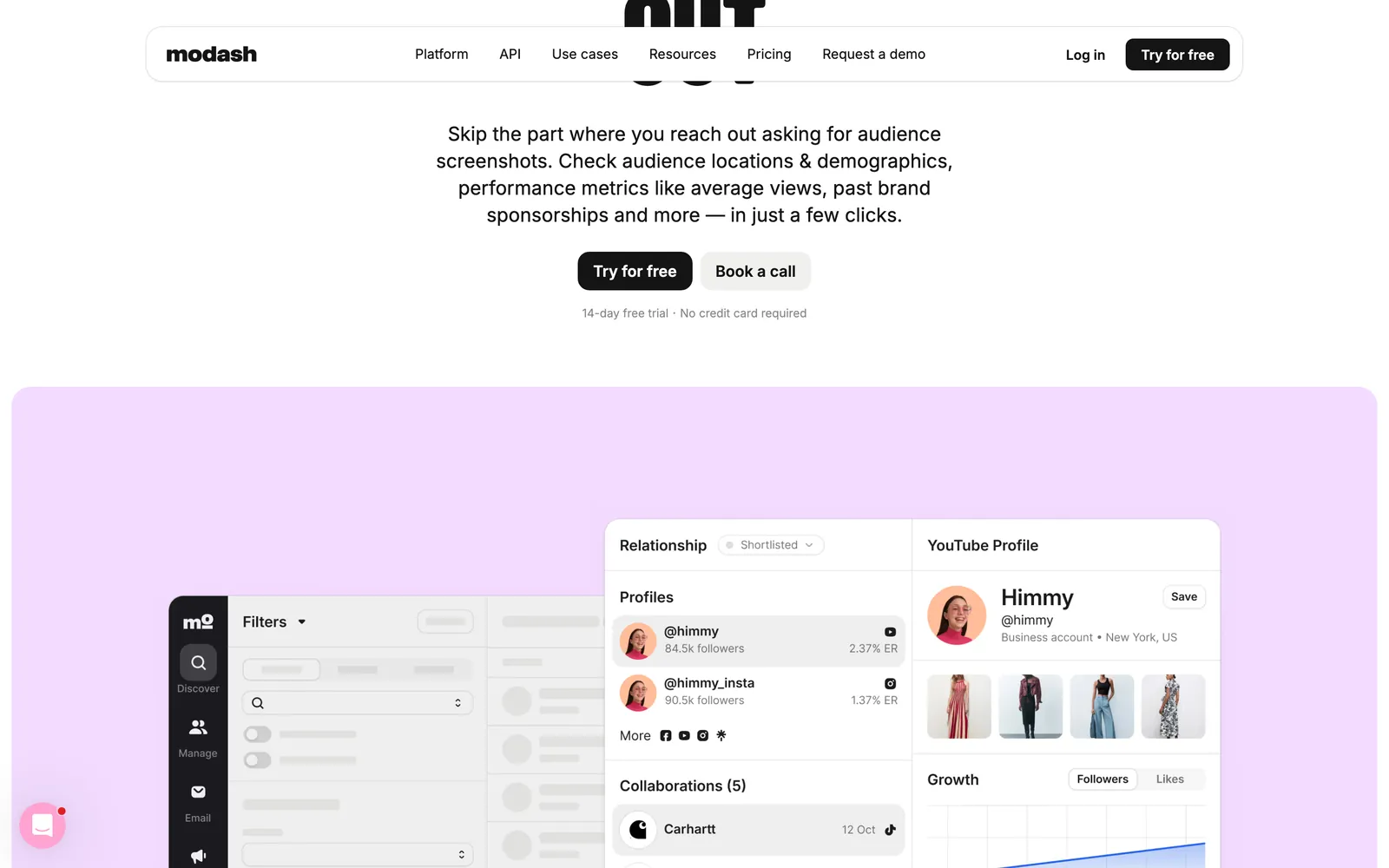
In-house influencer teams running reach campaigns at scale are the design target: you brief in audience terms (US women 25-34 interested in skincare), Modash finds and vets against exactly those terms, and the Track-Pay-Email stack absorbs the operational drag. Shopify DTC brands get the tightest fit thanks to the integration and the influential-fans discovery.
It is the wrong tool if your unit of decision is a UGC video rather than an audience: you would be paying $399 a month (or $299 annual) largely for demographic data that does not predict whether a creator's content sells product. Small teams also feel the meters fast; 300 profile opens sounds like plenty until a serious discovery sprint burns it in a week. And there is no outreach automation beyond email sequences you write yourself.
What Modash does well
Data quality and breadth. Because it indexes everyone rather than waiting for creators to sign up, its search does not have the marketplace bias problem, and its audience analytics let you kill bad picks before spending. The operating stack around it is real: auto-tracking content without creator opt-in is a genuine differentiator, international payments remove a procurement headache, and the email module grew proper sequences. Reviewers reward all this: 4.9 averages on G2 and Capterra, with praise for shipping speed on customer requests.
Where Modash falls short
It measures reach, not selling. The collaborations timeline shows disclosed sponsorships, but UGC lives on undisclosed, native-style brand work, and Modash makes no claim of detecting it. So for the specific question 'which creator's videos move product for brands like mine,' a 350M-profile index still leaves you guessing among lookalikes. Combine that with metered opens and unlocks, and heavy UGC sourcing on Modash is both indirect and expensive.
Smaller gripes from reviewers: reporting polish lags the data underneath, the inbox 'feels bolted on' to some, small-city coverage needs manual requests, and there is no LinkedIn, Twitch, or Pinterest coverage. None are dealbreakers; all are worth knowing at this price.
Modash pros
- Huge searchable index: every public IG/TikTok/YouTube profile over 1K followers
- Deep audience analytics with fake-follower detection
- Full ops stack: tracking, payments, affiliates, Shopify integration, email sequences
- Consistently strong review scores (on small review counts)
Modash cons
- Influencer-generic: no verified UGC brand-work evidence, only disclosed collabs
- Metered usage: 300 profile opens and 150 email unlocks/mo on Essentials
- Price raised in H1 2026; Reddit calls $299+ 'too much' for small teams
- You still do the vetting and run the outreach yourself
What Modash reviewers say
G2 and Capterra both ~4.9 from roughly 15 reviews each; Reddit sentiment is positive on data, negative on price (checked July 9, 2026).
★★★★★“Modash is OKAY. It looks to be powerful, but highly restrictive.”
r/influencermarketing user, 2024, via Reddit
★★★★★“Modash is great but $299/mo minimum which is too much right now.”
r/influencermarketing user, 2025, via Reddit
★★★★★“The reporting presentation is not yet as visually polished or time-efficient as we would like.”
Regina K. (5-star review, quoting its cons), August 15, 2025, via Capterra
Modash alternatives
If your program is reach-driven, Modash is probably the tool to beat, and the question is annual billing. If you are actually buying UGC, Octohog attacks the evidence gap directly: creators ranked by verified brand work from 1,000,000+ analyzed UGC videos, outreach run by the agent, competitor monitoring included, at $249/mo with no meters. The marketplaces (Billo, Insense, Collabstr, SideShift) trade data for transactions. We compared all five with screenshots and live pricing.
| Modash | Octohog | Collabstr | |
|---|---|---|---|
| Model | Influencer database + CRM | AI agent working from your brief | Gig marketplace you browse |
| Starting cost | $399/mo ($299 annual) | $249/mo flat, 7-day trial | Free + 10% fee per order |
| Usage limits | 300 opens, 150 unlocks/mo | No metering | 20-50 audience reports/mo |
| Vetting data | Audience demographics, fake-follower checks | Verified brand work, evidence attached | Listings + metered reports |
| Third-party ratings | G2/Capterra ~4.9 (small samples) | New product, no review wall yet | Capterra ~4.6, Trustpilot mixed |
The better alternative for UGC: Octohog
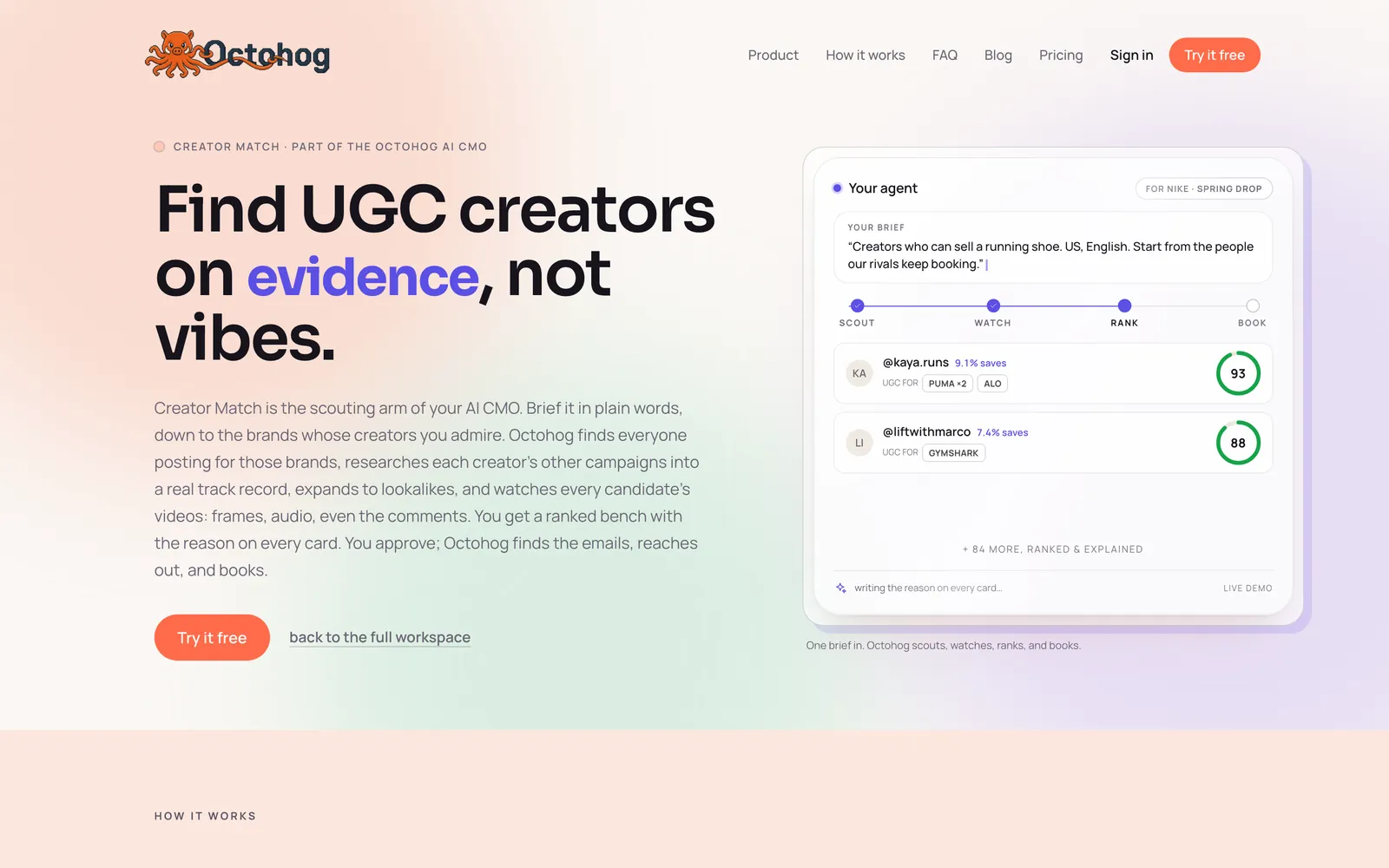
If you keep using Modash to answer a UGC question, which creators actually sell products like mine, Octohog answers it directly instead of by proxy. Built on a corpus of 1,000,000+ analyzed UGC videos, it ranks an index of 177,000+ UGC creators by verified brand work, disclosed or not, scored against your brief with the source videos attached. There are no profile-open meters and no email unlocks: the agent finds the creators, runs the outreach, and books the ones you approve.
It also covers the intelligence Modash does not attempt: Radar watches your competitors' creator programs daily (new creators, new hooks, campaign launches, with proof), TikTok Deep-Dive x-rays any account pre-spend, and Video Blueprints converts winning videos into briefs. At $249 per month flat with a 7-day trial, it costs less than the metered Essentials plan and does the legwork Modash leaves in your inbox.
Sources
Checked July 9, 2026: modash.io/pricing · modash.io features · Capterra · Reddit discussion.